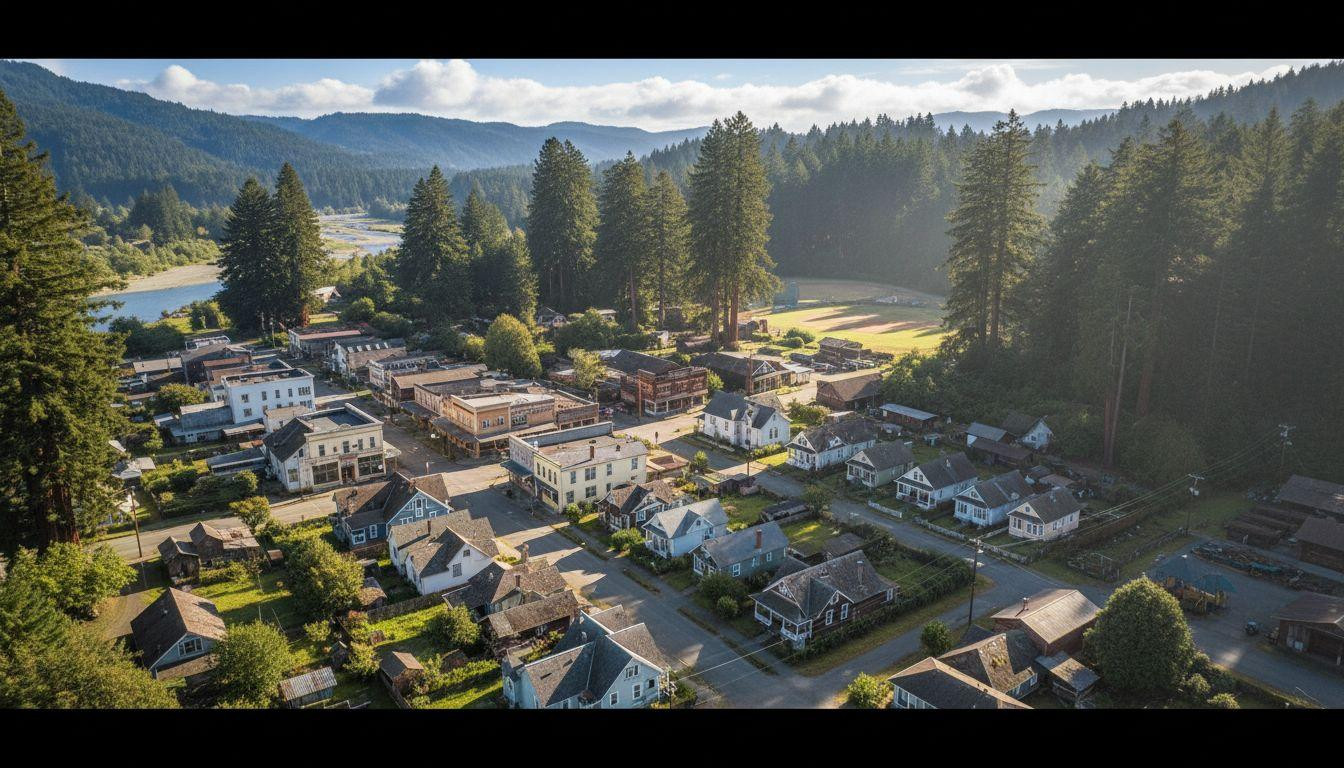
Scotia sits in Humboldt County redwood groves, population 1,000, where Pacific Lumber Company built Victorian streets in 1863. Port Gamble faces Puget Sound from Olympic foothills, founded 1853 by Pope & Talbot as Washington’s first timber town. Lynch clings to Kentucky ridges where U.S. Steel carved 19,000 acres for coal in 1917. Ten company towns hide in American forests and mountains, preserved or vanished, where wooden boardwalks and mill ruins tell stories of industrial isolation. Late January 2026 brings snow-covered silence to streets built for thousands that now hold hundreds.
The Pacific Northwest lumber legacy in redwood and spruce
Scotia’s main street looks unchanged since 1888. Redwood-floor Victorian buildings frame the town center. Marathon Asset Management sells off 270 homes one by one after Pacific Lumber’s 2008 bankruptcy. Only 170 sold by 2026. Morning fog rolls through daily January through March, thick enough to hide the Eel River 200 yards away. The scent hits first: damp resin from ancient trees, earthy and heavy in coastal air.
Port Gamble keeps ornate manager homes and worker bunkhouses 50 miles from Seattle. A 90-minute drive plus Kitsap ferry crossing at $50 per car. The town preserves 1850s timber-era architecture in evergreen mist. Weathered boardwalks creak underfoot. Olympic Peninsula timber towns beyond Port Angeles share similar fog-veiled isolation.
Gilchrist stands in Deschutes National Forest pine country, 280 miles from Portland. The 1940s Gilchrist Timber Company designed movable buildings lifted by crane. Self-contained with theater, schools, shops. Population under 500. Winter temperatures drop to 25-40°F. Spring visits from March through May avoid snow challenges without summer crowds.
Appalachian coal camps carved into mountain wilderness
Lynch sprawls across cleared wilderness grid streets on Appalachian ridges. U.S. Steel built its own railroad after Louisville & Nashville refused access. Coal-tipple ruins dominate the skyline at 2,000 feet elevation. Population 700 in 2026, down from thousands at peak. Portal 31 coal mine museum offers underground tours. Local diners serve venison and Appalachian ramps for $12 average meal.
The narrow-gauge railroad through Cheat Mountain
Cass operates as West Virginia state park, population around 100. West Virginia Pulp & Paper founded the town in 1901. Shay locomotives run 11-mile scenic rail through Cheat Mountain spruce at 2,400-foot elevation. Steam whistles pierce forest silence, echoing sharp blasts that reverberate through valleys. The acrid bite of coal smoke mixes with damp spruce scent. Park cabins rent for $100 per night.
New 2025 winter rail extensions announced in October let visitors ride through snow-covered tracks. Cass draws 50,000 annual visitors, mostly summer. January through March brings near-zero crowds. Kentucky coal country landscapes near Lynch share similar ridge-top isolation and mining heritage.
Ghost structures and vanished communities
Blue Heron sits in Daniel Boone National Forest, McCreary County. Stearns Coal & Lumber operated 1937 to 1962. The site now displays ghost structures: frameworks showing building outlines without walls. Free entry. Primitive camping available. Winter temperatures 30-45°F bring near-zero visitors to artistic coal-camp ruins.
Valsetz disappeared completely. Various lumber firms operated until post-1980s razing for tree farm conversion. The site sits 80 miles from Salem in Cascades foothills. Hiking-only access now. No visible landmarks remain, just forest where a town stood. GPS required to find former townsite trails.
Alaska copper and Oregon high desert extremes
Kennecott rises at 2,200 feet in Wrangell-St. Elias National Park. Kennecott Copper Mines operated 1903 to 1938, extracting nearly $200 million in copper ore. The 14-story concentration mill stands against Chugach Mountain ice fields. Hospital, school, general store, and dairy remain in good preservation. National Historic Landmark status since 1986. National Park Service acquired the site in 1998.
Glacier cracks echo across the valley: sharp rumbles from crevasses opening. Thin air at elevation causes labored breathing. Ravens call over frozen ruins. Access requires 200 miles from Anchorage, either seven-hour drive or flight to McCarthy plus shuttle at roughly $500 round-trip. Kennecott draws 40,000 annual visitors. Winter access extremely limited. Visit May through September.
High desert mill towns and Olympic Range logging camps
Hines operates in Harney County high desert at 4,100 feet. Edward Hines Lumber founded the town in 1928 after Forest Service land sale. Population under 500. The mill remains partially operational in 2026. Steens Mountain Loop offers seasonal driving through high desert meeting mountain forest. Remote Harney County location keeps crowds minimal year-round.
Camp Grisdale served as Simpson Timber’s logging nexus high in Olympic Range southern foothills, 25 miles from Shelton. Early 1900s operations. The site now shows moss-covered concrete foundations in dim forest light. Emerald moss drapes slabs amid ferns. Remote access requires 4WD in winter. No lodging on-site. Pioneer settlements maintaining 1840s buildings share similar preservation challenges in wilderness settings.
Industrial nostalgia meets profound wilderness quiet
Walking Scotia’s streets at dawn, the quiet makes sense. Built for 10,000, now 1,000. Redwood groves frame Victorian storefronts unchanged since 1888. Wind through hemlock the only sound. Lynch’s coal-tipple ruins stand against ridge skylines where 2,000 miners once lived. Now 700 residents maintain memory in Appalachian hollows.
Cass morning fog settles on narrow-gauge rails. Steam locomotives sit silent between runs. Company housing rows stretch empty in winter. Port Gamble’s evergreen mist veils timber relics. Boardwalk textures: weathered wood, soft with age and coastal damp. These towns deliver time-capsule stillness where industrial roar faded to forest silence.
Kennecott’s 14-story mill freezes in winter. Root Glacier viewpoints frame copper-processing ruins. The profound quiet breaks only with raven calls and distant ice cracks. Colorado mining town winter isolation offers similar snow-buried heritage in Victorian architecture.
Your questions about old company towns in forests and mountains answered
What’s the best season to visit these remote company towns?
January through March 2026 brings optimal winter solitude. Snow covers Victorian streets and mill ruins. Crowds drop to near-zero at most sites. Cass, Lynch, and Scotia offer atmospheric fog and profound quiet. May through June provides accessibility without summer peaks. Kennecott requires May through September visits due to Alaska winter closure. October brings fall colors to Appalachian coal towns.
How do these towns compare to European industrial heritage sites?
Welsh Rhondda coal valleys and German Ruhr mining towns draw more visitors with urban museum infrastructure. American company towns preserve in-situ wilderness ruins. Scotia, Cass, and Kennecott maintain original structures without reconstruction. European sites emphasize interpretation centers. US towns offer raw authenticity: working communities or ghost sites in extreme geography. Lodging costs run 20-30% below national averages.
Can you visit multiple towns in one trip?
Pacific Northwest lumber circuit connects Scotia, Port Gamble, and Gilchrist in three-day loop. Total roughly 600 miles. Appalachian coal triangle links Lynch, Cass, and Blue Heron in two-day route. Budget $800 per person for four-day PNW trip including flights and $100-150 nightly lodging. Kennecott requires dedicated Alaska mission. Combine with Wrangell-St. Elias Park hiking for week-long wilderness immersion.
Late January 2026 snow buries history under 175 inches at elevation sites. Morning light touches redwood groves in Scotia. Steam whistles echo through Cass spruce forests. Kennecott’s copper mill stands frozen against glacier backdrop. These ten towns preserve industrial wilderness heritage in populations under 1,000, where Victorian elegance meets extreme geography and silence replaces the roar of thousands.