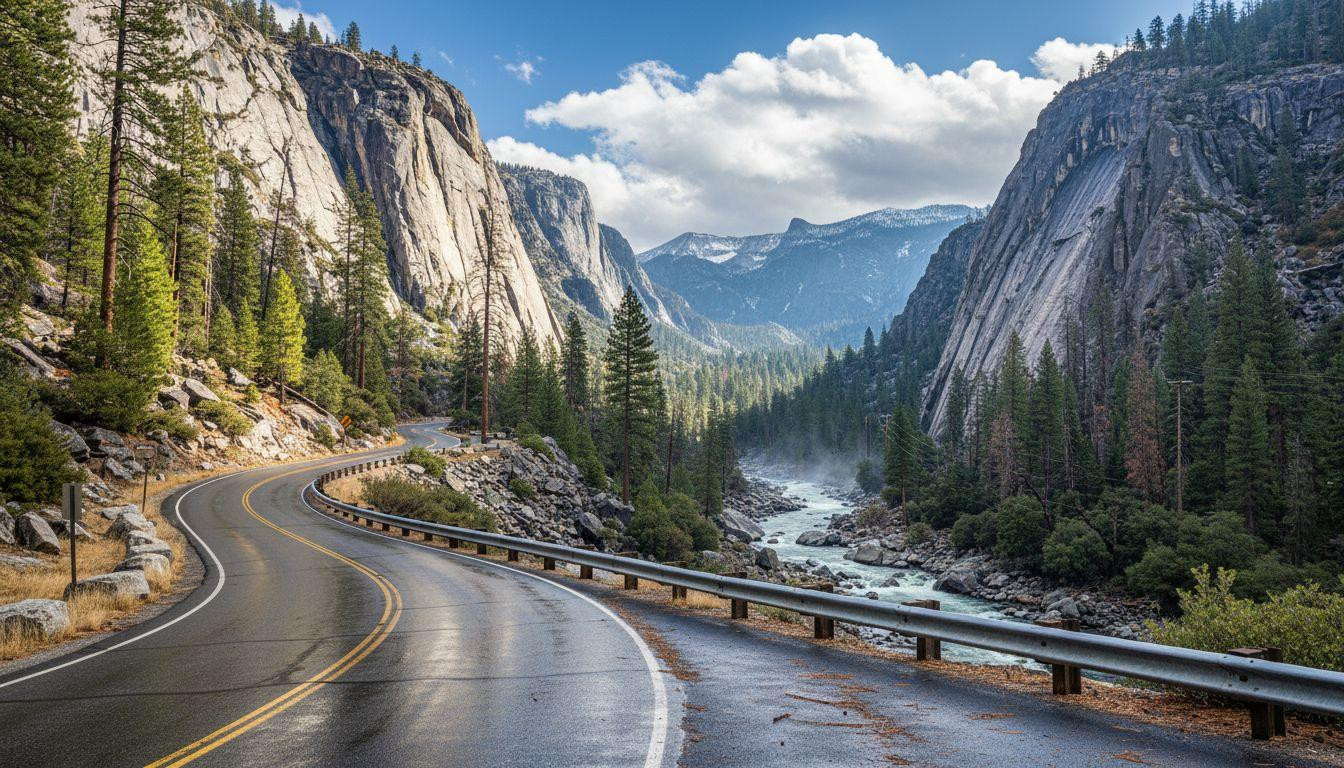
The Kings River drops 8,200 feet through granite walls you can drive beside. Highway 180 zigzags 30 miles into North America’s deepest canyon, passing 11 pullouts where mist from Grizzly Falls drifts across the pavement. January 2026 brings 5,000 visitors instead of July’s 100,000. The road stays quiet.
Fourteen river canyons across the West offer paved routes through gorges that took millions of years to carve. Most stay open through winter. Chains sit in trunks, unused. The rivers roar below.
Kings Canyon Scenic Byway drops 3,000 feet in 30 miles
Highway 180 starts at 4,500 feet near the park entrance. The road ends at 4,600 feet at Roads End, but the elevation gain hides the real story. The canyon floor drops away beneath you. Granite walls rise 4,000 feet on both sides.
Eleven designated pullouts mark the route. Grizzly Falls appears at mile 23, a 75-foot cascade reduced to winter trickle. Muir Rock sits at 4,600 feet, reached by a half-mile trail from the parking area. Yucca Point offers fishing access where the South and Middle Forks meet.
The drive takes 45 minutes without stops. Two hours if you pull over for photos. Standard cars handle the pavement fine. Park entry costs $35 per vehicle. Gas runs $4.89 per gallon along the route.
Grand Canyon’s Desert View Drive runs 25 miles above the Colorado
The South Rim road connects Grand Canyon Village to Desert View Watchtower. Nine viewpoints break up the 25 miles. The canyon drops 6,000 feet to the river. Kaibab limestone layers show at Yaki Point.
January cuts crowds by half compared to July. Tuesday through Thursday see the fewest visitors. Sunrise hits at 7:30am, sunset at 5:40pm. The Hermit Road shuttle runs daily through winter. No chain requirements unless snow falls.
Entry matches Kings Canyon at $35. Gas costs $4.45 per gallon near Tusayan. The drive takes 45 minutes straight through, 2.5 hours with photo stops. This Colorado gorge drops 2,000 feet in winter silence without Grand Canyon crowds if you want fewer people.
Kolob Canyons offers Zion’s quieter alternative in 5 miles
The Kolob Canyons Road climbs from 6,100 to 6,500 feet in five miles. Three viewpoints overlook red cliffs that rise 2,000 feet. The route sees 10 percent of main Zion’s traffic. Taylor Creek trailhead sits at mile 4.5.
Kolob Arch spans 310 feet, stands 150 feet high. The formations include Timber Top and Finger Canyon Mesa. Park entry costs $35. Gas runs $4.60 per gallon near St. George. The drive takes 15 minutes without stops, 45 minutes with.
Hells Canyon requires 4WD for the full experience
The Snake River carved a gorge 7,993 feet deep, deeper than Grand Canyon’s 6,000 feet. Hat Point Road climbs 22 miles from Imnaha, gaining 4,000 feet. Five viewpoints mark the route. Forty percent is paved, sixty percent gravel.
High clearance and 4WD handle the rough sections. The road closes November through May, typically reopening June 1. Winter temperatures run 20 to 40 degrees. No entry fee applies. Campgrounds cost $10 per night. 4WD rentals add $50 per day.
Black Canyon shows 1.7 billion years of rock
The Gunnison River cuts through Precambrian gneiss along South Rim Drive. Seven miles of pavement connect 12 named viewpoints. Painted Wall rises 2,250 feet. The canyon narrows to 1,100 feet at its tightest point.
The South Rim stays open year-round. North Rim closes until May. Chains go on when snow falls. Entry costs $30 per vehicle. Winter sees 60 percent fewer visitors than summer. Warner Point Trail extends 1.5 miles from the road.
Royal Gorge and New River offer Eastern alternatives
Arkansas River flows 1,053 feet below the Royal Gorge Bridge. The bridge spans 955 feet. Skyline Drive adds a gravel spur with six pullouts over 15 miles total. Bridge Park charges $32 per adult for 2026. Free views exist from Highway 50 pullouts.
New River Gorge in West Virginia drops 876 feet beneath its namesake bridge. Highway 19 and Grandview Drive cover 20 miles with eight viewpoints. The Bridge Walk operates 10am to 4pm for $72. Thurmond ghost town preserves 20-plus structures. Park entry stays free.
Feather River follows an old rail grade through volcanic canyons
Highway 70 runs 80 miles from Oroville to Quincy, climbing from 200 to 3,500 feet. Twenty-plus pullouts mark the route. The road follows a rail grade with a maximum 3 percent slope. Morning fog appears 70 percent of winter days.
Tobin Bridges date to 1935, two spans of 340 feet each. Grizzly Dome rises to 4,000 feet. Belden offers limited services. Gas costs $4.85 per gallon. The drive takes two hours without stops, four-plus with. This Colorado town soaks in 104°F springs while snow falls at 7,040 feet makes a good side trip.
Titus Canyon requires high clearance through Death Valley
The one-way dirt road runs 28 miles through Death Valley backcountry. Four pullouts break up the route. Elevation drops from 5,000 feet to 500 feet below sea level. Canyon walls rise 3,000 feet. Eight inches of clearance minimum.
Leadfield ghost town shows 10-plus ruins. Petroglyphs appear at mile three. Park entry costs $30. 4WD rentals add $60 per day. The route stays open through winter. Drive time runs two hours without stops, four with.
Oak Creek and Rio Grande complete the Southwest circuit
Highway 89A connects Sedona to Flagstaff through Oak Creek Canyon. Thirty miles of pavement climb from 3,300 to 7,000 feet. Twelve viewpoints overlook 800-foot walls. Slide Rock State Park charges $20 to $30 per car. West Fork Trail starts 0.2 miles from the road.
Rio Grande Gorge cuts 800 feet through basalt near Taos. Highway 64 crosses a 565-foot-high bridge. Twelve miles of road connect five viewpoints. John Dunn hot springs maintain 100-degree water. West Rim Trail extends four miles. No entry fee applies.
Snake River Canyon and Big Sur finish the list
Perrine Bridge spans Snake River Canyon at 486 feet high. The scenic byway covers 53 miles along Highway 93. Ten-plus overlooks mark the route. Shoshone Falls peaks in April. Centennial Park provides access. BASE jumping viewing happens from the Idaho side.
Highway 1 through Big Sur runs 70 miles from Ragged Point to Carmel. Twenty-five viewpoints overlook cliffs that rise 1,000 feet. McWay Falls requires a 0.3-mile trail. Julia Pfeiffer parking holds 20 spots. Bixby Bridge stretches 714 feet, stands 260 feet high. Gas costs $5.20 per gallon.
Your questions about river canyon scenic drives answered
Which canyons stay open through winter 2026?
Grand Canyon South Rim, Kolob Canyons, Black Canyon South Rim, Royal Gorge, New River Gorge, Oak Creek, Rio Grande, Snake River, and Big Sur maintain year-round access. Kings Canyon typically reopens mid-April 2025. Hells Canyon Hat Point Road closes November through May. Yosemite Valley stays open but requires chains. Check Caltrans for Highway 1 conditions.
What vehicle do these routes require?
Most routes handle standard cars on paved roads. Hells Canyon Hat Point Road needs 4WD and high clearance for its 60 percent gravel sections. Titus Canyon requires eight inches of clearance minimum. Royal Gorge Skyline Drive suggests high clearance for rutted sections. Rental 4WD upgrades cost $50 to $60 per day.
How do Kings Canyon and Grand Canyon compare for depth?
Kings Canyon drops 8,200 feet from rim to river, making it North America’s deepest. Grand Canyon measures 6,000 feet on average at the South Rim. Hells Canyon reaches 7,993 feet. Kings sees 500,000 annual visitors versus Grand’s 5 million. Better than Antelope where tours cost $225 and White Pocket keeps sandstone waves free offers another Southwest alternative. Kings lodging averages $120 per night compared to Grand’s $180.
Planning your canyon road trip
January through February brings the emptiest roads. April and May add wildflowers. June through August pack crowds. Most routes charge $30 to $35 park entry. Gas runs $4.10 to $5.20 per gallon depending on location. Camping costs $10 to $30 per night.
Download offline maps before driving. Cell service drops in remote sections. Carry water. Respect pullout etiquette by parking fully off pavement. 9 snowshoe routes where elk herds cross white prairie 11 miles from hot springs pairs well with canyon drives for winter activity variety.
Morning light hits east-facing walls best. Afternoon sun illuminates west faces. Sunrise runs 7:15 to 7:40am across these sites in late January. Sunset falls between 5:10 and 5:50pm. Gray whales migrate past Big Sur January through February.
The granite at Grizzly Falls turns pink at 7am. The mist catches light for maybe ten minutes. Then the color fades and the next pullout waits three miles ahead.