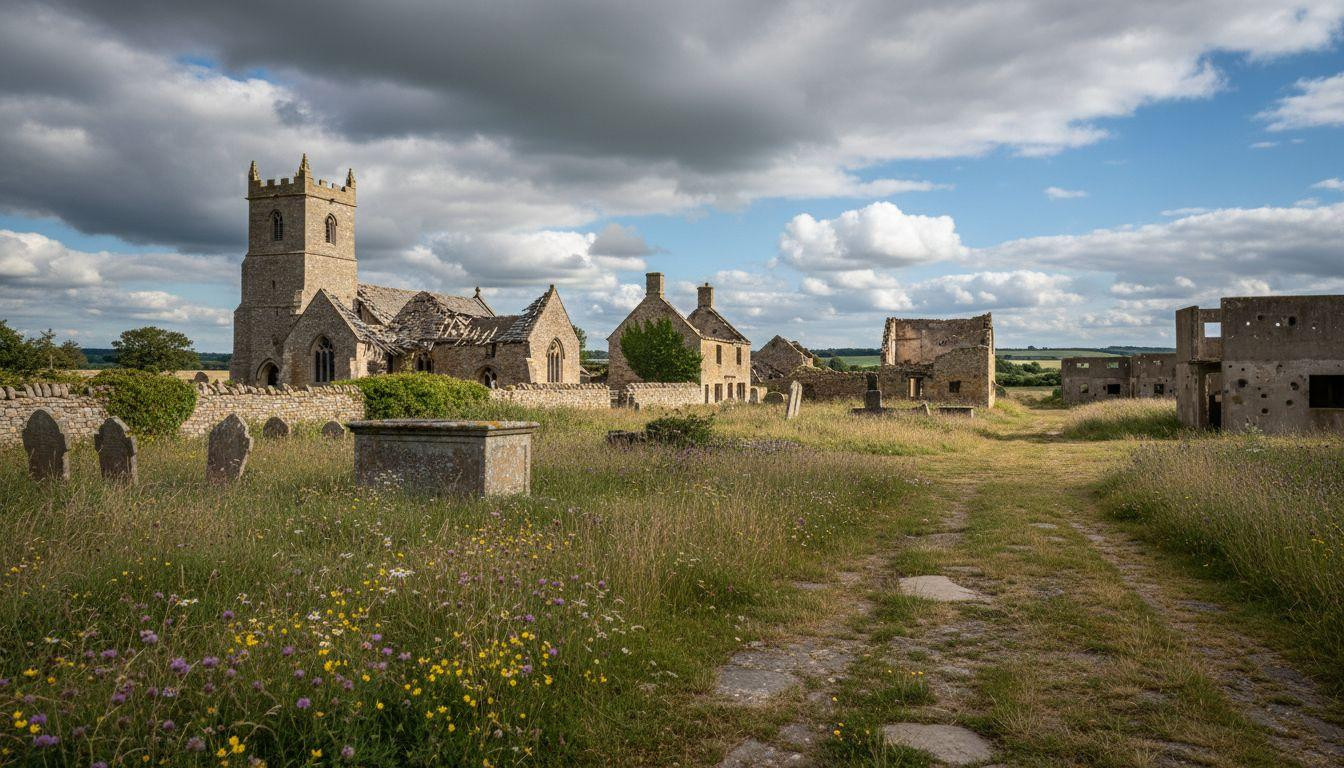
The Ministry of Defence signs say “DANGER: Military Firing Range. No Public Access.” But four times a year, the gates open and civilians walk into a village where time stopped on November 1, 1943. Imber sits in the center of Salisbury Plain, 15 miles from Warminster, population zero for 82 years. Stone cottages stand with empty windows. The church bell tower rises alone against overcast grasslands. No one has lived here since US troops trained for D-Day in these streets.
A village frozen in wartime
Imber occupies a shallow valley on 94,000 acres of military training land. Golden-gray stone cottages line the main road, weathered to soft patina. Windows gape. Roofs sag or collapse entirely. The 14th-century St. Giles Church stands fenced and maintained, its tower visible for miles across the plain.
Twenty to thirty structures remain. Some are authentic 18th-century farmhouses with rubble walls. Others are 1970s mock terraced houses, windowless shells built for urban combat training. Bullet holes pock the stone. Shrapnel scars mark doorframes. Wind whistles through empty rooms where families once cooked dinner and children played.
The Bell Inn sits roofless. Imber Court crumbles behind warning signs. A few rusted military vehicles decay near the church, hard targets for live-fire exercises. The landscape feels suspended, neither ruin nor restoration, just waiting.
The 47-day notice that never ended
December 1943 evacuation
In November 1943, 150 residents from 40 families received 47 days’ notice to evacuate. The War Office needed the village for American soldiers preparing to invade occupied Europe. Families packed belongings, locked doors, and moved to nearby Warminster. The military promised return within six months after the war ended.
US troops used Imber’s streets to practice house-to-house fighting. They cleared rooms, navigated rubble, simulated urban warfare. D-Day came in June 1944. The war ended in 1945. The residents never came back.
Why they never returned
Post-war military expansion kept Salisbury Plain under MoD control. In 1961, over 2,000 protesters rallied for the villagers’ right to return. A public inquiry affirmed military use but mandated church maintenance and limited public access. Three days per year initially, now four.
The army added mock buildings in the 1970s for FIBUA training. Fighting In Built Up Areas simulations prepared troops for Northern Ireland, then Iraq, then Afghanistan. Imber became a permanent training asset. The original cottages decayed. The fake houses absorbed bullets. The village stayed frozen between past and present.
What the open days reveal
Walking the main street
Visitors arrive on December 29 to January 1, plus August bank holiday weekends. Parking sits near the church. Paths lead through the village center. St. Giles opens 11am to 4pm, volunteers serving tea and cakes from a camping stove. The church has no utilities. Water comes in bottles. Light filters through medieval stained glass.
You can walk the main road and photograph exteriors. You cannot enter the cottages. Keep Out signs mark unsafe structures. Climbing the rusted tanks is forbidden. Jagged metal and unexploded ordnance risks remain real. Stick to marked paths or the MoD may withdraw future access.
On August 2025’s Imberbus event, 4,000 visitors came. The church filled with quiet reverence. Crowds peaked between 11am and 2pm, thinning after 3pm. Most stay two to four hours, walking slowly, taking photos, listening to wind over empty grassland.
The church that survived
St. Giles dates to the 13th century, with 15th-century wall paintings still visible inside. The Churches Conservation Trust maintains it. An annual service happens the Saturday nearest September 1, drawing 100 to 200 attendees. The Grade I-listed building stands as the village’s only preserved structure, a reference point for what was lost.
Inside, light is dim and cool. Stone floors echo footsteps. Volunteers share stories about former residents. One man, Ray Nash, left Imber in 1936 but asked to be buried here in 2023 beside his father. The church holds memory when everything else decays.
The haunting legacy
Standing in Imber feels different from visiting preserved heritage sites. There is no gift shop, no guided tour, no interpretation center. Just wind, stone, and the distant thud of artillery from active ranges. Wildlife has reclaimed the streets. Owls nest in rafters. Foxes den in collapsed walls. Chalk grassland and orchids push through old foundations.
Visitors describe a sense of waiting. The village holds its breath. Locals who remember say it feels like the residents might return any day, even though 82 years have passed. Recent social media posts use words like “eerie” and “reverential.” Time stopped, but decay continues. The paradox creates a quiet, unsettling beauty.
Your questions about Imber answered
When can you visit Imber?
Imber opens four days per year. December 29, 2025, to January 1, 2026, covers the Christmas period. August bank holiday weekends typically allow access. Check imberbus.org for exact dates. The volunteer Imberbus service runs on August open days, raising funds through donations (typically $10 to $15 per person). Parking is free. No access happens in winter 2026 outside these dates due to active military training.
What makes it different from other ghost towns?
Imber remains an active military site. Tyneham in Dorset, another WWII evacuee village, opens more frequently and has better-maintained structures. Imber’s authenticity comes from neglect. Bullet holes are real. Decay is unmanaged. The MoD still uses it for tactical exercises five days a week. You cannot visit commercialized US ghost towns like Bodie, California, which charge entry fees and preserve buildings as museums. Imber stays raw, restricted, and genuinely off-limits most of the year.
Can you explore the buildings?
No. All cottages and ruins are off-limits except St. Giles Church. Entering unsafe structures risks collapse. Unexploded ordnance warnings cover the area. Stay on marked paths. Photography is allowed from public routes. The MoD patrols during closed periods, and trespassing can result in fines or arrest. Respect the restrictions or future access may be withdrawn entirely.
Morning fog lifts around 10am on open days. For maybe ten minutes, the whole valley turns gold. Then overcast returns, and the village settles back into gray. The church bell tower stands silent. No one rings it anymore.