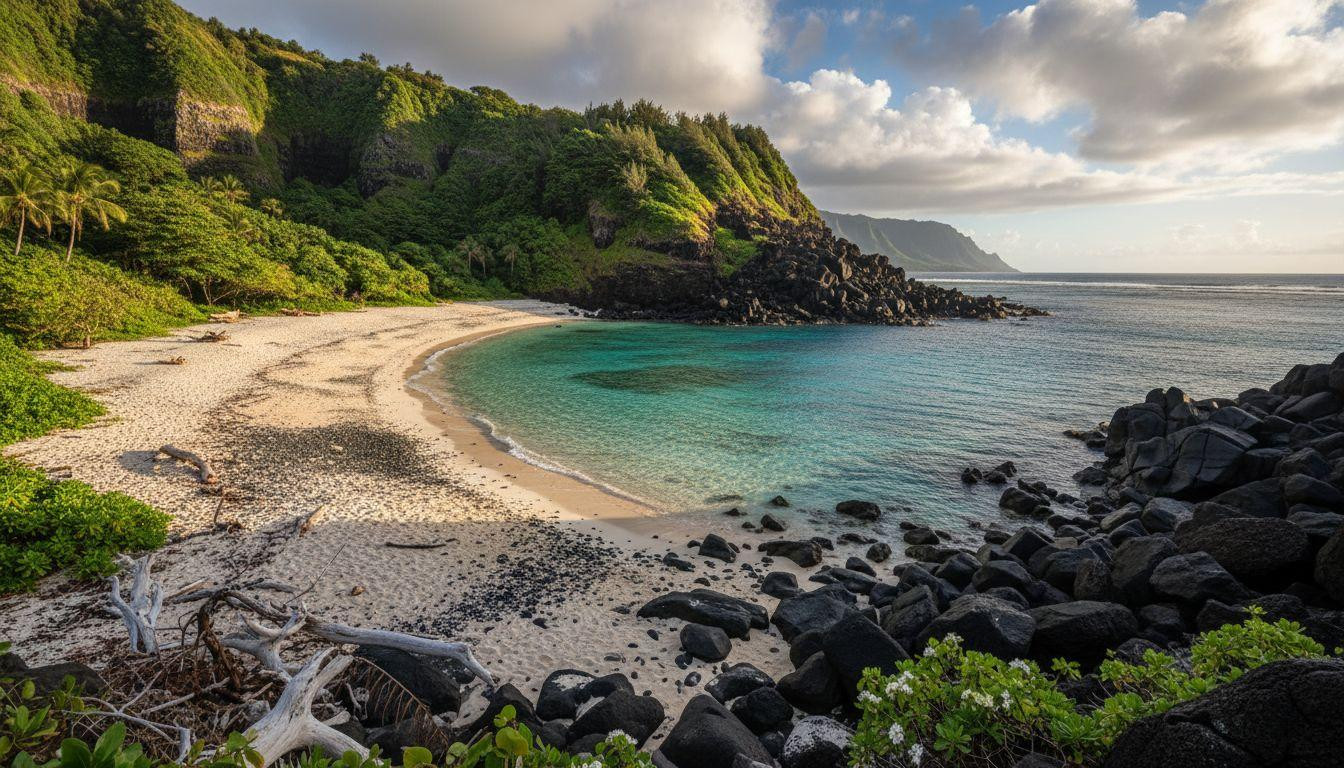
The boulder-hop descent takes ten minutes. Your feet find purchase on smooth lava rock, then white sand appears between the stones. Papa’a Bay opens ahead: a turquoise crescent framed by green cliffs where Harrison Ford’s plane crashed in 1998. The movie set is gone now. The seclusion it faked became real.
Most visitors to Kauai never find this cove. The 100-yard boulder scramble from Aliomanu Beach filters crowds better than any gate. What remains is a reef-protected lagoon that convinced Hollywood it could pass for French Polynesia, now returned to the quiet it only pretended to have on screen.
Where Six Days Seven Nights found Polynesia in Kauai
Director Ivan Reitman needed a South Pacific island for his 1998 romantic comedy. Papa’a Bay’s turquoise reef lagoon, white sand, and jungle backdrop matched Bora Bora without the 5,000-mile flight. The production built temporary over-water huts and a thatched bar for the final village scene. Harrison Ford and Anne Heche filmed the plane crash sequence here, the aircraft nose-down in shallow water.
Producer Peter Guber bought the surrounding 174 acres after filming wrapped, building the luxury estate Tara on the hillside. The $28 million sale in 2009 set a Kauai record. The movie structures came down, but the bay’s visual appeal remained: steep green hills, calm turquoise water, and that crescent shape that reads as remote even when you’re standing in it.
The film’s Polynesian illusion worked because Papa’a Bay actually looks untouched. No resorts line the shore. No rental chairs dot the sand. The reef keeps the water shallow and clear, creating that specific shade of turquoise that signals tropical paradise in every beach movie ever made.
The crescent that looks like Bora Bora
Turquoise reef lagoon
The bay’s reef creates a natural barrier 200 yards offshore. Inside this protection, the water stays calm and reaches depths of 6-10 feet at high tide. The white sand bottom reflects sunlight through the water, producing the turquoise color that made this location work for Hollywood. Low tide exposes more reef and creates wading pools where visibility extends 30 feet on calm days.
The contrast hits immediately: green cliffs rise 300 feet behind the beach, their slopes thick with hala trees and ferns. White sand meets turquoise water meets dark lava boulders. It’s the same visual composition that defines Hanalei Bay’s crescent beach where winter surf transforms calm summer swims, but compressed into a smaller, quieter space.
Boulder shore access
The trail from Aliomanu Beach parking drops steeply through brush, then meets the boulder field. These are smooth lava rocks, some the size of cars, that form the bay’s northern edge. The 100-yard scramble requires reef shoes and attention. Loose stones shift. Gaps between boulders can twist an ankle.
This physical barrier keeps Papa’a Bay off the tourist circuit. Families with small children turn back. Visitors expecting easy beach access choose elsewhere. What the boulders create is a natural filter: only people willing to work for it make it to the sand. The result is a bay that sees fewer than 10,000 visitors annually, compared to millions at Kauai’s roadside beaches.
What the movie left behind
Overgrown set remnants
The over-water huts are gone, dismantled after filming wrapped in 1998. What remains are subtle traces: wooden posts in the shallow water, now covered in algae. A few concrete footings near the treeline where the bar set stood. These aren’t maintained ruins or marked historical sites. They’re just things the jungle is slowly reclaiming.
The best time to photograph the bay is between 5:30pm and 6:30pm, when the sun drops behind the western cliffs and the light turns golden. The water glows. The green hills darken. For those ten minutes, you can see why a location scout chose this spot to fake paradise. Similar lighting transforms Kauai’s Napali Coast sea caves where winter swells close summer kayak routes into something otherworldly.
The quiet the crowds missed
Papa’a Bay receives a fraction of the visitors that Hanalei Bay sees daily. No lifeguards patrol the shore. No facilities exist beyond the beach itself. You pack in what you need and pack out what you bring. This absence of infrastructure is what preserved the bay’s character after the movie made it briefly famous.
Winter swells from November through March can make the lagoon unswimmable, with waves breaking over the reef. April through October offers calmer conditions, with water temperatures around 77°F and visibility for snorkeling. Early mornings see the fewest people. By 10am, maybe five groups share the entire crescent. By Kauai standards, that’s empty.
Standing where Harrison Ford crashed
The plane crash scene was filmed in the shallow water near the bay’s center. The aircraft was positioned nose-down, tail up, creating the visual of a hard landing in paradise. That specific spot is now just water and sand again, indistinguishable from the rest of the lagoon.
What makes Papa’a Bay work 27 years after the film is that the movie’s fame didn’t change the place. The access stayed difficult. The estate ownership limited development. The boulder-hop kept filtering visitors. What Hollywood faked as remote seclusion became genuinely remote through a combination of geography and circumstance. The irony is complete: the fake paradise is now more authentic than most real ones.
The bay holds maybe 50 people comfortably before it feels crowded. On an average day in May, you might count 15. The sound is mostly waves and wind through the palms. No music from beach bars. No jet ski engines. Just the quiet that made this location worth filming in the first place, preserved by accident rather than design. Similar seclusion defines this 10 minute hike through hurricane ruins that reaches St Martin’s clearest turquoise cove, where nature and circumstance created barriers that protect what remains.
Your questions about Papa’a Bay answered
How do I reach Papa’a Bay safely?
Park at the north end of Aliomanu Beach, accessible via Aliomanu Road off Kuhio Highway. The trail starts near the parking area and descends through brush for 5-10 minutes before reaching the boulder field. Wear reef shoes with good grip. The rocks are smooth and can be slippery. Bring water, sunscreen, and snorkel gear if you plan to swim. Pack out all trash. No facilities exist at the bay.
When is the best time to visit?
April through October offers the calmest seas and best snorkeling conditions. Winter months from November through March bring larger swells that can make the lagoon dangerous for swimming. Water temperature stays around 75-77°F year-round. For the fewest people, arrive before 9am. Golden hour for photography runs from 5:30pm to 6:30pm. January 2026 falls in the winter swell season, so check surf reports before making the hike.
Is it worth the boulder-hop compared to easier beaches?
Papa’a Bay offers seclusion that roadside beaches cannot match. The effort required filters crowds, creating an experience closer to this Wild West town that sits 3 miles from Yellowstone where 200 frozen waterfalls glow turquoise blue in its sense of discovery. If you want easy access and facilities, Hanalei Bay or Poipu beaches serve better. If you want to see where Hollywood faked remote paradise and find it genuinely remote now, the ten-minute scramble delivers.
The turquoise water catches afternoon light around 4pm. The reef creates patterns of lighter and darker blue. A heron stands in the shallows near the eastern rocks. This is what the movie captured and what remains when the cameras leave: a crescent bay that looks exactly like what people imagine when they picture a hidden Hawaiian beach, protected now by the simple fact that getting here requires effort most visitors won’t make.