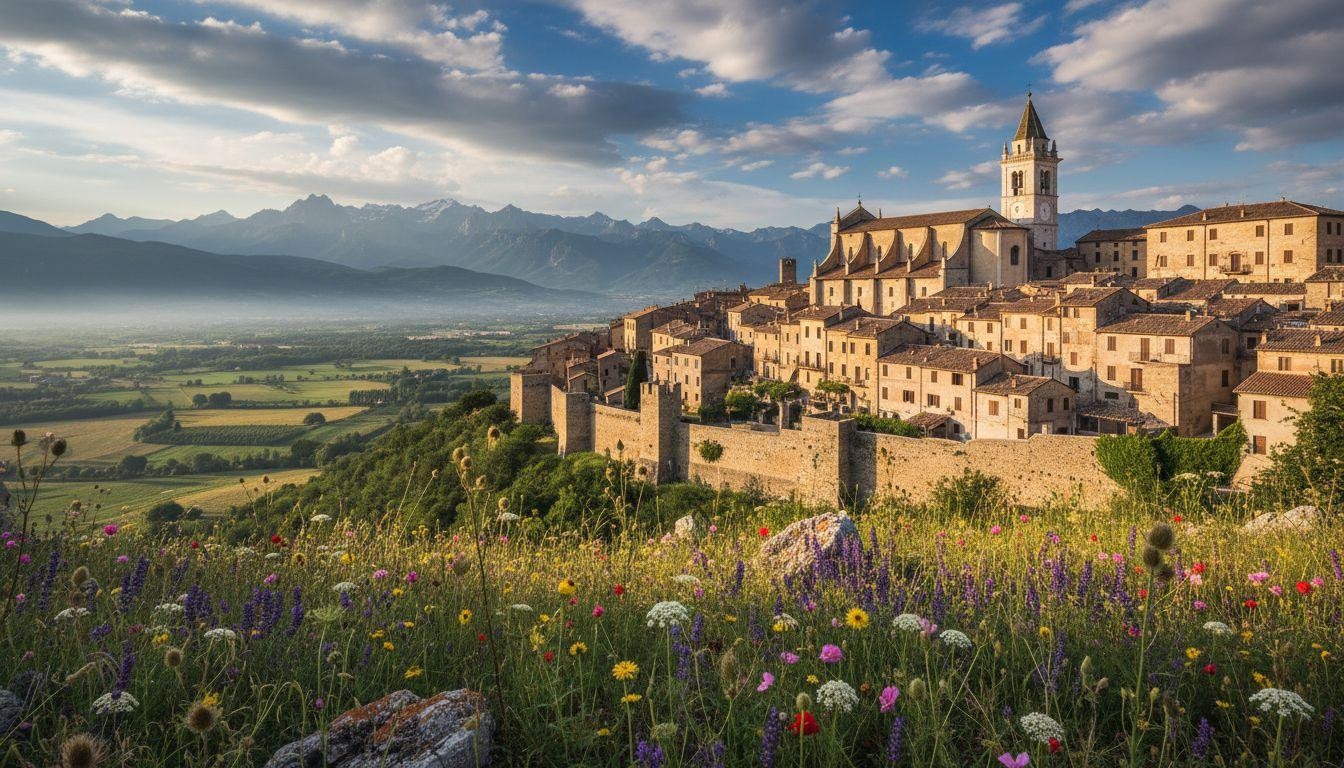
San Ginesio sits at 2,260 feet in the Marche hills, population 3,500. The medieval walls frame golden stone buildings that catch morning light around 7am. Local tourism boards confirm the village earned UNESCO recognition as Italy’s Best Village in 2021, yet most travelers heading to Tuscany never hear its name.
The town occupies a ridge locals call the Balcony of the Sibillini. On clear mornings the view spans 30 miles east to the Adriatic and west to the Sibillini peaks. The stone streets climb in tight switchbacks. Red tile roofs stack upward toward the 13th-century Collegiata church at the summit.
The medieval core that survived 500 years
The historic center dates to the 14th and 15th centuries. Stone walls built around 1350 still encircle the entire township. The 2016 earthquake damaged 40% of buildings in the province, but San Ginesio’s restoration follows original construction methods. Masons replace fallen stones using traditional lime mortar.
The Ospedale dei Pellegrini stands near the main gate. This 13th-century pilgrims’ hospital features a winch-operated chandelier that still functions after 700 years. The mechanism raises and lowers the iron fixture for candle replacement. Medieval travelers stopped here en route to Rome or the Sanctuary of San Nicola, 18 miles south.
Walk the perimeter walls at dawn before tour buses arrive from Macerata. The flagstone path circles the town in 25 minutes. Below spreads a patchwork of green valleys and wheat fields. The Sibillini range rises to 7,100 feet in the distance.
The August festival that transforms cobblestones
Medieval reenactment in period costume
The second week of August brings Medievalia Palio. The entire village adopts 14th-century dress for six days. Four town districts compete in archery, crossbow shooting, and jousting tournaments. The festival commemorates San Ginesio’s 1377 victory over neighboring Fermo.
Period musicians perform in the main piazza each evening. Vendors serve medieval recipes including wild boar stew and honey-glazed pork. The horse races run through narrow streets on August 15. Advance booking becomes essential as the single hotel fills by June.
The patron saint of actors and musicians
San Ginesio takes its name from Saint Genesius, a Roman mime martyred by Emperor Diocletian around 300 AD. This connection to performance arts continues today. The Festival of Mimo and Gestural Theater enters its 13th edition in 2026, featuring physical theater companies from across Europe.
Classical music programming runs May through September. Cellist Mario Brunello performs an annual concert in the Collegiata. The acoustics in the stone church amplify string instruments without electronic enhancement. Tickets cost $25 and sell through the tourism office.
What you actually do in San Ginesio
Walking medieval streets and mountain access
The historic center requires 90 minutes to explore thoroughly. The Collegiata opens 9am-12pm and 3pm-6pm daily, entry free. Inside hang 15th-century frescoes depicting the saint’s martyrdom. The adjacent museum displays religious artifacts and medieval manuscripts, admission $4.
Sibillini National Park begins 8 miles west. Hiking trails range from 2-hour loops to full-day ridge walks. The park office in town provides trail maps and current conditions. Summer temperatures reach 82°F in the valleys but stay 15 degrees cooler at elevation. A resident who’s guided hikers for 20 years recommends early starts before afternoon heat.
Vincigrassi and mountain refuge meals
Restaurant San Fabiano sits 2 miles outside town in converted farm buildings. The specialty is Vincigrassi, a local pasta dish layered with béchamel and meat ragù. Locals insist lasagne copied their recipe, not the reverse. A full meal with wine costs $35-45.
The village bakery on Via Roma has operated since 1953. Morning focaccia comes out at 8am, still warm. Pecorino cheese aged in nearby caves sells for $18 per pound. Mountain refuges in the Sibillini serve lunch using local ingredients, typically $20 for soup, pasta, and house wine.
The quiet that settles after day-trippers leave
Most visitors arrive from Macerata on afternoon buses and depart by 5pm. The evening light turns the stone buildings amber. Locals gather in the main piazza around 7pm. The single café serves espresso for $1.50 at outdoor tables.
Christmas brings a different atmosphere. Recent visitor surveys conducted in 2025 reveal December guests describe a festive warmth despite cold weather. The town decorates with simple lights. Panettone appears in every shop window. The population swells briefly as former residents return for the holidays.
Your questions about San Ginesio answered
How do I get there from major cities?
Rome sits 120 miles south, a 2.5-hour drive via A14 and SS77. Florence is 150 miles north, roughly 3 hours. The nearest train station is Macerata, 12 miles east. Buses run twice daily from Macerata to San Ginesio, fare $3. Car rental at Ancona airport costs $40-60 per day. Parking outside the medieval walls is free.
Where should I stay with only one hotel option?
Est Locanda is the sole accommodation within the walls. The 8-room property books months ahead for August. Rates run $95-120 per night depending on season. Alternative lodging exists in Macerata, where hotels average $80-110. Several agriturismos operate within 6 miles, offering farm stays from $70 per night with breakfast included.
How does this compare to Tuscan hill towns?
San Ginesio matches the medieval preservation of Montepulciano or Pienza but receives 80% fewer visitors according to regional tourism data. Meal costs run 30% lower than Tuscan equivalents. The Sibillini mountain access provides hiking diversity that Tuscany lacks. Similar UNESCO villages in France face heavier crowds. The tradeoff is limited accommodation and the need for advance planning.
Morning fog lifts from the valleys around 8:30am in September. For maybe 20 minutes the whole landscape turns gold before the day settles into its rhythm. The church bells mark the hour. Locals head to work. The quiet returns.