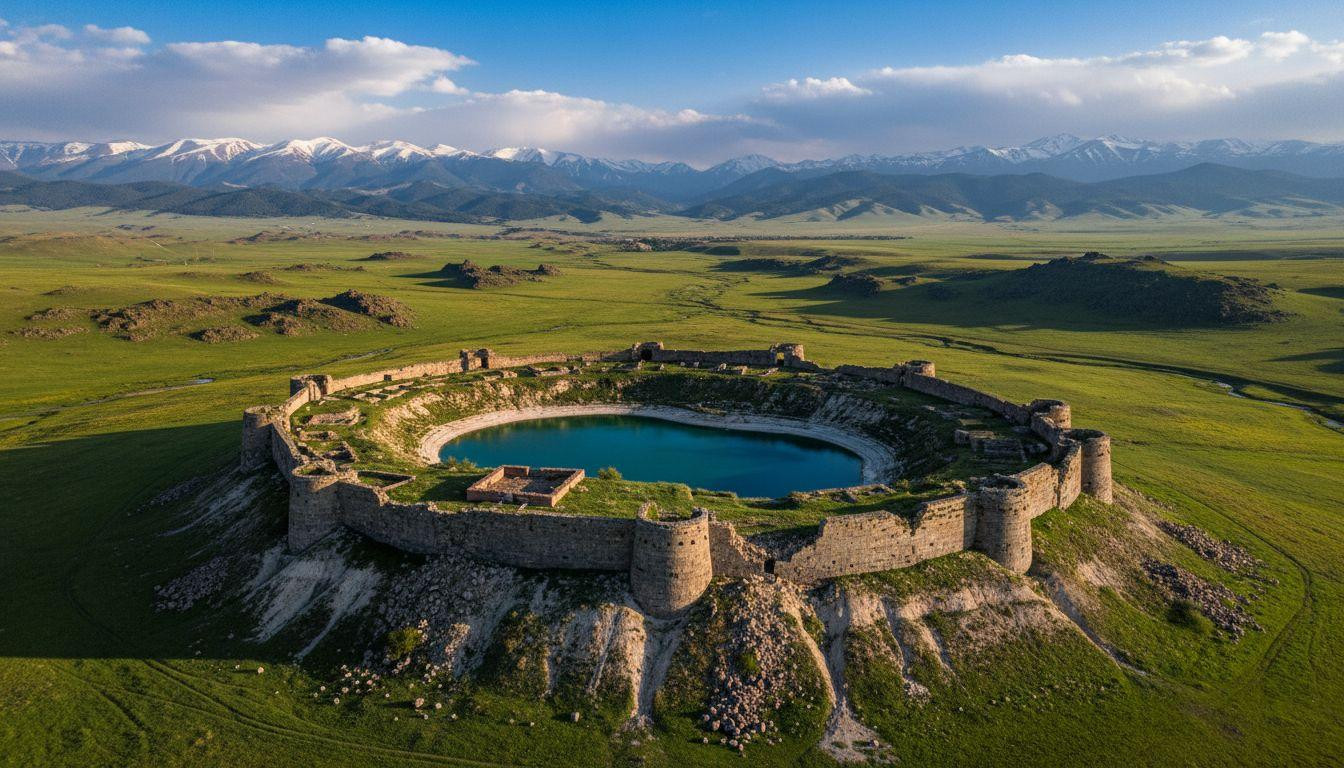
A blue crater lake sits at the center of grey basalt ruins in northwestern Iran. The water never drains. For 700 years, sacred flames burned on platforms above this artesian spring. Zoroastrian priests tended fires while pilgrims bathed in pools dedicated to the water goddess Anahita. The site operated as Persia’s holiest sanctuary under Sasanian kings from the 5th to 7th centuries. Today, fewer than 100,000 visitors per year walk these oval walls at 8,038 feet altitude. Most tourists in Iran head to Persepolis, 621 miles south. This fortress sits 28 miles from Takab, a rural town of 12,000 in West Azerbaijan Province.
The fire temple that needed water
Takht-e Soleyman translates as Throne of Solomon. The name came later, after Arab conquest in the 640s. Locals renamed the Zoroastrian complex to protect it from destruction. The original name was Shiz, home to Azar-Goshasb, one of three Royal Fires where Sasanian emperors humbled themselves before coronation. King Khosrow I expanded the sanctuary between 531 and 579 CE. His son Khosrow II added palace buildings around the lake.
The artesian spring creates a natural mound 197 feet high. Calcium deposits built the platform over millennia. Fire temples stood on the eastern edge. The Anahita water temple occupied the western side. A 43-foot basalt wall with 38 defensive towers enclosed the oval precinct, measuring 1,148 by 1,804 feet. Two gates controlled access. The northern entrance remains partially visible beneath debris.
Why fire and water coexisted
Zoroastrian theology honors fire as Ahura Mazda’s symbol of purity. Water represents Anahita, goddess of fertility and war. Warriors prayed to both before battle. The spring’s permanence made it doubly sacred. Flames never went out for seven centuries. Priests maintained ritual fires in stone chambers while pilgrims performed ablutions in adjacent pools. Byzantine forces sacked the complex in 624 CE during wars with Persia. The fire rekindled afterward, burning until perhaps the 10th century when Zoroastrianism declined under Islamic rule.
The Ilkhanid rebuilding
Mongol rulers discovered the ruins in the 13th century. Abaqa Khan, grandson of Genghis Khan, rebuilt parts of the complex as a summer palace between 1265 and 1282. Ilkhanid architects added porticos and residential quarters around the lake. Their work blended Persian and Mongol styles. UNESCO recognizes this layering as evidence of cultural continuity across 2,500 years. The site influenced Islamic architecture throughout the region, particularly in the use of enclosed courtyards around water features.
Walking the oval fortress today
The drive from Takab takes 45 minutes on rural roads through green highland valleys. Snow-capped peaks rise to 15,912 feet in surrounding ranges. Parking sits at the base of the volcanic mound. A 10-minute walk up loose stone paths reaches the main gate. Entry costs approximately $7 in 2026. The lake appears first, brilliant blue against grey ruins. Basalt blocks lie scattered where walls collapsed. Spring grasses grow between foundation stones from April through June.
The platform feels isolated. Wind carries no traffic sounds. Ancient footpaths connect the main site to secondary temples. Morning light hits the water at angles that reveal depth. Locals say the lake has no bottom, though geological surveys suggest 100 feet. The artesian source maintains constant levels year-round. Temperature stays cool even in summer, fed by underground springs.
The prison crater nearby
Zendan-e Soleyman sits 1.9 miles west. This volcanic cone drops 328 feet into a sulfur-rich crater. Pre-Sasanian temples from 830 to 660 BCE occupied the rim. Hot springs once bubbled at the bottom. Local legend claims Solomon imprisoned a demon here. The black hole releases toxic gases. A 30-minute hike from the access road reaches the crater edge. Raw brick ruins cling to the cone’s outer slope. The site predates the main fortress by several centuries, suggesting continuous sacred use of the volcanic valley.
Practical visit details
Guesthouses in Takab charge $25 to $45 per night in 2026. The town has basic restaurants serving lamb kebabs for $8 and barley soup for $6. Kurdish influences shape local cuisine. Regional cheeses come from highland pastures. Saffron tea accompanies most meals. Guided tours from Tabriz, 155 miles north, cost $120 to $180 for full-day trips including transport. Self-drivers can rent cars in Zanjan, 155 miles east, for approximately $40 daily. The site has no facilities. Bring water and sun protection. Cell coverage is limited at the fortress.
The highland setting at 8,038 feet
Altitude affects weather patterns. Winters bring snow from December through February. Spring arrives late, with green grasses peaking in May. Summer temperatures reach 77°F by July but nights stay cool. Fall colors appear in September. The volcanic valley sits between mountain ranges that block coastal moisture. Volcanic geology created the artesian system. Mineral deposits built the platform over thousands of years. The isolation protected the site from urban development. No villages exist within 12 miles. Herders graze sheep on surrounding slopes in summer.
The emptiness feels intentional. Sasanian architects chose this location for its remoteness. Pilgrims traveled days to reach the sanctuary. The journey itself became part of the ritual. Modern visitors experience similar solitude. Crowds never form. Most days see fewer than 50 people at the ruins. Winter closes access when snow blocks roads. Spring and fall offer the clearest conditions for photography and exploration.
Your questions about Takht-e Soleyman answered
When should I visit for the best experience?
April through June offers optimal conditions. Green grasses cover the valley floor. Temperatures range from 50°F to 68°F. Midday light illuminates the lake without harsh shadows. Roads remain passable after winter snowmelt. September and October provide similar weather with fall colors. Avoid July and August when heat reaches 85°F and vegetation browns. Winter visits require 4-wheel drive and cold weather gear. The site officially opens year-round but access depends on snow conditions.
Why did Zoroastrians build fire temples around water?
Zoroastrian theology venerates both elements as sacred. Fire represents Ahura Mazda’s light and purity. Water symbolizes Anahita’s life-giving power. The artesian spring’s permanence made it especially holy. Priests believed the water came from cosmic sources. Warriors sought blessings from both fire and water before battle. The coexistence demonstrated cosmic balance. No other Zoroastrian site combined both elements at this scale. The spring’s calcium content created the platform, literally building the foundation for temples. This geological gift reinforced the site’s sacred status.
How does this compare to Persepolis for visitors?
Persepolis draws millions annually. Takht-e Soleyman sees perhaps 5% of that traffic. UNESCO recognition hasn’t changed its quiet character. Accommodation in Takab costs 30% less than Shiraz, Persepolis’s base city. Entry fees run $7 versus $25 at Persepolis. The trade-off is infrastructure. Persepolis offers detailed signage, guides, and facilities. Takht-e Soleyman provides raw ruins without interpretation. Visitors interested in Zoroastrian spiritual sites find more atmosphere here. Those wanting grand imperial architecture prefer Persepolis. Both merit visits, but this fortress rewards travelers seeking isolation over spectacle.
The lake reflects clouds at dawn. Basalt walls frame the water in shades of grey and green. No other visitors arrive this early. The silence feels earned, not accidental. Seven centuries of flames burned here above artesian springs. The paradox remains visible in stone foundations and still water. This is what sacred ground looks like when crowds forget to come.