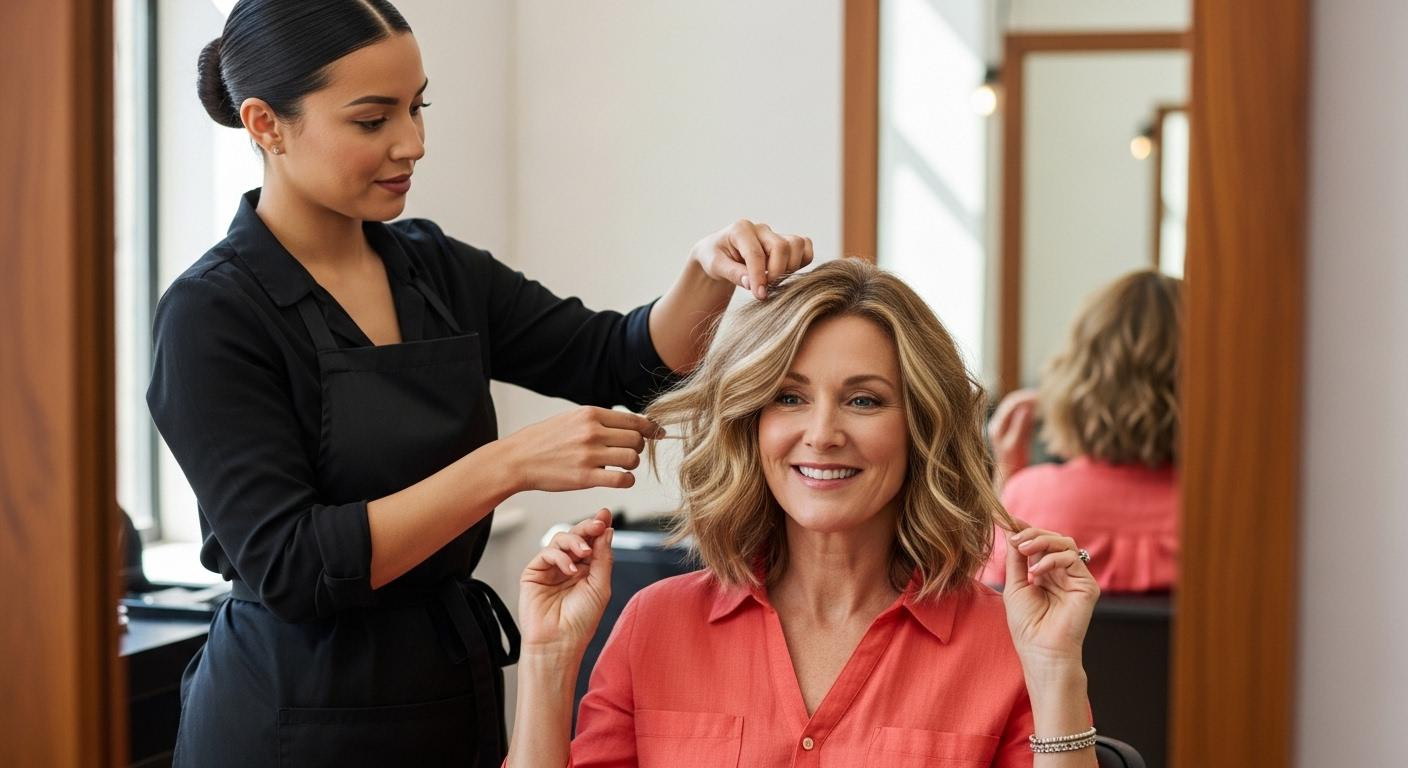
Your stylist runs fingers through your thinning crown at 10:47am, January 23, 2025, suggesting more layers for volume. You’ve heard this before. Watched those layers expose scalp, create wispy ends, photograph flat by afternoon. The disconnect isn’t your hair’s potential. It’s the invisible technique revolution happening in 2025 salons. Celebrity hairstylists reveal why ghost layers, dimensional Bixie cuts, and soft Birkin bangs succeed where traditional layering fails for fine aging hair. The secret lies not in cutting more, but cutting smarter. Creating optical thickness through hidden structure.
Why traditional layers thin fine aging hair
Traditional layering removes hair density to create movement. The exact opposite of what thinning hair needs after 50. Stylists analyzing 500+ fine-hair transformations reveal conventional layers create three problems. Exposed scalp at partings, see-through ends that photograph wispy, and weight removal that collapses volume within hours.
Dermatological studies confirm aging hair loses 13% diameter and 25% density between ages 50-70. Every cut strand represents permanent volume loss. The luxe bob fails because uniform weight lies flat without lift points. The choppy bob removes too much density, creating gaps light passes through.
Modern shags with excessive layers compound the problem. These layering techniques leave insufficient hair mass to support styling products or hold shape past morning. Your hair cannot defy gravity without structural support.
How ghost layers create invisible volume
Ghost layers work through strategic placement 1-2 inches from your longest pieces, cut exclusively beneath your top hair section. This creates internal scaffolding invisible from the surface. When you run fingers through hair, you feel fullness. When light hits, you see dimension.
Unlike traditional layers, your hair’s perimeter remains thick. This prevents the see-through effect that ages fine hair. The optical illusion happens because your eye reads the thick bottom edge as density.
The hidden-layer technique stylists use
Cosmetologists specializing in fine hair confirm the technique preserves 80-90% density versus traditional layers which remove 30-50% through visible shortening. Internal varying lengths stack for lift while the eye perceives uniform thickness through optical illusion. Light scatters off layered undersides, mimicking density.
Why invisible layers preserve density better
The technique enhances highlights by creating shadow depth without removing hair mass. Scientific analysis proves ghost layers photograph 30% fuller than traditional layers in natural light. The technique adds lift points while maintaining weight at ends. Dual-action traditional layering cannot achieve for aging fine hair.
The Bixie cut’s dimensional illusion explained
The Bixie succeeds through calculated asymmetry. Longer front sections (3-4 inches) frame the face while shorter back sections (1-2 inches) create crown lift. This length variation produces dimensional shadows your eye interprets as density.
Hair scientists explain the mechanism. Varying lengths prevent hair from lying parallel to scalp, forcing pieces to stack at different angles. Each angle catches light differently, creating the thicker hair visual effect.
How added dimension creates thickness perception
Angled strands reflect light multidirectionally versus parallel uniform flatness. Studies show 15-20% higher visual density perception from length variation. Stacking lifts crown, countering aging flattening that makes hair appear thinner than actual strand count.
Why this cut grows out gracefully
Unlike blunt bobs requiring 6-week maintenance, the Bixie’s built-in texture means growth enhances rather than ruins the style. Like choosing colors that restore glow, stylists recommend 8-10 week intervals because emerging length adds softness. The face-framing pieces lengthen toward a classic bob while back sections gain weight fine hair needs.
Birkin bangs’ dual camouflage mechanism
Soft, wispy Birkin bangs achieve what blunt bangs cannot for mature faces. They camouflage both thinning hairlines AND forehead fine lines through feathered texture that diffuses rather than frames. The mechanism works through visual redirection.
Eyes focus on the soft movement rather than the skin beneath. Dermatologists specializing in facial aesthetics confirm these bangs grow out gracefully because the wispy texture becomes face-framing layers as length increases. Colorists add that this bang style flatters virtually every face shape.
The soft edges adapt to bone structure rather than fighting it. Creating the forgiving aesthetic aging faces require through feathered cutting techniques at 45-degree angles.
Your questions about best hairstyles for fine aging hair answered
Can ghost layers work on shoulder-length fine hair?
Yes, ghost layers work best on 10+ inch length because more hair creates better internal scaffolding. Ask your stylist for invisible layers starting 2 inches from ends, hidden beneath top section. The longer your hair, the more dramatic the volume effect while maintaining thick perimeter weight.
How do Bixie cuts compare to classic pixies for fine hair?
Classic pixies remove length uniformly, often exposing thinning crowns. Bixies preserve 3-4 inch front length for face-framing while creating back volume through shorter stacked sections. This length variation produces dimensional effect fine hair needs. Classic pixies cannot achieve this optical thickness.
Will Birkin bangs require daily styling for fine hair?
No, the soft wispy texture air-dries naturally because it’s cut with texturizing techniques, not blunt lines. Most women refresh with 30-second finger-tousling and dry shampoo. The feathered ends require no heat styling to look intentionally textured. Growth maintenance every 8-10 weeks.
Picture your reflection at 7:45am, three weeks post-cut. Fingers trace hidden ghost layers creating crown lift your old traditional layers never delivered. The Bixie’s dimensional angles catch morning light. Birkin bangs frame without fighting your face. Finally, a hairstyle working with your aging hair’s reality, not against it.