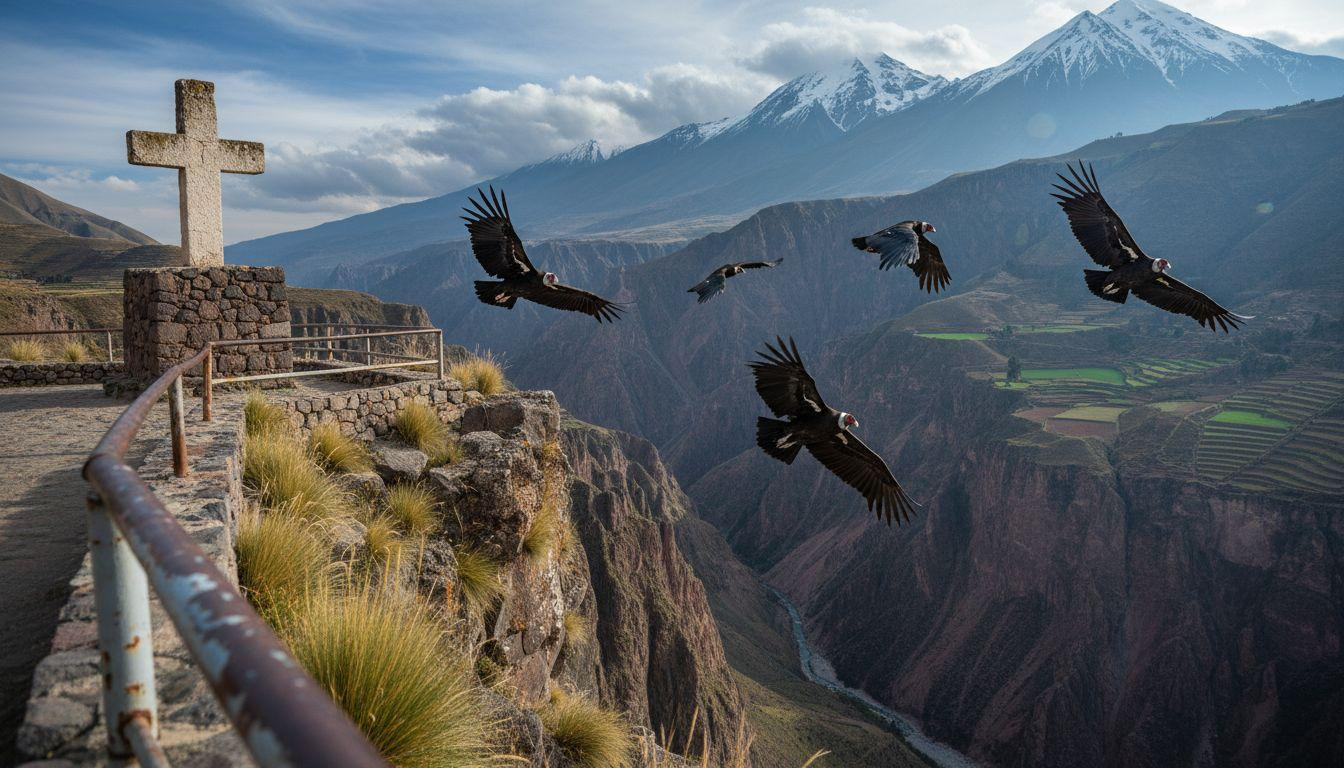
Grand Canyon’s South Rim parking lots fill by 9am on summer mornings. Shuttle buses queue at overlooks where 6 million visitors annually jostle for canyon photos. Peru’s Colca Canyon drops nearly twice as deep at 11,154 feet against Grand Canyon’s 6,093 feet, yet welcomes fewer tourists in an entire year than Grand Canyon sees in a single busy weekend. At Cruz del Cóndor viewpoint, you wait in morning silence for thermals to strengthen and giant condors to appear, their 11-foot wingspans gliding past at eye level.
Why Grand Canyon feels overrun while Colca stays peaceful
Grand Canyon National Park recorded 4.73 million visitors in 2023. South Rim’s Desert View Drive requires timed entry reservations during peak season. Bright Angel Trail descends through regulated zones where permits determine access weeks in advance.
The canyon’s fame creates its own burden. Visitor facilities dominate the rim experience with hotels, restaurants, and shuttle systems. This creates theme park atmosphere rather than wilderness immersion. Other American canyons offer geological drama without the infrastructure strain.
Peak summer months bring 20,000 daily visitors to South Rim alone. Rangers estimate 90% cluster at five major viewpoints. Wildlife viewing focuses on reintroduced California condors and elk populations.
Meet Colca Canyon where depth meets solitude
Colca Canyon sits 62 miles northwest of Arequipa in southern Peru. The gorge plunges 11,154 feet at its deepest sections through volcanic highlands flanked by peaks exceeding 19,685 feet. The Colca River carved this chasm over millions of years.
What makes the visual experience distinct
Cruz del Cóndor viewpoint at kilometer 32 from Chivay provides the iconic encounter. You stand at the rim as Andean condors soar from nesting sites 3,937 feet below. These birds never flap their wings, existing in perpetual gliding mode on mountain thermals.
The canyon’s terraced slopes preserve agricultural systems predating the Inca Empire. Green valley floors contrast against rust-colored canyon walls. Volcanic peaks create dramatic backdrops visible from multiple viewpoints.
The living culture Grand Canyon lacks
Villages like Yanque and Maca maintain traditional life within the gorge itself. Residents wear distinctive colorful clothing reflecting ancestral heritage. Remote Andean communities preserve customs impossible to experience at commercialized destinations.
Terraced fields grow quinoa and amaranth varieties dating back centuries. Some agricultural terraces remain actively farmed today, making Colca one of the world’s oldest continuously cultivated landscapes.
The condor ritual Grand Canyon cannot match
The meditative ceremony begins before dawn. Tour groups depart Arequipa at 3am, arriving at Cruz del Cóndor as first light touches volcanic peaks. Then you wait in mountain silence.
Why patience becomes part of the experience
Wind conditions determine everything. Condors rely entirely on thermal currents (warm air rising from canyon floor) to generate lift. On calm mornings, they stay grounded in cliff nests.
When thermals strengthen around 8-9am, the spectacle begins. Birds with 7-8 foot wingspans (occasionally reaching 11 feet) emerge from nesting sites. They glide past viewpoint rails mere meters away, surfing invisible air rivers with subtle wing adjustments.
The biological advantage over other canyons
Andean condors live 60-70 years and nest in Colca’s cliffs generationally. Multiple families inhabit the Cruz del Cóndor area year-round. Wildlife viewing experiences requiring this level of patience create deeper connection than drive-up photography.
Recent visitor surveys show 85% success rate for condor sightings during optimal hours (early morning and late afternoon). Wait times average 20-30 minutes before thermals bring birds into view.
Practical realities favor the underdog
Three-day Colca Canyon packages from Arequipa start at $295, including transport, accommodation, and meals. Budget lodging in Chivay costs $20-40 nightly. Local meals average $5-15. Total daily costs run approximately $75-100.
Grand Canyon lodge rooms inside the park cost $350-450 nightly during peak season. Budget alternatives require driving 60+ miles from rim viewpoints. Three-day Grand Canyon trips typically cost $800-1,200 per person.
Access requires flying to Arequipa (90 minutes from Lima), then 3-4 hour drive to Chivay entrance town. Most visitors book organized tours through Arequipa operators. Best timing runs April through November during dry season.
Your questions about Colca Canyon answered
How reliable are condor sightings compared to Grand Canyon wildlife?
Cruz del Cóndor offers 85% success rates during optimal viewing hours (8-10am and 4-6pm). Multiple condor families nest permanently in the area. Grand Canyon’s California condors appear less predictably, often requiring multi-day stays for sightings.
What cultural experiences does Colca offer that Grand Canyon lacks?
Traditional villages preserve pre-Incan terraced agriculture and indigenous customs. Visitors can explore thermal baths at La Calera, visit baroque Lari Church from the 18th century, and observe traditional textile weaving. Grand Canyon tourism focuses primarily on geological rather than cultural heritage.
How do costs compare for a typical 3-day canyon experience?
Colca Canyon averages $300-400 total for 3-day guided tours including accommodation and meals. Grand Canyon requires $800-1,200 for equivalent duration with park lodging, meals, and activities. Colca delivers superior depth statistics and wildlife encounters at roughly one-third the expense.
Morning mist rises from the Colca River 11,000 feet below as condors catch the day’s first thermals. Their shadows pass over terraced fields that have fed valley communities for a thousand years. This is canyon majesty earned through patience rather than purchased through crowds.