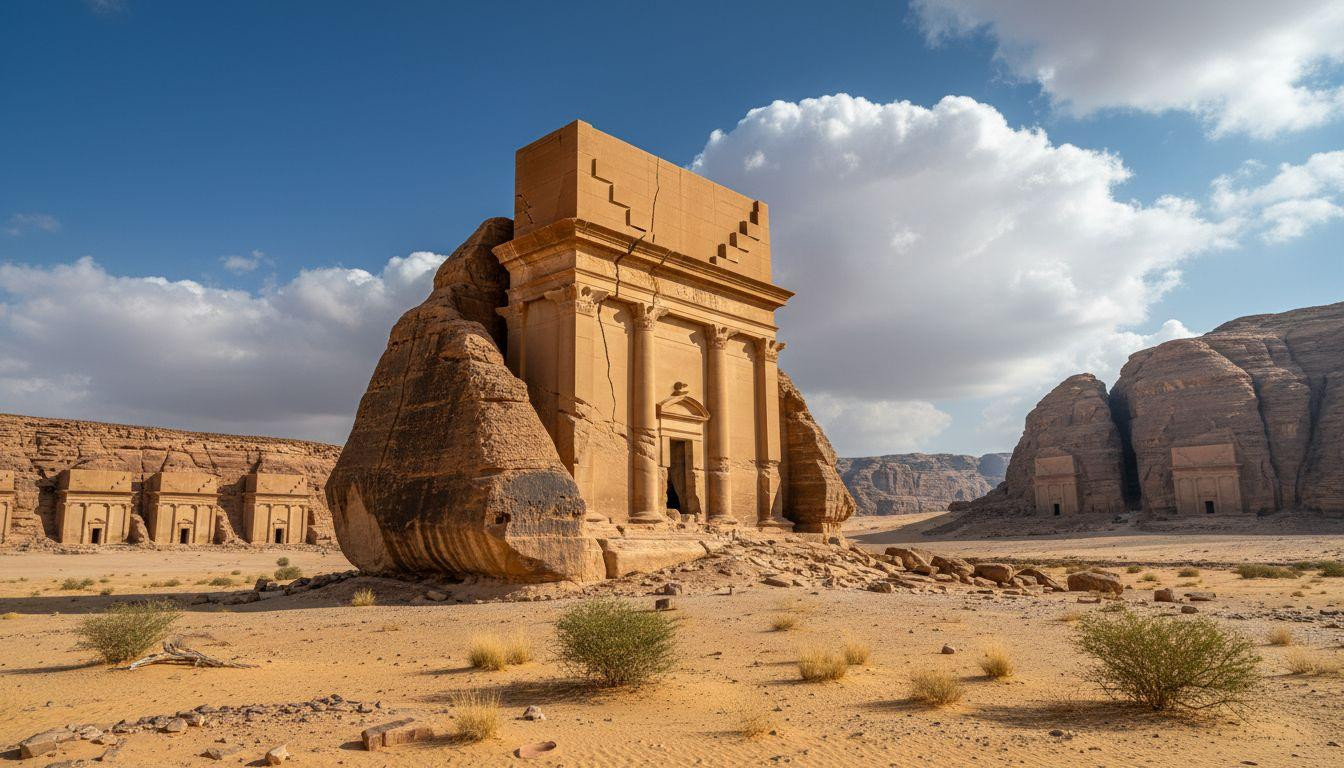
This Saudi site carved 111 tombs into honey-amber cliffs before Petra became famous. Hegra stands as Saudi Arabia’s first UNESCO World Heritage Site, where Nabataean stonemasons created monumental rock-cut facades between the 1st century BCE and 1st century CE. The ancient necropolis rises from desert silence, offering the same architectural sophistication as Jordan’s Petra but with virtually no crowds.
Located 12 miles from AlUla town center in northwestern Saudi Arabia, Hegra preserves what archaeologists consider the largest conserved Nabataean settlement south of Petra. Winter temperatures hover between 50-64°F, making January through March the optimal visiting season.
Where Nabataean stonemasons created Arabia’s necropolis
The AlUla Valley stretches across dramatic desert terrain where monumental sandstone boulders rise abruptly from flat ground. Hegra occupies this stark landscape 680 miles northwest of Riyadh, positioned along ancient incense trade routes that connected the Arabian Peninsula with Mediterranean markets.
Flying from Riyadh takes approximately 2 hours to reach AlUla’s regional airport. The 12-mile drive to Hegra requires 25-40 minutes through landscapes that photographer visitors describe as resembling fantasy film settings.
The site spans a vast desert plateau where 111 monumental tombs display varying scales of craftsmanship. 94 tombs feature decorated facades carved directly into honey-colored sandstone cliffs that shift from deep ochre at dawn to golden amber at sunset.
The architecture Petra influenced but couldn’t overshadow
Carved facades that tell family stories
Qasr al-Farid (Lonely Castle) stands as Hegra’s most enigmatic monument. This isolated tomb was carved into a solitary boulder positioned away from the main cliff face, creating compelling questions about why the Nabataeans left it architecturally complete but geologically unfinished.
The facades display sophisticated design elements: precisely carved columns, pediments, and decorative moldings that reflect Hellenistic and Near Eastern influences. Inscriptions in Nabataean, Lihyanite, and Thamudic languages name the deceased and their lineages, providing direct evidence of cultural exchange across ancient civilizations.
The Siq and sacred spaces beyond tombs
A narrow passageway called the Siq creates intimate counterpoint to the site’s monumental scale. This canyon between massive sandstone walls features small altars dotted throughout, indicating its function as a processional route with religious significance in pre-Islamic Arabian practice.
The Diwan ceremonial structure and approximately 50 pre-Nabataean inscriptions preserve evidence of spiritual traditions that predated the tomb construction. Ancient artificial wells engineered by the Nabataeans for water extraction remain functional today, representing an unbroken line of technological utility spanning over 2,000 years.
Experiencing Hegra’s contemplative atmosphere
Guided tours through time-capsule silence
Visits to Hegra require organized tours through Experience AlUla, as independent exploration is not permitted for preservation reasons. Official tours operate year-round with morning and afternoon departures lasting 2-3 hours including transfer time from AlUla.
Local guides called Rawis traditionally served as storytellers preserving Nabataean narratives. Modern tour experiences employ these cultural historians to maintain authentic storytelling traditions while accommodating up to 45 visitors per bus.
Tours begin at $25 per adult, with children ages 5-12 paying $12 and under-4s entering free. The controlled capacity creates what travelers consistently describe as “undisturbed archaeological atmosphere” compared to Petra’s crowded pathways.
Golden hour light on ancient stone
The honey-amber sandstone responds dramatically to changing light angles throughout the day. Early morning sun creates sharp shadows that accentuate carved relief details, while afternoon light softens the stone’s texture, making ancient facades appear almost ethereal.
Winter sunrises illuminate the monuments with warm, low-angle light around 6:45-7:00 AM. Sunset occurs approximately 4:45-5:00 PM, creating dramatic contrasts between illuminated facades and deep shadows in carved recesses.
The absence of commercial development creates acoustic conditions where only wind moving through stone crevices and occasional desert bird calls break the silence. Visitors can spend extended periods before individual monuments without feeling rushed.
Practical realities for January 2026 visits
AlUla offers accommodation ranging from $40-80 budget guesthouses to $320-665+ luxury desert resorts. The Chedi Hegra opened in December 2024 with 35 rooms housed in a historic train station, while Hyatt Place AlUla added 215 rooms in 2025.
Local restaurants serve traditional Saudi cuisine at moderate prices. Casual dining costs $8-19 per meal, featuring kabsa (fragrant rice with meat) and fresh dates from AlUla’s palm groves. Mid-range restaurants charge $21-40 per entree for international options.
Specialized experiences command premium pricing. The “Hegra After Dark” immersive theatrical experience costs from $67 per person, while sunrise hot air balloon flights exceed $150-200. The nearby Heritage Oasis Trail provides walking routes through palm groves surrounded by dramatic cliffs.
Your questions about Hegra answered
How does Hegra compare to Petra’s crowds?
Petra attracts approximately 1 million annual visitors, creating bottlenecks at major monuments with daily peaks reaching nearly 4,000 people. Hegra recorded 286,259 total visitors in 2024 across the entire AlUla region, maintaining contemplative exploration conditions that allow unobstructed photography and genuine connection to ancient craftsmanship.
Why wasn’t Hegra famous before UNESCO designation?
Pre-Islamic stigma in conservative Saudi culture limited promotion of Nabataean heritage until recent decades. The 2008 UNESCO designation as Saudi Arabia’s first World Heritage Site marked a turning point, followed by substantial tourism infrastructure development under Saudi Arabia’s Vision 2030 initiative.
Can international visitors access Saudi Arabia easily?
Saudi Arabia streamlined tourist visa processes, making entry increasingly accessible for international travelers. Access typically routes through Riyadh or Jeddah international airports, with expanded airline connectivity supporting the kingdom’s positioning of AlUla as an alternative to Jordan’s desert destinations. Advanced booking through official channels like experiencealula.com ensures guaranteed access during peak winter season.
Standing before Qasr al-Farid at sunset, the isolation of this carved monument generates contemplative silence. The honey-amber facades turn deep purple against the darkening sky, creating moments of profound quiet awe that mass tourism has eliminated from comparable Middle Eastern heritage sites.