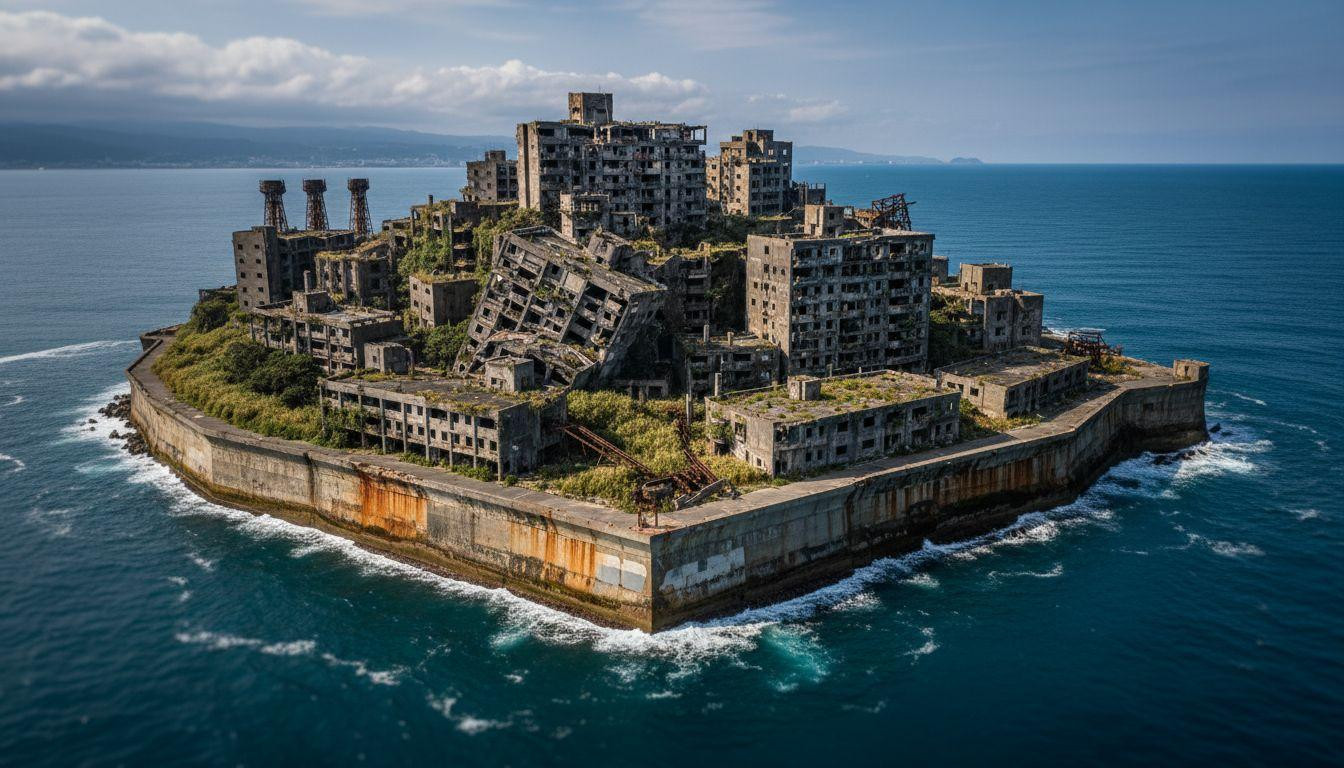
The ferry cuts through choppy East China Sea waters, and suddenly it appears. A concrete battleship rising from turquoise depths 9 miles offshore from Nagasaki. Hashima Island emerges like a post-apocalyptic vision, its gray high-rises collapsing into the sea after 50 years of abandonment.
This UNESCO World Heritage site once housed 5,267 souls on just 16 acres. Today, guided tours reveal 10 distinct zones where Japan’s industrial past lies frozen in concrete and rust.
Building 65 where families lived nine stories high
Japan’s oldest reinforced concrete apartment building dominates the island’s skyline. Built in 1916, this 9-story fortress housed 140 families in vertical dystopia. Upper floors have collapsed by 30-50%, revealing exposed interiors like a concrete dollhouse.
Rusted rebar pierces crumbling walls. Balconies hang precariously over 40-foot sea cliffs. Tour guides point out where laundry once dried, where children played in narrow corridors, where life thrived in impossible density.
The building exemplifies Japan’s early embrace of vertical living. Families of four shared 200-square-foot apartments while mining coal beneath the ocean floor. This Mojave ghost town preserves similar industrial heritage, but Hashima’s oceanic isolation creates unmatched atmospheric power.
The shopping district that served 5,267 residents
Naka-no-shima District packed 25 shops into 5,000 square meters of narrow alleys. Pachinko parlors, cinema screens, elementary classrooms – everything a mining community needed existed within walking distance. Faded shop signs remain readable in 2025, ghostly advertisements for daily life that vanished overnight.
What the ruins reveal today
Central courtyard staircases lead nowhere, their destinations collapsed or cordoned off. Broken storefront windows frame empty shelves where groceries once fed thousands. The cinema’s projection booth sits exposed to salt air, film reels long since scattered by typhoons.
The density that broke world records
At peak capacity in 1959, Hashima achieved 83,500 people per square kilometer. Streets measured just 3-5 meters wide, yet accommodated the world’s highest population density. Residents navigated vertical neighborhoods where floor numbers mattered more than street addresses.
This Croatian island demonstrates similar density, but within medieval walls rather than modern concrete towers.
Shaft Number 1 where coal built an empire
The Mitsubishi mining operation extracted 15 million tons of coal between 1890 and 1974. Underground shafts plunged 1,000 meters beneath the seabed, deeper than the island is wide. Korean and Chinese forced laborers worked these dangerous depths during World War II, their stories now acknowledged in UNESCO documentation.
Industrial infrastructure frozen in time
Rusted mining equipment dots the landscape like abstract sculptures. Ventilation towers pierce the skyline, their purpose clear but their function silenced. Conveyor belt foundations trace paths from shaft to shore, mapping the flow of coal that powered Japan’s naval expansion.
The evacuation that ended everything
On April 20, 1974, the last residents boarded the final ferry. Oil had replaced coal, making the dangerous undersea operation economically obsolete. Families left furniture, photographs, and entire lives behind in their rush to catch the last boat to the mainland.
Mining tours guide visitors through this preserved moment of industrial transition. These narrow canyons offer similar atmospheric contemplation of geological time and human impermanence.
The seawall that battles endless storms
A 1,800-meter concrete perimeter shields the island from 5-10 meter typhoon waves. Built in the early 1900s, this seawall represents remarkable engineering for its era. Orange-brown rust streaks now paint abstract patterns down its face, while green moss softens hard edges where fresh water meets salt spray.
Tour boats approach these walls carefully, especially during April-October when landing success rates reach 80-90%. Winter cancellations exceed 80% when winds surpass 10 meters per second and waves crash with 80-decibel force.
The James Bond film Skyfall featured these dramatic seawalls in 2012, using Hashima’s exterior for villain sequences. These Blue Lagoon zones demonstrate similar regulated access protecting authentic experiences from overcrowding.
Your questions about Hashima Island answered
When should I visit for the best experience?
April through October offers 80-90% landing success rates compared to 50% in winter months. May and October provide optimal conditions with fewer tourists, mild temperatures averaging 68°F, and dramatic overcast skies that enhance the island’s dystopian atmosphere. Book 2-3 backup dates as weather cancellations are common.
How much does a complete Hashima experience cost?
Gunkanjima Concierge tours cost $41-48, including boat transport, guided island tour, and Digital Museum entry. Nagasaki accommodation ranges from $35-70 for budget options to $150-210 for luxury hotels. Tram fare from Nagasaki Station to terminals costs under $1. Total day trip: $80-120 per person.
How does Hashima compare to other ruins tourism sites?
Hashima attracts 200,000 annual visitors versus Chernobyl’s 150,000, but costs $40-50 compared to $150+ for Ukraine trips. Access requires only boat tours versus radiation guides. Photography restrictions apply only to safety zones, not entire areas like Pripyat’s illegal access.
Salt spray stings faces as the ferry departs, Hashima’s battleship silhouette dissolving into gray mist. The concrete dystopia shrinks but never disappears, its ghost story of 5,267 vanished lives haunting long after the mainland comes into view.