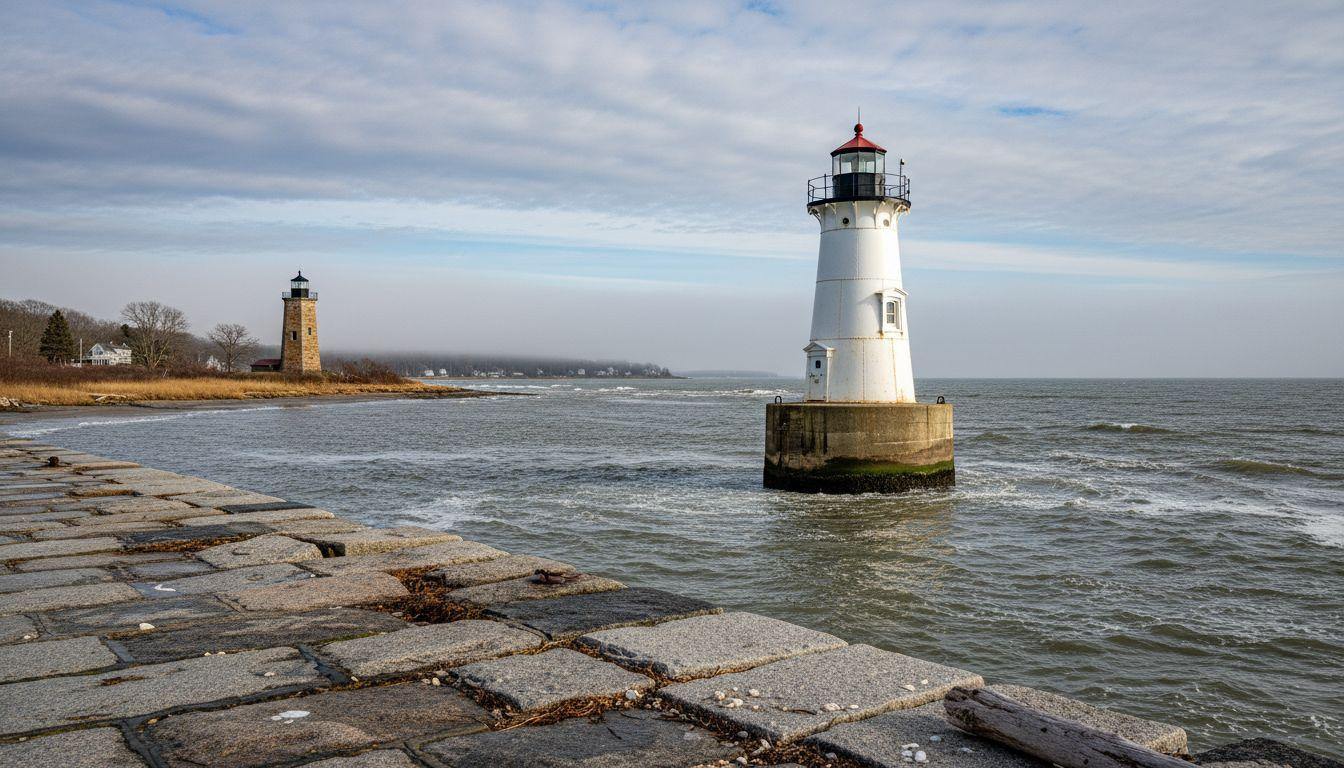
Winter fog drifts across the Connecticut River mouth where two lighthouses stand sentinel 3,000 feet apart. Old Saybrook’s twin lights mark where New England’s longest river meets Long Island Sound. An atmospheric confluence just 20 minutes from New Haven. While coastal Connecticut draws summer crowds, January transforms this maritime crossroads into something rare. Authentic coastal quiet where fog horns once echoed and weathered brownstone still guards historic channels.
Where river meets Sound
The geography creates the magic. Connecticut River’s massive freshwater flow collides with Long Island Sound’s tidal salt water at this precise point. This generates the persistent fog that historically plagued mariners.
Lynde Point Light’s 65-foot brownstone octagon anchors the west bank while Saybrook Breakwater’s white cast-iron sparkplug sits offshore. This paired configuration is rare. Most harbors use single lights.
The fog rolls thickest in winter when cold river water meets relatively warmer Sound currents. Creating the atmospheric mist that modern visitors cherish but 1800s keepers dreaded. Maine’s fog-wrapped islands share similar maritime mysteries.
The lighthouse revelation
Two towers, two eras
Lynde Point (1838-39 rebuild) represents early American maritime infrastructure. Solid brownstone masonry, octagonal strength, Gothic Revival keeper’s house demolished in 1966. Saybrook Breakwater (1886) embodies industrial-age engineering with cast-iron caisson foundation and sparkplug cylinder.
Walking between them reveals technological evolution frozen in architecture. The brownstone feels timeless while the sparkplug feels utilitarian.
The fog that built them
Historical logs show fog obscured the first 1803 Lynde light so completely that complaints forced the 1838 rebuild. More powerful lamps were needed. Local tourism boards confirm that keeper Sidney Gross’s 1938 hurricane log from Breakwater recorded everything swept away except the tower.
Today that same fog creates cinematic mornings where paired lights emerge from gray like sentinels in a maritime painting. Norway’s atmospheric landmarks offer similar mystical encounters.
The experience
The walking route
Park near Saybrook Point Resort with free street parking available. Walk the public breakwater pier stretching 1,800 feet of stone extending toward the lighthouse. Anglers fish year-round while mist swirls around the tower base.
Return to shore then drive 1.5 miles to Lynde Point Road for brownstone tower access. Total walking time: 30 minutes. Best time arrives at dawn or late afternoon when fog creates layers between lights.
Winter brings solitude. Expect to see more gulls than humans. Caribbean’s quieter beaches provide similar peaceful escapes.
The local rhythm
Old Saybrook’s 10,000 residents live maritime slow. Lobster rolls cost $20 at harbor shacks. Salt marshes yield cranberries and no crowds disturb the peace.
No resort noise interrupts the eternal rhythm of river meeting Sound. January temperatures (25-40°F) keep tourists away, leaving the lights to locals and photographers. Regional visitor centers report 80% fewer visitors during winter months.
The quiet discovery
This isn’t Acadia’s tourist lighthouses or Cape Cod’s postcard shores. It’s working-class maritime heritage accidentally preserved by proximity to bigger destinations. New Haven draws the crowds while Old Saybrook keeps the fog.
The lights still guide vessels with automated LED now replacing oil lamps. Their real function today is atmospheric: twin anchors in mist marking where America’s longest river surrenders to the sea. In January, standing between them with fog erasing horizons, you’re alone with 200 years of coastal continuity.
Winter trail experiences throughout New England offer similar seasonal transformations from crowded to contemplative.
Your questions about Old Saybrook’s lighthouses answered
Can you climb the lighthouses?
No interior access is available as both are Coast Guard-owned and automated. Lynde Point allows grounds walking while Breakwater requires pier walk to base only. Photography opportunities remain excellent from both locations with unrestricted exterior views.
Why twin lights instead of one?
Navigation precision demanded paired beacons. Inner light (Lynde) marks channel entrance from Sound while outer light (Breakwater) warns of offshore rocks. Paired bearings helped captains triangulate safe passage into river harbor. This proved crucial for lumber and fishing commerce to Hartford upriver.
How does this compare to Maine lighthouses?
Less dramatic cliff settings but equally historic with Lynde’s brownstone rivaling Portland Head. Major advantage: zero crowds, free access, easier parking. Maine’s lights see 1,000+ daily summer visitors while Old Saybrook sees maybe 50. Trade scenic intensity for solitude.
Dawn breaks over Long Island Sound as fog lifts between the twin sentinels. Brownstone and cast-iron stand eternal watch while the Connecticut River flows past toward the sea. Winter silence holds court over this overlooked maritime crossroads.