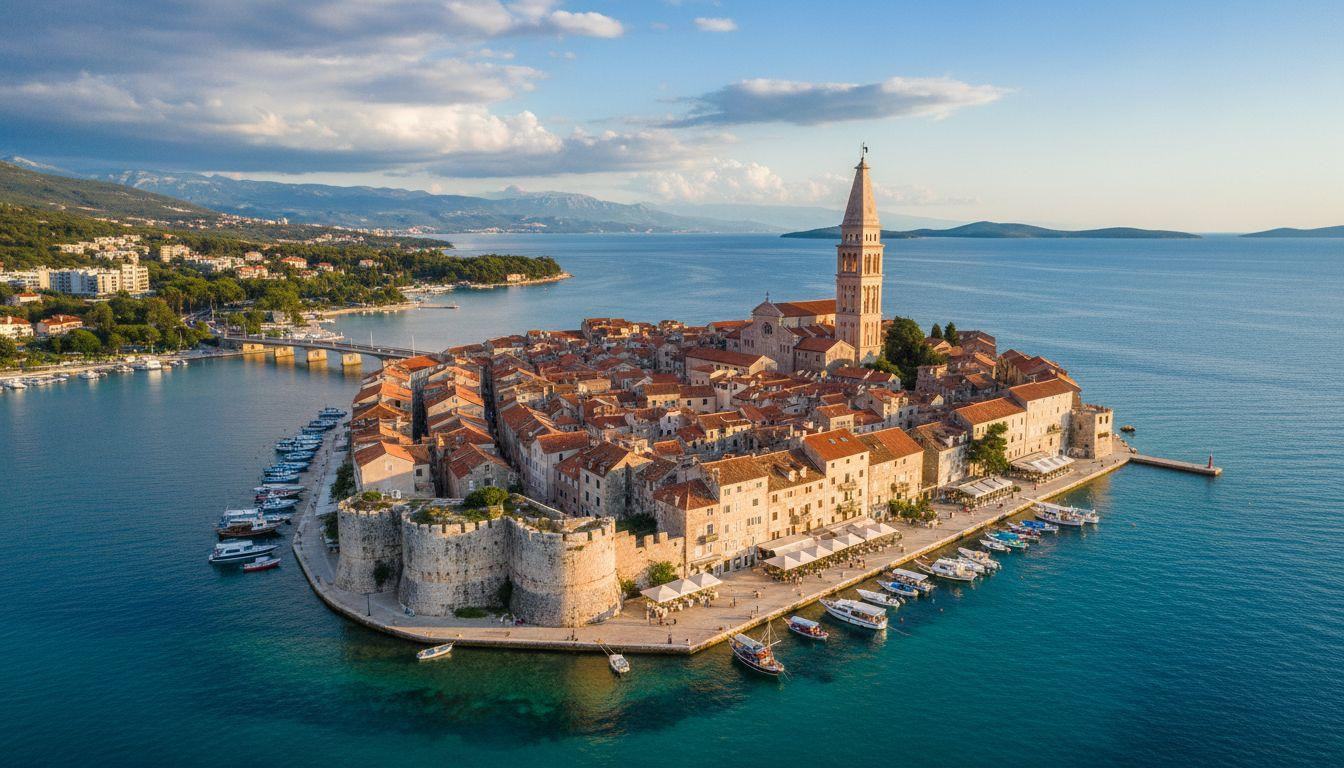
Stone bridges connect you to a medieval world floating on Adriatic water. Trogir spreads across a half-mile island where 13,000 residents live inside UNESCO walls built before America existed. Golden Venetian palaces rise from turquoise harbors just 19 miles from Split Airport. January mornings here feel like stepping into a living museum where church bells echo through empty alleys.
The island breathes history you can walk across in 20 minutes. Yet most travelers rush past toward Dubrovnik’s crowds.
The island that time built slowly
Greek colonists founded Tragyrion in the 3rd century BC on this strategic islet. Roman engineers laid the orthogonal street grid that survives today. Venetian merchants added Renaissance loggias and Gothic palaces during 500 years of rule.
The island measures just 500 meters long by 250 meters wide. Stone bridges link it to mainland Croatia and neighboring Čiovo Island’s beaches. This geography preserved medieval architecture that mainland sprawl destroyed elsewhere.
Walking the perimeter promenade takes 15 minutes. Every narrow alley leads to courtyards where laundry flutters between 700-year-old walls. The island’s compact scale creates intimacy impossible in larger cities.
Stone layers you can touch
Cathedral bell tower views
The 47-meter bell tower of St. Lawrence Cathedral offers panoramic views over red-tiled rooftops and glittering Adriatic water. Master Radovan’s 1240 carved portal features stone lions that locals say guard the town. Climbing the narrow spiral stairs reveals Split’s coastline to the east and Čiovo’s white cliffs to the south.
From the top, Trogir’s medieval grid spreads below like an architectural textbook. Split’s Diocletian Palace sits 19 miles east where Roman emperors once retired.
Venetian fingerprints on every corner
Kamerlengo Fortress guards the island’s western tip with 15th-century stone walls. The Duke’s Palace blends Romanesque foundations, Gothic windows, and Renaissance loggias in perfect architectural harmony. Hidden courtyards reveal Venetian wellheads carved with family crests.
UNESCO inscribed Trogir in 1997 for exemplifying urban continuity with minimal modern intervention. Walking these streets feels like time travel because preservation policies protect authentic patina over tourist polish.
Evening on the waterfront
The promenade rhythm
Local families begin their evening passeggiata at sunset when golden light warms limestone facades. Seaside cafes fill with residents sharing Pošip white wine while fishing boats bob against Renaissance stone docks. The waterfront promenade stretches along the island’s southern edge where gentle waves lap medieval foundations.
Konobas serve crni rižot (black risotto with cuttlefish ink) for $16 while harbor lights reflect off calm water. Unlike Gordes where hotels cost $330, Trogir’s boutique accommodations average $120-200 per night.
January’s secret advantage
Winter occupancy drops below 30 percent, leaving cathedral courtyards empty and alley echoes undisturbed. Daytime temperatures reach comfortable 54-57°F for exploring without summer heat. Morning mist over the harbor creates ethereal light through Gothic arches.
January visitors discover authentic rhythms when tourism pauses. Fishermen arrive at 5am with fresh catches while church bells mark unhurried time in stone-walled silence.
Living inside history
Four thousand residents maintain daily life within UNESCO walls, creating authenticity that museum-villages lack. Morning markets by the waterfront sell fresh figs and local olive oil while elderly men play chess in medieval squares. Stone masonry workshops continue centuries-old traditions passed through generations.
Klapa a cappella singing echoes from tavern courtyards during summer festivals. St. Lawrence Day on August 10th brings traditional feasts to island squares. These bridges built before 1776 still carry residents to work each morning.
Local tourism boards confirm prices run 15-20 percent below Croatia’s national averages due to Trogir’s medium-tourism scale. Authentic rhythm survives because real families call these Renaissance palaces home.
Your questions about Trogir answered
How do I get there without crowds?
Split Airport sits 19 miles east with direct buses to Trogir costing $6-9 for the 30-minute journey. Arrive before 9am or after 4pm to avoid day-trip crowds from Split. Winter months from November through March eliminate cruise ship visitors entirely. Stay overnight instead of day-tripping to experience evening tranquility when tour groups depart.
What about costs compared to famous alternatives?
Boutique hotels average $120-180 per night versus $220-385 in Dubrovnik. Traditional crni rižot costs $16 at waterfront konobas. Cathedral and fortress entries total $11 combined. Compared to Split’s tourism prices, Trogir offers 20 percent savings with equal UNESCO heritage quality.
How does it compare to Venice?
Both cities feature Venetian Gothic architecture on compact islands accessed by bridges. Trogir offers similar canal-town atmosphere at fraction of Venice’s crowds and costs. The medieval core preserves better continuity than Venice’s tourist-saturated districts. Renaissance palaces face harbors instead of canals, creating Mediterranean warmth versus Alpine dampness.
Morning light transforms golden stone facades while fishing boats prepare for another day. Harbor bells mark time in this floating medieval world where authentic life continues inside UNESCO walls.