Standing on a stone bridge built three centuries before America was founded feels like touching history itself. These eight European villages preserve medieval bridges where daily life continues around arches that predate the Declaration of Independence. Winter brings solitude to these ancient crossings.
Where centuries-old stone meets modern footsteps
Medieval engineers built these bridges to last lifetimes, not decades. Portuguese schist, French granite, and Swiss alpine stone carry pedestrians across rivers that have flowed unchanged since the 1300s. Each village guards its bridge like a family heirloom.
Piódão clings to Portugal’s Serra do Açor mountains with 17th-century schist footbridges spanning seasonal streams. The white-and-blue chapel of Nossa Senhora da Conceição rises above dark stone paths where residents still greet strangers. Winter temperatures hover around 46°F with occasional frost dusting the terraces.
Ancient engineering in living villages
These aren’t museum pieces behind velvet ropes. Local farmers cross Pont Joly in Semur-en-Auxois carrying market baskets as their ancestors did in the 13th century. Medieval towers rise from pink granite cliffs above the Armançon River where morning mist creates perfect reflections.
Stone that defied centuries
Dinant’s Charles-de-Gaulle Bridge follows 16th-century stone foundations beneath its modern surface. Colorful saxophone sculptures line the span honoring Adolphe Sax’s birthplace. The citadel towers 330 feet above the Meuse River where winter fog transforms the cliff into charcoal silhouettes.
Where water replaces roads
Giethoorn spreads across 180 footbridges connecting thatched farmhouses via 13th-century canals. Electric boats glide beneath brick arches where Amazon packages arrive by water rather than truck. January brings hushed mornings with canal-side windows reflecting in mirror-still water.
Walking through time
Crossing these bridges creates temporal vertigo. Your footsteps echo where medieval merchants haggled and knights rode to distant wars. Ancient lighting traditions continue in several villages during winter months.
Alpine bridges beneath waterfalls
Lauterbrunnen’s stone crossings span glacial streams beneath 72 waterfalls cascading from 3,000-foot cliffs. Staubbach Falls drops nearly 1,000 feet behind the village where Tolkien found inspiration for Rivendell. Winter snow muffles the constant roar of falling water.
Visegrád overlooks the Danube Bend where Hungarian kings held court in the 14th century. Ancient ferry crossings connected trade routes that modern bridges now span. The citadel commands views across an S-curve that has guided river traffic for 700 years.
Ottoman arches over emerald rivers
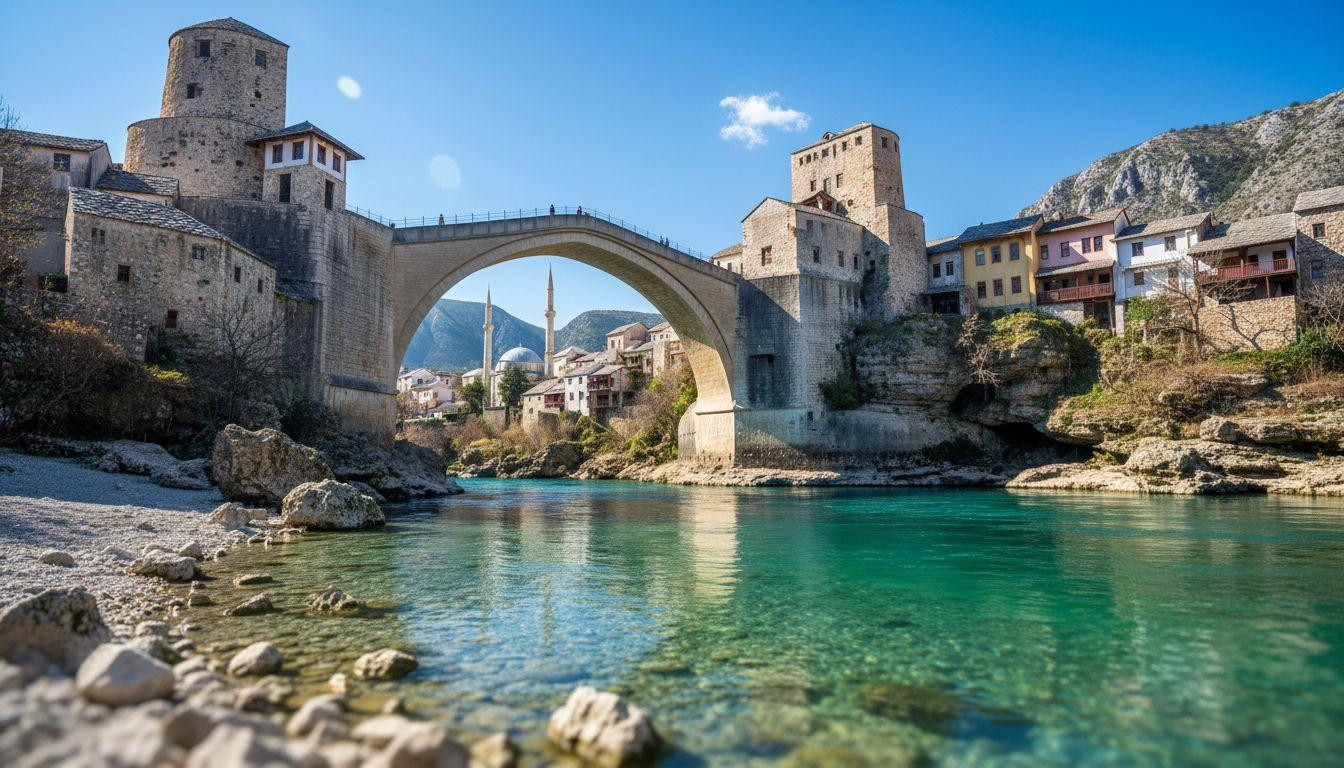
Mostar’s Stari Most originally spanned the Neretva River from 1557 to 1993. Reconstruction using traditional methods restored the 16th-century arch where local divers still leap 79 feet into icy water.
Rüdesheim am Rhein crowns UNESCO’s Upper Middle Rhine Valley with half-timbered houses descending to ancient ferry crossings. Rhine barges slip past vineyard terraces that have produced wine since the 9th century. Cable cars climb to the Niederwald monument for valley views stretching 12 miles.
Planning your bridge journey
January through March offers solitude and dramatically lower prices across all eight villages. Portuguese guesthouses cost $50-75 nightly while Swiss accommodations demand $100-155. Traffic-free alternatives preserve the medieval atmosphere modern tourists seek.
Regional trains connect most villages to major cities within 1-3 hours. Dinant sits 90 minutes from Brussels while Visegrád requires 28 miles from Budapest. Winter schedules reduce some services but eliminate summer crowds entirely. Photography improves with longer shadows and dramatic winter light.
Your questions about European fairytale villages with stone bridges older than the USA answered
Which villages offer the most affordable winter stays?
Mostar and Visegrád provide exceptional value with guesthouses from $28-55 nightly. Portuguese mountain lodging costs $50-75 while Swiss Alps accommodations reach $100-155. Bosnia and Hungary deliver medieval atmosphere at budget prices with hearty local meals under $18.
How do winter conditions affect bridge access?
All eight villages maintain year-round bridge access though some Alpine paths become icy. Swiss locations experience snow from December through March while Mediterranean villages stay mild around 50°F. Services reduce in January-February but winter brings atmospheric fog and empty photography opportunities.
Which bridges predate Columbus by the widest margin?
Semur-en-Auxois and Visegrád claim the earliest foundations dating to the 13th-14th centuries. Pont Joly spans the Armançon River using stones laid 300 years before Columbus sailed. Hungarian river crossings connected medieval trade routes when Europe was still finding its boundaries.
Dawn breaks over ancient stones where morning mist rises from rivers unchanged since medieval times. These bridges carry more than footsteps. They bear the weight of centuries.