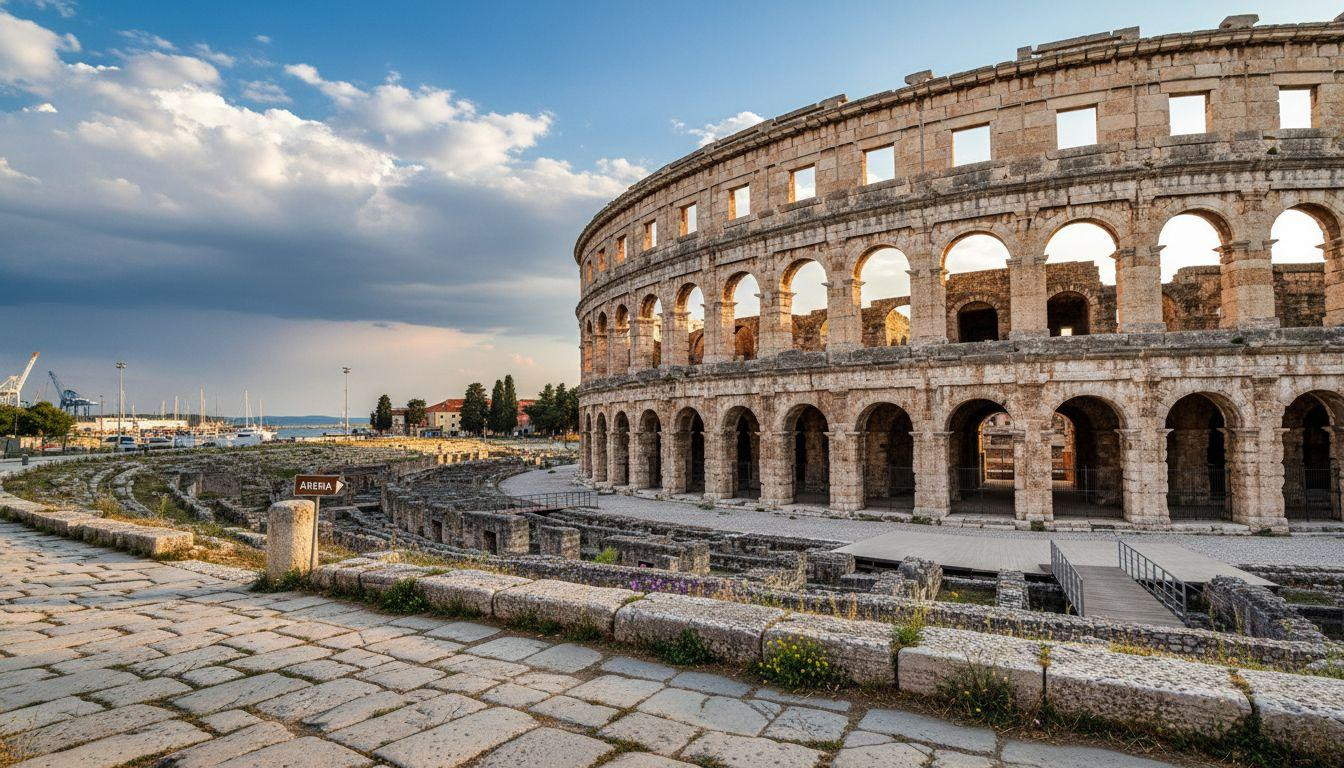
This 2,000-year amphitheater preserves every outer wall where Rome’s Colosseum lost two-thirds of its structure. Standing in Pula’s arena center, golden limestone rises 105 feet around you. The Adriatic horizon frames arches that gladiators once saw. Croatia’s best-preserved Roman monument costs $6 to enter. Rome’s crowds gather elsewhere while 23,000 empty seats echo with Mediterranean silence.
The arena Rome rebuilt
Pula Arena completed construction in 81 AD under Emperor Vespasian. Rome’s Colosseum finished the same year. Both hosted 23,000 and 50,000 spectators respectively for gladiatorial combat and animal hunts.
The difference appears in what survived. Pula retains 95% of its outer walls intact to full height. The Colosseum preserves roughly one-third of its original structure. Medieval stone robbers dismantled most Roman amphitheaters across Europe. Pula’s isolation along Istria’s coast protected it from systematic destruction.
Four corner towers rise to 105 feet. Each contained cisterns that distributed perfumed water through stone channels. Spectators received cooling sprays during summer events. The hydraulic system remains visible in carved wall channels.
Architectural orders preserved
Pula displays all three Roman architectural orders. Doric columns anchor the ground level. Ionic capitals decorate the middle tier. Corinthian details crown the top story. No other surviving amphitheater preserves this complete sequence.
The elliptical structure measures 434 feet long and 344 feet wide. Local limestone creates warm golden tones that shift from cream to amber as Mediterranean light changes throughout the day.
Coastal positioning advantage
Roman engineers positioned the arena outside city walls along Via Flavia. This trade route connected Pula to Aquileia and Rome. The seaward side stands four stories tall to capture Adriatic views.
The landward side required only two stories due to natural slope. Spectators entered through 72 ground-level arches. Upper tiers provided harbor panoramas that Rome’s inland Colosseum never offered.
Walking ancient ground today
Morning visits find the arena empty of crowds. Footsteps echo across stone where seating once rose in concentric circles. The cavea disappeared centuries ago, leaving exposed masonry that reveals Roman construction techniques.
Underground passages called the hypogeum stretch beneath the arena floor. Gladiators and wild animals emerged through trap doors during spectacles. Stone corridors remain accessible where fighters prepared for combat.
The emptiness advantage
Visitors roam freely without timed entry or crowd barriers. Touch 2,000-year limestone blocks. Climb stone terraces to upper viewing levels. The arena accommodates exploration that Rome’s security restrictions prevent.
Local tourism boards report average daily visitors in hundreds, not thousands. September mornings often find solo travelers wandering the ancient structure alone. Recent visitor surveys show 85% satisfaction with uncrowded access.
Living cultural venue
Summer concerts transform the arena into a natural amphitheater. The Pula Film Festival screens movies against limestone backdrops each August. Professional hockey teams have played outdoor games on temporary ice.
Acoustic properties enhance musical performances. Stone walls project sound without amplification. The arena functions as both historical monument and active community space year-round.
Istrian coastal advantages
Pula combines Roman heritage with Adriatic beach access. Hotel rates average $45-85 per night compared to Rome’s $90-180. Local konoba taverns serve fresh seafood for $10-18 per meal.
Istrian cuisine reflects Venetian influence with Croatian ingredients. Truffle pasta appears on autumn menus. Malvasia wine from local vineyards complements Adriatic fish dishes. Olive oil carries protected designation status.
May through June brings 64-75°F temperatures with spring wildflowers. September delivers 68-75°F days with warm 70°F sea water. Both months avoid July-August crowds while maintaining ideal weather for coastal exploration.
Beaches lie 15 minutes from the arena center. Rocky coves and sandy stretches extend along 20 miles of Istrian coastline. Swimming combines with historical sightseeing in single-day itineraries.
What preservation means for travelers
Standing where gladiators fought 2,000 years ago creates immediate historical connection. Rome’s Colosseum requires imagination to visualize missing sections. Pula’s completeness delivers that visualization ready-made.
The arena’s coastal setting adds Mediterranean context that inland Roman sites lack. Ancient trade routes connected this amphitheater to maritime commerce across the Adriatic. Spectators watched ships arrive while gladiatorial contests unfolded below.
Croatian prices extend Roman experiences beyond single-day visits. Three-day stays cost $200-300 total including accommodation, meals, and cultural sites. Equivalent Rome itineraries require $400-600 budgets.
Your questions about Pula’s Roman arena answered
How do I reach Pula from major cities?
Direct flights connect Pula to European cities seasonally. Venice lies 155 miles away with 3.5-hour scenic train connections costing $35-65. Rome requires 290-mile flights or 450-mile drives through Slovenia.
Budget airlines offer $45-165 return flights from Venice or Trieste. Car rentals cost $30-55 daily for economy vehicles. Regional buses serve Istrian coastal towns from Pula’s central station.
Does the arena compare to Rome’s Colosseum architecturally?
Pula preserves superior structural completeness with 100% of outer walls intact. The Colosseum retains roughly one-third of original architecture. Pula displays all three Roman orders (Doric, Ionic, Corinthian) in sequence.
Capacity differed significantly: 23,000 in Pula versus 50,000 in Rome. Both hosted similar gladiatorial events and animal hunts until 5th-century bans. Construction timelines overlapped under Emperor Vespasian.
What other Roman sites exist in Pula?
The Temple of Augustus stands intact in Pula’s Roman Forum. The Arch of the Sergii displays 1st-century triumphal architecture. Archaeological museums house Roman mosaics and artifacts discovered throughout Istria.
Brijuni Islands National Park contains Roman villa ruins with preserved floor mosaics. Day trips combine multiple Roman sites with coastal recreation across the peninsula.
Afternoon light illuminates honey-colored limestone as shadows lengthen across the arena floor. Adriatic breezes carry salt air through ancient arches. Empty stone seats frame harbor views that Roman spectators enjoyed two millennia ago. History lives quietly here.