·
17 min read
Saatva Loom & Leaf · scored by the World Sleep Almanac · read methodology
You pull back your duvet tonight and see what you always see. One flat comforter stretched across the mattress. Two standard pillows propped against the headboard. Maybe a throw crumpled at the foot of the bed. The setup looks functional but not inviting. Not like the hotel beds you scroll past on Instagram with their seven distinct layers creating dimensional depth and thermal cocoon luxury. The gap between your bed and those dreamy winter sleep setups isn’t budget. You probably spent $280 on bedding this year already. The difference is the invisible layering system hotels use and most people skip, especially layer number four, the mid-weight textural bridge that transforms flat into plush. Here’s the exact formula design professionals confirm for winter sanctuaries, broken into strategic tiers you can implement this weekend for $300 to $500.
Why your 3-layer bed looks flat and hotels use 7
Your typical bedroom setup includes three functional layers. A fitted sheet hugs the mattress. A duvet covers everything. Maybe one decorative pillow sits on top. That’s it. Hotels build seven intentional layers instead, each serving thermal regulation, visual dimension, or tactile invitation. According to ASID-certified interior designers, this creates an enveloping, restful atmosphere through layering strategy, not square footage or expensive materials.
The psychological gap starts with how you stack your bedding. You buy quality pieces like a $89 Target duvet and a $60 Pottery Barn throw. But you arrange them in a single visual plane with no depth architecture. Hotels create shadow play through graduated heights, contrasting textures, and strategic color tones. Think creamy base layers with hunter green or burgundy accents for winter warmth. The missing element isn’t more stuff or higher thread counts. It’s the layering mathematics that signals luxury to your eye and comfort to your body during cold months.
The 7 layers hotels always use in exact order
Layers 1 to 3 build the invisible foundation
Layer one is your fitted sheet. Ignore thread count myths about 1000-plus being better. Design experts featured in Architectural Digest recommend 300 to 600 thread count for optimal breathability in cotton weave. Expect to pay $30 to $60 at Target or Brooklinen. Layer two adds a flat sheet for thermal regulation. Choose light cotton or linen in $25 to $50 range from IKEA or Parachute. Most people stop here and jump straight to their duvet.
Layer three is where hotels get smart and home beds fail. This lightweight blanket hides under your duvet but adds warmth without bulk. Professional organizers with certification confirm this cotton or microfiber layer costs $40 to $80 and provides crucial thermal gradation. You adjust your temperature at night by removing top decorative layers while this middle blanket maintains consistent baseline warmth. Hotels keep rooms at 68 to 72 degrees year-round. Your home fluctuates, so this hidden layer becomes your secret weapon for winter sleep comfort.
Layers 4 to 5 create the textural bridge most people skip
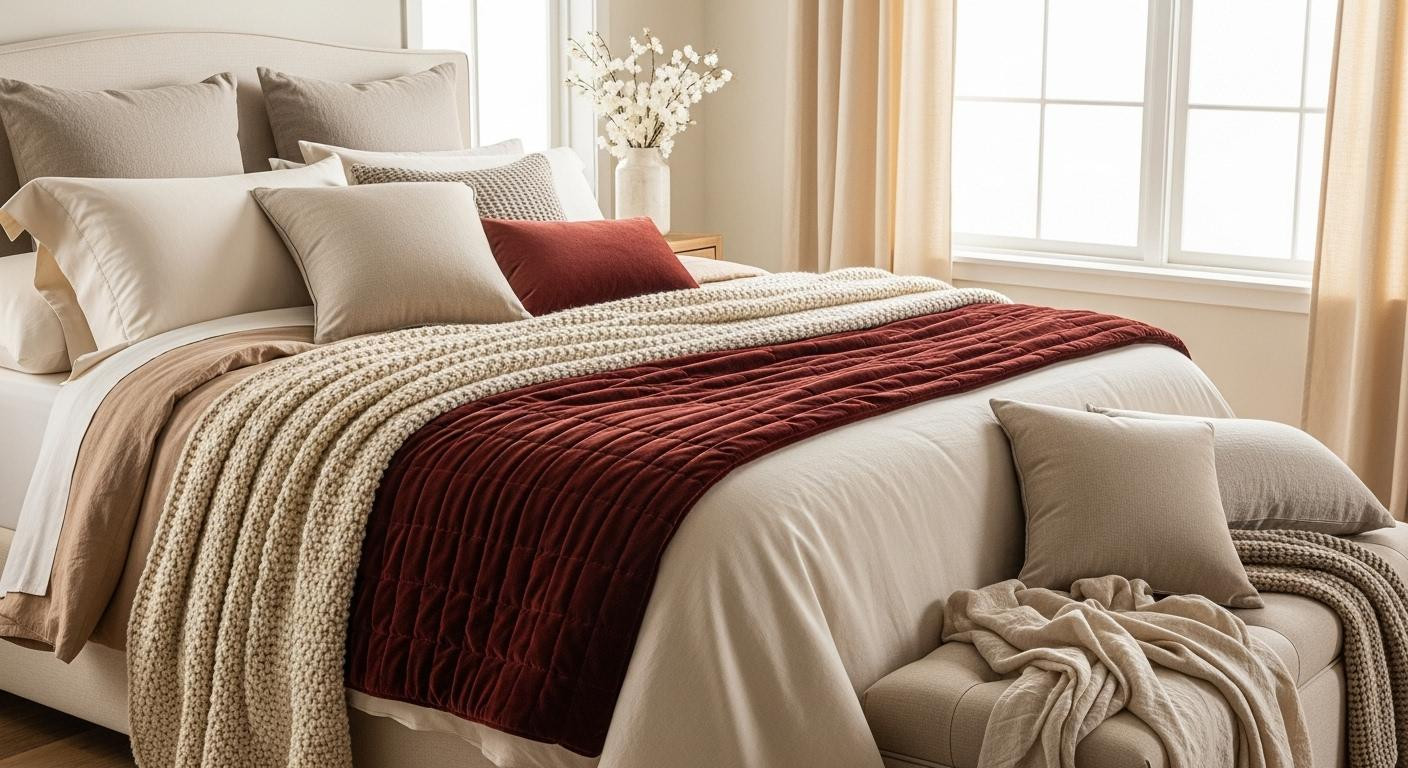
Layer four is the game-changer. This mid-weight knit throw in a contrasting tone sits folded at your bed’s foot in a triangle fold. Choose bouclé, chenille, or chunky knit materials weighing 12 to 18 ounces per square yard. Budget decorators featured on Apartment Therapy confirm you’ll spend $40 to $80 at Pottery Barn, West Elm, or Anthropologie. This creates the expensive-looking depth you crave because it’s the texture interrupt that breaks visual monotony between your sheets and duvet.
Layer five is your duvet or comforter, the primary visual anchor everyone already owns. Down alternative fills work perfectly at $89 from Target Casaluna or $150 to $300 for organic cotton from Pottery Barn. The key isn’t spending more on this layer. It’s choosing warm neutrals like cream, oatmeal, or greige instead of stark white. Lighting designers with residential portfolios note that soft neutrals create visual warmth that stark white rooms lack during winter months. Fold your duvet down one-third from the top to reveal the layered foundation beneath.
Layers 6 to 7 plus pillow strategy complete the invitation
Layer 6 signals luxury through decorative accents
Your sixth layer is a decorative throw draped asymmetrically across your duvet’s corner. This isn’t about functional warmth anymore. Velvet, faux fur, or wool tartan in $30 to $80 range from HomeGoods or Zara Home creates pure visual richness. According to design professionals, this layer says styled intentionally rather than functional necessity. The asymmetric drape adds dimensional shadow play that photographs beautifully and feels deliberately curated when you walk into your bedroom each evening.
Layer 7 and pillow architecture finish the tactile experience
Layer seven introduces silk or satin pillowcases in 19 to 22 momme weight for durability and luster. Amazon Bedsure dupes cost $20 to $30 while West Elm versions reach $50. These regulate temperature and reduce hair friction during sleep. Now add pillow architecture using the hotel five-pillow formula. Start with two standard sleeping pillows measuring 20 by 26 inches. Layer two Euro shams behind them at 26 by 26 inches. Finish with one lumbar accent pillow in front at 12 by 20 inches.
Professional stylists with client portfolios recommend mixing matte linen Euro shams with sheen silk pillowcases and textured knit lumbar pillows. This fabric interplay creates luxury shadow play throughout your layered bed. Use odd numbers because design psychology confirms asymmetry enhances depth perception. Your total pillow investment runs $100 to $200 across all tiers. Choose 80 percent neutral solids in oatmeal or navy for winter with 20 percent pattern accents like burgundy tartan for visual interest. For winter bedroom lighting ideas that complete this transformation, this guide to ambient layers shows the three-tier system designers use.
Why $300 layered beats $800 spent wrong
You previously invested $280 in three visible-plane items. An $89 duvet plus $120 in decorative pillows plus a $71 throw equals flat bedding that photographs in two dimensions. The hotel formula reallocates that same $300 budget across seven strategic layers instead. Spend $30 on a fitted sheet, $40 on a flat sheet, $50 on a lightweight blanket, $60 on a textural throw for layer four, $89 on your duvet, $45 on a velvet accent throw, and $30 on silk pillowcases. That totals $344 but creates three times the visual depth you had before.
Interior designers specializing in small spaces note the difference isn’t money spent but distribution architecture. One $120 decorative pillow adds zero dimension to your bed. Six $20 graduated pillows in varied sizes build an inviting sanctuary instead. You’re not buying more expensive materials. You’re investing in the invisible system that creates enveloping luxury through strategic layering rather than single statement pieces. The warm neutral bedroom approach pairs perfectly with this textile strategy, as explored in this color psychology guide for winter months.
Your questions about winter bed layering answered
How do I layer without overheating at night?
Thermal regulation is the hidden benefit of this system. Lighter base layers like a cotton sheet and breathable blanket trap less heat than a single heavy comforter. You adjust by removing or adding top decorative layers like throws four and six while sleeping under your consistent duvet. Hotels maintain steady temperatures year-round, but your home fluctuates between 65 and 72 degrees depending on thermostat settings. Remove your velvet throw on warmer winter nights. Keep your knit throw at the foot for 3am temperature drops. The multi-layer approach outperforms single comforters by allowing peel-back flexibility throughout the night.
What if my bedroom is only 150 square feet?
Layering makes small bedrooms feel more luxurious, not cramped. It’s vertical dimension rather than horizontal sprawl that creates visual impact. Focus on graduated pillow heights that create depth without requiring floor space. Professional organizers with certification confirm folded throws maintain clean lines better than draped versions in tight quarters. Design experts note one statement element like a properly layered bed grounds small rooms rather than overwhelming them. The technique works in 100 to 150 square foot rentals just as effectively as 200 to 300 square foot primary bedrooms. Avoid the common mistake of over-layering by reading this guide to strategic restraint in textile styling.
Can I use what I already own?
Absolutely audit your current pieces first. You likely own a duvet for layer five, one throw for layer four or six, and sleeping pillows already. You’re missing a flat sheet for layer two at $25, a lightweight blanket for layer three at $40, a second textural throw at $50, two Euro shams at $60 total, and silk cases at $30. That’s a strategic $205 addition completing the hotel formula using your existing $280 investment as the foundation. You’re not starting over. You’re filling the invisible gaps that prevent your current bedding from achieving dimensional luxury. The wall color behind your bed matters too, as detailed in this exploration of dark walnut tones for winter warmth psychology.
Eight December evenings later, you slide into your transformed bed. Cool silk touches your cheek first. Your fingertips find the soft bouclé throw folded at the foot. Dimensional pillows cradle your shoulders in graduated support. The bedroom measures the same 200 square feet it always did. The bed feels like a completely different sanctuary. That’s the invisible mathematics of invitation working exactly as hotels designed it to work.
All Almanac scores in this article are produced by the JM Editorial Team’s World Sleep Almanac methodology, applied identically to every mattress we feature.
If this article reached you, you’re already considering a serious sleep upgrade. Saatva’s 365-night home trial means you can test the mattress for a full year before committing — and the lifetime warranty holds without proration. Click below for today’s price.
Affiliate disclosure: World Sleep Almanac is reader-supported. When you buy through links on this page, we may earn a commission at no additional cost to you. Almanac scores are produced by the JM Editorial Team using the World Sleep Almanac methodology applied identically to every mattress we feature.