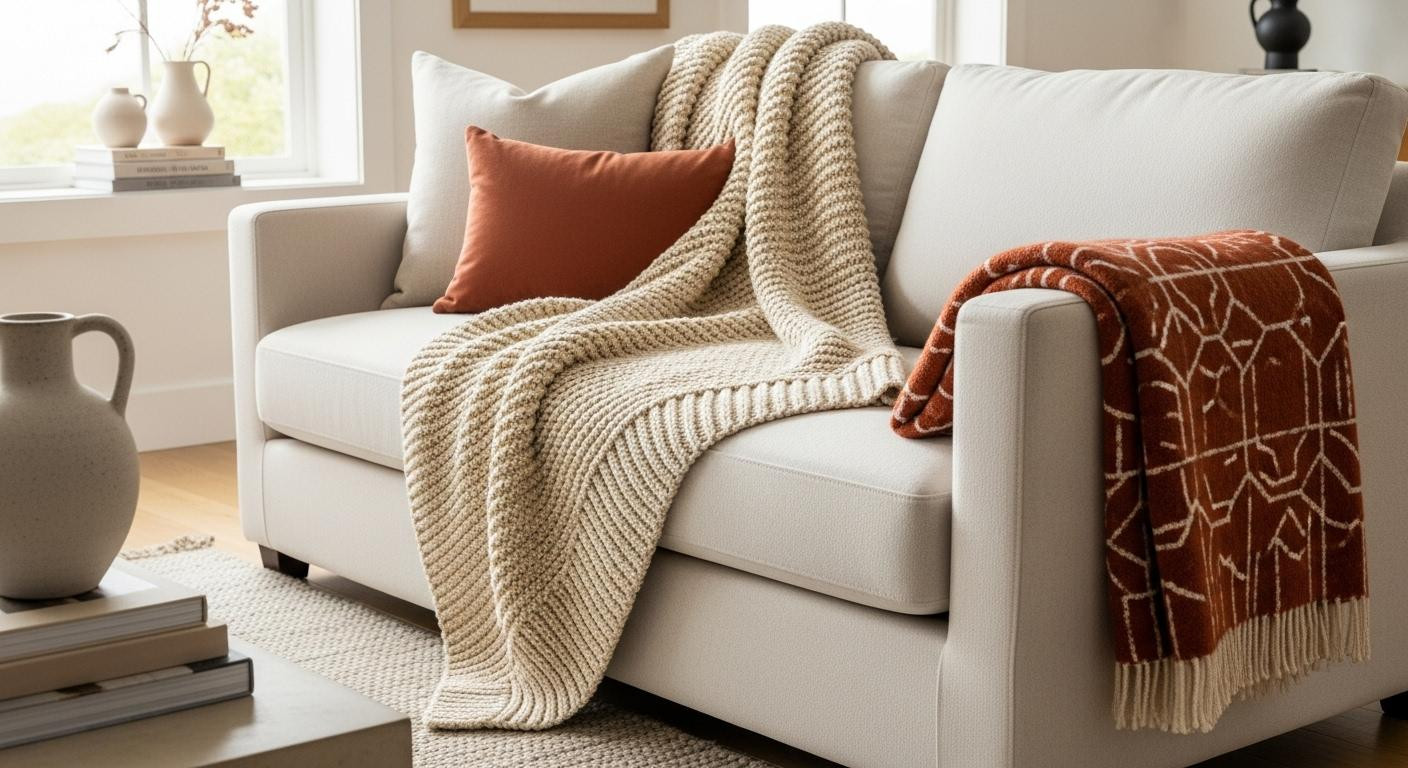
You stand in your living room counting throw blankets. Seven layers drape across the sofa, three more stack on the ottoman, two cascade from the armchair. The Pinterest boards promised luxury. Your room feels cluttered instead. Interior designers with ASID certification see this mistake weekly. They use three strategic layers to create hotel-level opulence, not seven random throws competing for attention.
Why 5+ blankets cheapen rooms (the texture confusion designers see)
Visual clutter occurs when similar-texture blankets fight for attention. Design professionals specializing in residential interiors call this texture noise rather than layered depth. Your eye processes three distinct visual layers comfortably before triggering stress responses.
Retail stores display 15+ throws simultaneously to drive impulse purchases. This conditions shoppers to believe quantity equals luxury. The opposite proves true in actual living spaces. Textile experts featured in design publications confirm that bold patterns add sophistication only when not competing with four other busy prints.
Survey data shows consumers average 3.4 sheet sets per bed, with 71% owning three or more complete sets. This baseline suggests over-layering already dominates American homes. The luxury bedding industry stocks two full bedding sets per hotel room, rotating for freshness while marketing abundance to guests who interpret excess as opulence.
The 3-layer texture formula that looks expensive
Professional stylists with textile design backgrounds build luxury through strategic hierarchy. The formula requires one smooth foundation, one tactile middle, one personality accent. This structure prevents visual overload while creating photographable depth.
Base layer: smooth foundation (linen, cotton, matelassé)
The invisible anchor establishes calm visual space. Cream linen duvets at 300-600 thread count or cotton matelassé coverlets provide light-reflective surfaces. This prevents texture overload before you begin layering.
Matelassé weave adds subtle dimension without bulk. Optimal weight measures 200-400 gsm for year-round breathability. This three-material hotel bed formula demonstrates how professional bases anchor entire compositions.
Mid layer: tactile depth (chunky knit, boucle, waffle weave)
The sensory hero carries 60% of perceived luxury according to trend forecasters. Chunky knit throws measuring gauge 5-7mm create loft that photographs beautifully. Boucle loops at 3-5mm depth invite touch without overwhelming smaller spaces.
Drape this layer asymmetrically at 30-45 degree angles. Fold edges to reveal 40% of the smooth base beneath. This contrast creates rhythm your eye follows naturally. Budget options from Target start at $25-40 while West Elm’s cumin rug blanket hybrid reaches $159 for mid-tier quality.
Top layer: personality accent (bold pattern, contrasting color)
The finishing touch measures smaller than foundational layers. Throws sized 40×50 inches for chairs or 50×60 inches for sofas prevent overwhelming carefully built compositions. Geometric prints with 1-2 inch repeats or botanical patterns at 4-6 inch scale add interest without chaos.
Terracotta, rust, and deep olive tones align with 2025 color forecasts. Design experts recommend folding this accent layer casually rather than perfectly. The slight disorder signals lived-in luxury versus staged showroom stiffness. Winter duvet layering techniques translate directly to living room applications.
Shopping the 3-layer stack (budget to luxury spectrum)
The texture formula works at every price point. Visual impact matters more than thread count when building foundational collections. Professional organizers with certification confirm that strategic layering achieves 70-80% of luxury aesthetics at budget prices.
Budget execution: $100-150 total investment
IKEA’s chunky throw blankets start at $29 for wool-acrylic blends. Target’s boucle bases range $25-40 with four-star durability ratings. Amazon’s patterned accent throws cost $35 with free Prime shipping.
This $89-104 combination mirrors luxury compositions through texture hierarchy alone. Textile specialists note that synthetic boucle performs identically to natural fibers in visual tests. Machine washability adds practical value for homes with pets or children. Small space cabin formulas demonstrate how budget layers transform compact living rooms.
Investment approach: $500+ for heirloom quality
Restoration Hardware’s Italian wool throws start at $300 with 10-year fade resistance. Pottery Barn’s heirloom matelassé lines range $200-400 for bases that improve with washing. West Elm’s handwoven accents cost $159-225 for artisan-printed patterns.
The buy-once philosophy applies to base and mid layers exclusively. Rotate top accent layers seasonally for $50-150 refresh budgets. Investment pieces carry transferable value through multiple home moves. Professional appraisers note that quality wool blankets retain 60% resale value after five years of use.
Multi-room application (bedroom, sofa, reading nook versatility)
The same three-layer principles transform every textile surface in your home. Bedroom applications require different drape widths than living room sofas. Queen beds need 80×20 inch foot-of-bed folds while king sizes extend to 100×20 inches.
Living room sectionals place one complete three-layer stack per cushion arm. Standard sofas accommodate single oversized throws as top layers. Coordinate ottoman blankets with mid-layer textures from nearby seating. Interior designers specializing in small spaces achieve luxury in 200-400 square foot rooms through this portable formula.
Reading nooks pair accent chairs with 40×50 inch top layers only. The reduced scale prevents overwhelming intimate spaces. Rental-friendly advantages include complete portability and zero wall damage. Compact hygge applications prove the formula works in studio apartments.
Seasonal rotations take 10 minutes per room. Store vacuum-sealed accent blankets to save 60% closet space. Swap rust terracotta for spring sage while maintaining base investments. Professional stylists with visual merchandising backgrounds recommend photographing your winter stack before storage. This creates easy reassembly templates for next December.
Your questions about layered blankets answered
Can I mix patterns in the 3-layer stack?
Yes, but follow scale rules strictly. If your base shows subtle linen weave, keep mid layers solid in chunky knits. Reserve bold geometric or botanical prints for top accents exclusively. Never mix two or more busy patterns simultaneously. This causes the texture confusion professional designers avoid in client homes.
What if I live in a warm climate?
Adjust material weight rather than layer count. Lightweight cotton waffle bases under 300 gsm replace heavy duvets. Linen mid layers provide visual texture without thermal overload. Gauze accent throws maintain depth perception in hot weather. The three-layer formula creates luxury through visual hierarchy, not insulation alone.
How do I store off-season accent layers?
Vacuum-seal top accent blankets in space-saver bags. This saves 75% closet space while protecting from dust and moths. Keep base and mid layers accessible year-round since they anchor all seasonal rotations. Label sealed bags with colors and patterns for quick identification. Spring sage, fall rust, and winter grey accents rotate through the same foundational stack.
December evening light catches the edge of a chunky oat throw draped across your sofa arm. Beneath it, cream linen creates visual calm. Above, a rust geometric accent adds personality without chaos. Three strategic layers replace the seven competing blankets from this morning. Your living room finally achieves the Pinterest aesthetic you saved months ago.