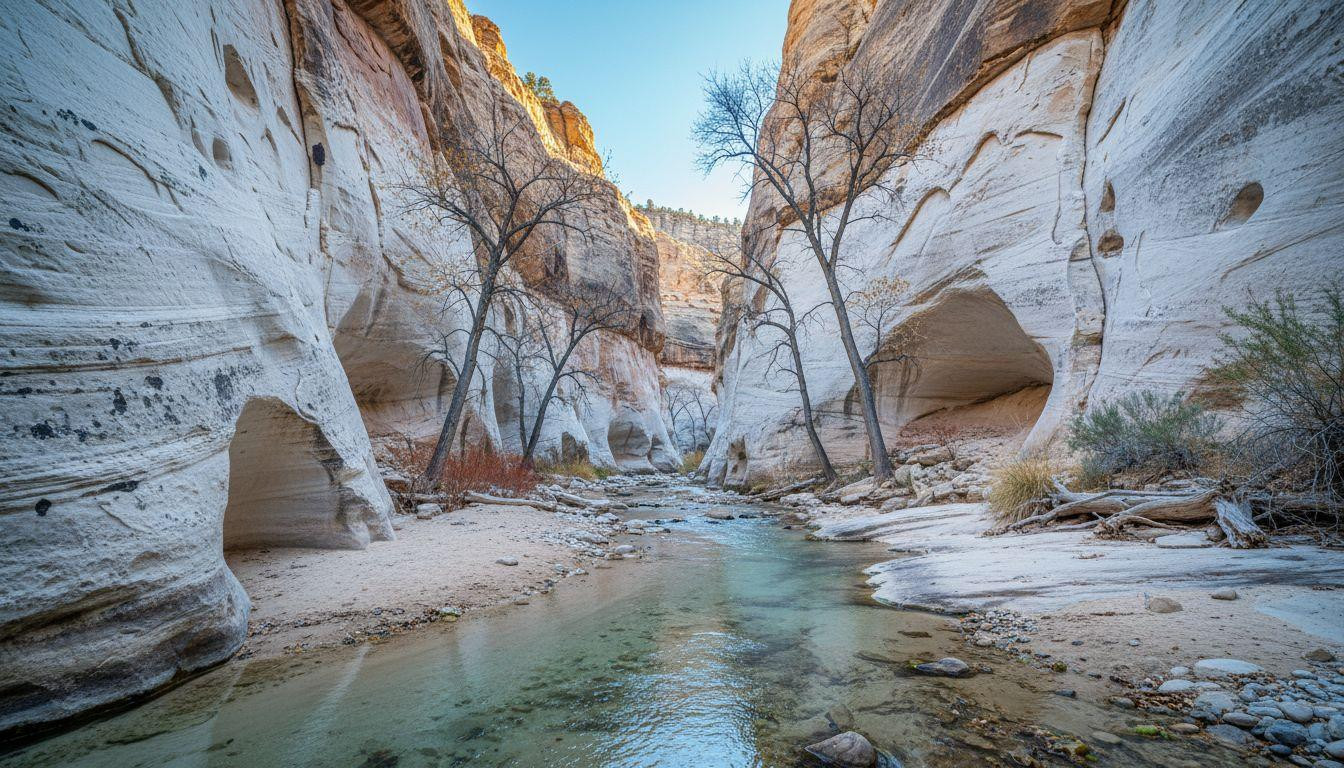
Winter silence fills Halls Creek Narrows where white Navajo sandstone walls tower 1,200 feet above a perennial stream few Americans discover. This remote slot canyon in Capitol Reef’s Waterpocket Fold requires 56 miles of dirt road access and cold water wading through 15 distinct segments. While Zion Narrows processes 300,000 visitors annually, fewer than 100 people complete this 20-25 mile winter journey each year.
Segment 1: Halls Creek Overlook where 4WD roads end and silence begins
The trailhead sits at 5,800 feet elevation with parking for just 2-3 vehicles. Cell service cuts off immediately upon arrival. Winter temperatures here average 41°F during the day, dropping to 21°F at night.
High-clearance vehicles navigate the final 3 miles of rough dirt road. Standard cars must park earlier and add hiking distance. Remote canyons across the Southwest demand similar vehicle requirements for backcountry access.
Segments 2-5: The exposed descent through ancient geology
The initial descent drops 900 feet over exposed slickrock switchbacks. Winter ice forms on north-facing sections, requiring traction devices. Water remains scarce until reaching Fountain Tanks approximately 5 miles down.
Hall Creek junction where streams converge
Ankle-deep water marks the first stream crossing at Hall Creek Junction. Cottonwoods provide camping opportunities with proper backcountry permits. All water requires filtration due to giardia risk from wildlife upstream.
Pre-narrows approach through the waterpocket fold
Red Slide hoodoos become visible as the canyon widens before narrowing again. Exposed sections create dramatic temperature swings between shade and sun. Binoculars reveal distant arches carved into canyon walls.
Segments 6-9: The narrows core where walls close in
White Navajo sandstone walls begin their dramatic rise at the narrows entrance. Alcove camping becomes possible with 2-3 tent capacity maximum. Morning light doesn’t reach the canyon floor until after 9am in winter months.
Deep alcove chambers create cathedral acoustics
Walls reach their full 1,200-foot height in cathedral-like chambers. Complete midday shade provides relief from desert sun but amplifies winter cold. Echo effects make conversation carry surprisingly far through the narrow passages.
Narrow slot core demands shoulder squeezes
The tightest sections narrow to 18-24 inches, requiring backpacks under 3,000 cubic inches. No bypass routes exist if water levels rise from flash floods. Photography becomes challenging due to limited light penetration between towering walls.
Segments 10-12: Side canyon exploration and upper reaches
Unnamed arch detours add 0.5-mile scrambles to hidden formations. Winter exploration opportunities extend throughout Capitol Reef’s backcountry. Petrified wood scatter areas require leave-no-trace observation protocols.
Upper narrows sections may require swimming in chest-deep pools. Water temperatures hover between 35-45°F in winter, colder than Zion’s comparable passages. The 3.8-mile turnaround point marks most hikers’ deepest penetration into the slot system.
Segments 13-15: Return journey and final ascent
Return alcoves provide extended shade but accumulate ice buildup during winter mornings. Quiet wilderness experiences like this remind visitors why solitude matters. The final 1,000-foot climb back to the overlook tests endurance after 20-25 miles of desert hiking.
Cottonwoods display yellow fall colors that persist into early winter. Stream water becomes increasingly muddy on the return journey. Zero cell service continues until reaching the trailhead parking area at journey’s completion.
Your questions about Halls Creek Narrows winter backpacking answered
What permits and costs are required for winter access?
Backcountry permits cost nothing but must be obtained in-person at Capitol Reef Visitor Center. High-clearance vehicle rentals in nearby Torrey cost $100-150 per day. Gas for the 56-mile dirt road approach costs approximately $20-30 roundtrip.
How does winter difficulty compare to summer conditions?
Winter wading through 35-45°F water creates hypothermia risks absent in warmer months. However, flash flood dangers decrease significantly compared to July-September monsoon seasons. Technical hiking challenges require cold-weather gear and neoprene protection.
Why do fewer than 100 people complete this annually versus 300,000 at Zion Narrows?
The 56-mile dirt road approach deters casual visitors seeking easy access. Free permits eliminate lottery systems but demand in-person collection. Self-reliant navigation skills become essential where GPS signals fail in narrow slot passages.
Morning light touches white sandstone walls as hikers emerge from cathedral chambers. The Waterpocket Fold stretches endlessly beyond the overlook. Winter silence returns.