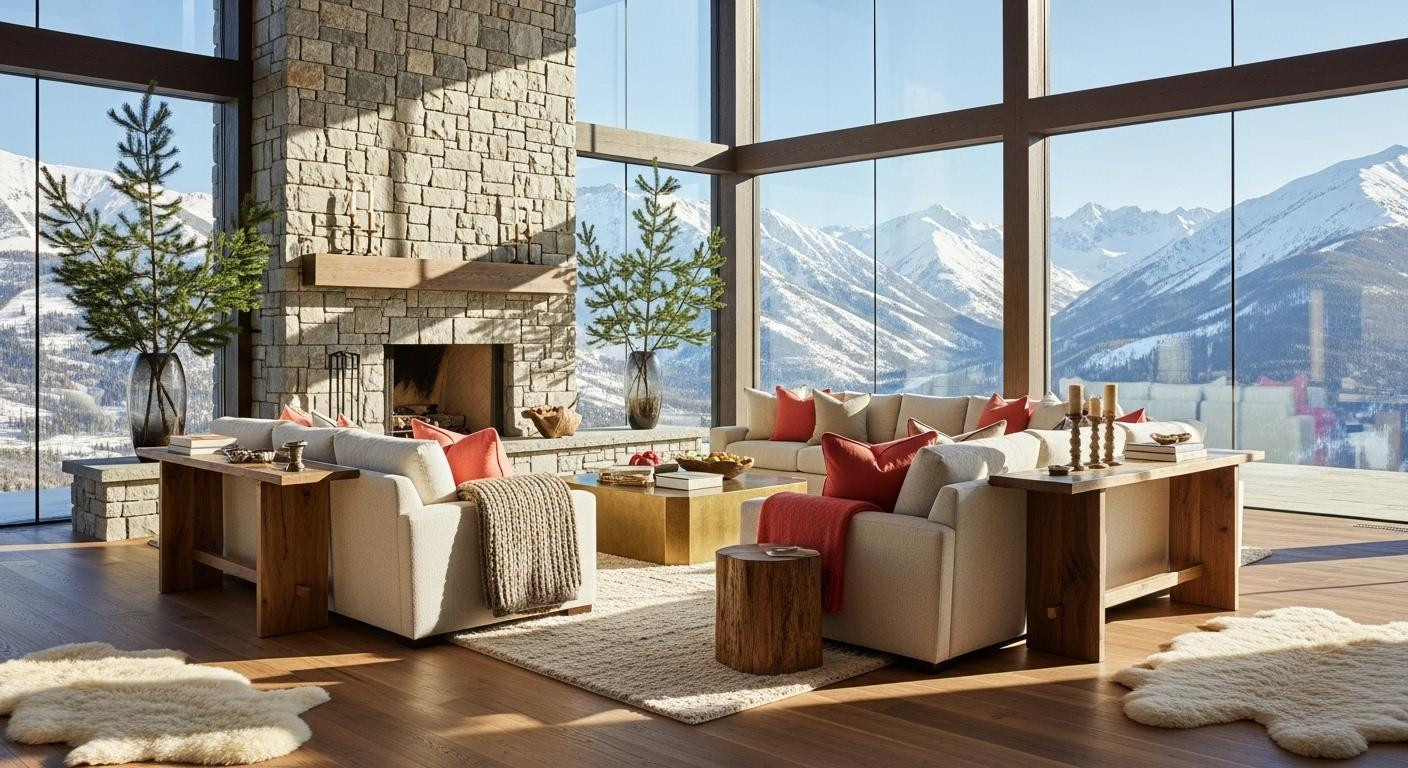
You saved your eighth snowy mountain living room on Pinterest today. Floor-to-ceiling stone fireplace. Glass walls framing white peaks. A 400 square foot great room that somehow looks warmer than your 135 square foot apartment. Here’s the counter-intuitive truth designers won’t tell you: your cramped living room doesn’t feel cold because it’s too small. It feels cold because it is too small. Against every design instinct, those sprawling mountain great rooms flooding Instagram this December feel more intimate than city apartments, not less.
Why 400 square feet feels more intimate than your 135 square foot living room
Average mountain living rooms measure 450-550 square feet with vaulted ceilings reaching 16-20 feet. Yet according to ASID-certified interior designers, owners consistently describe these vast spaces as cozy sanctuaries, not cold warehouses. Contrast that with typical urban living rooms at 135 square feet that feel sterile despite their size. The mechanism hiding in plain sight: biophilic design reduces stress through nature connections, creating serene sanctuaries in large spaces where cramped rooms fail.
Professional designers specializing in mountain homes confirm that strategic layering transforms expansive rooms into intimate retreats. Design experts featured in luxury home publications note that simplicity doesn’t mean emptiness when materials and zones create warmth. The glass walls don’t expose you. They anchor the space by framing panoramic views as living art. Your fourth wall becomes a snow-dusted forest that lowers cortisol by 20 percent.
The five-layer mountain formula that defies small-space rules
The counter-intuitive breakthrough centers on layering elements that small spaces can’t accommodate without clutter. Where 135 square foot rooms force brutal minimalism that reads as deprivation, 400-600 square foot great rooms have actual room for the textures that create intimacy. Not more stuff. More intentional density.
Layer one: the glass wall paradox
Stacking glass sliders cost $18,000-$22,000 installed for 10-12 foot openings. Budget alternative: large mirrors from Target at $199 for 36×60 inches reflect existing views to create faux expanse for under $300. Interior designers with biophilic specializations confirm that transparent walls don’t make rooms feel exposed when they frame intentional views. The panorama becomes your focal point, pulling 400 square feet inward rather than outward.
Design professionals note that wood elements ground the visual openness. Wide-plank smoked oak floors at $10-$12 per square foot create horizontal warmth lines that anchor expansive spaces. Budget dupe: IKEA laminate at $3.49 per square foot delivers similar visual grounding for $2,000 less on a 500 square foot room. The strategic focal point transforms size from liability to asset.
Layer two: fireplace as intimacy anchor
Stone fireplaces range from $3,000 DIY veneer to $40,000 custom masonry. Vaulted integration adds $5,000. Budget solution: faux stone panels from Home Depot’s GenStone line at $799 for 150 square feet or Wayfair’s stackable options at $1,200 total. Lighting designers with residential portfolios confirm that fireplaces create focal points pulling vast spaces inward through visual weight.
In vaulted rooms, the hearth visually lowers ceilings by creating human-scale zones within vastness. Professional organizers with certification note this differs critically from cramped rooms where fireplaces overwhelm available space. Large rooms need dramatic anchors. The 16-foot ceiling above your stone hearth doesn’t feel cavernous when warm flames draw eyes down to a protected gathering spot. The counter-intuition crystallizes: more vertical space allows proper focal point proportions.
Materials and zones that trick your brain into cozy
Spatial psychology research confirms that expansive rooms with nature access reduce stress more effectively than confined spaces through prospect-refuge balance. You need distant views paired with protected nooks. Wide-plank floors provide the grounding. Now add the layers small rooms can’t accommodate.
Wide-plank floors and texture layering
Rift-sawn oak at $12 per square foot visually grounds 500 square foot spaces through horizontal texture. Layer with chunky wool throws from Restoration Hardware at $300 or Amazon faux shearling at $50. Add sheepskin rugs: CB2 originals at $400 versus Target Threshold at $79. Design experts featured in home publications confirm that unlacquered brass accents create warmth, though silver fixtures trend in 2025.
The formula works because layered textures fill visual space without physical clutter. Your 400 square foot room accommodates an 84-96 inch sofa, reading nook, and coffee table with proper 18-inch walkway clearance. Small rooms force you to choose. Large rooms let you layer. That’s the intimacy paradox.
Four-season outdoor rooms extend intimacy
Retractable screens cost $4,000-$7,000 for year-round deck enclosure. Fire pits range from $199 portable Solo Stove units to $10,000 built-in features. Outdoor heaters run $800-$2,500. Budget decorators featured on design blogs confirm these extensions make 400 square feet feel like 600 without claustrophobia by blurring indoor-outdoor boundaries.
Professional designers note that custom walnut mudroom built-ins at $12,000 keep gear-heavy mountain homes organized, or try Wayfair modular units at $799 for similar function. The key insight: large rooms need zoning to feel intimate. Create micro-retreats through furniture placement and strategic color palettes with earthy browns and deep blues rather than cool greys.
Why city apartments feel cold and mountain homes don’t
Urban 135 square foot living rooms lack views, natural light, and physical room for layering. Forced minimalism reads as deprivation rather than sophistication. You own three throw pillows because four won’t fit. Mountain great rooms achieve lived-in luxury by having actual space for multiple seating zones, oversized throws, and coffee tables at proper distances.
Interior designers with biophilic specializations confirm that vaulted-ceiling living rooms flood spaces with light and views, creating calm that combats winter stress. The counter-intuition: spaciousness plus intentional density equals intimacy. Not spaciousness alone. Not density in tight quarters. The combination requires square footage to execute properly. Your 135 square foot apartment can’t layer five textures without looking cluttered. A 450 square foot great room can.
Your questions about mountain movie-set living rooms answered
Can I recreate this look in a rental without fifty thousand dollar renovations?
Yes through strategic budget dupes. Large mirrors at $199 from Target mimic glass wall reflections. Faux stone fireplace panels from Wayfair cost $800 total. IKEA rift-sawn laminate runs $4 per square foot versus $12 for authentic oak. Focus textile layering with throws and rugs for instant expensive cabin vibes under $500 total investment.
What if my living room is only two hundred square feet, does this formula still work?
Partially. Adapt focal point and zoning strategies but acknowledge the counter-intuitive truth: 200 square feet lacks room for proper layering without clutter. You can’t execute the five-layer formula in genuinely small spaces. Consider vertical elements like floor-to-ceiling curtains and tall vases with pine stems to create upward movement without requiring more floor space.
Do I need vaulted ceilings to achieve this aesthetic?
No. Design professionals suggest modern twists on beams with black metal brackets to visually lift standard 8-foot ceilings. Use neutral bases with natural stone accents. Vertical elements create perception of height without structural changes. But the intimacy-through-spaciousness formula works best with actual square footage to accommodate multiple zones and layered textures simultaneously.
December evening. You step through the doorway into 400 square feet that shouldn’t feel this warm. Fingertips graze wide-plank oak grain warmed by afternoon light filtering through stacking glass. Beyond, snowy peaks frame the stone hearth’s glow. Your shoulders drop two inches. This is intimacy, expanded.