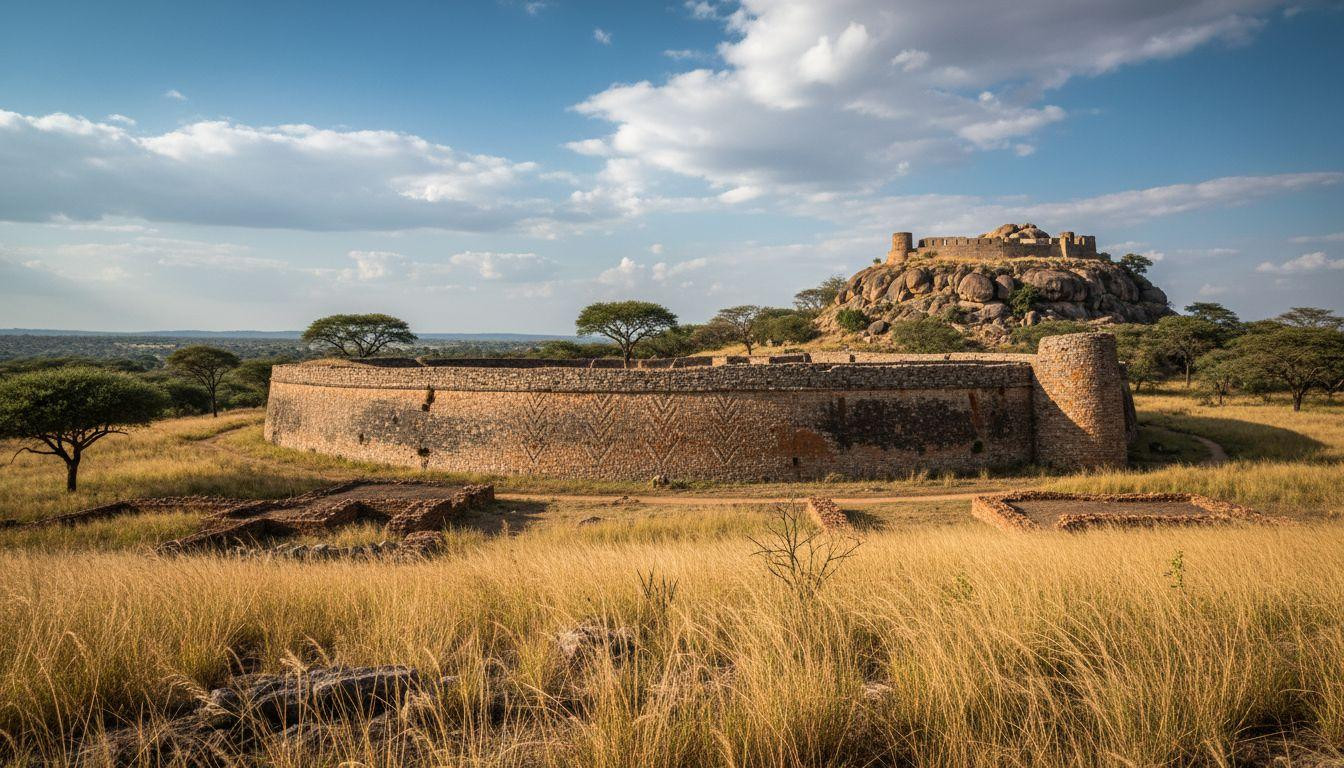
Eleven-meter granite walls stand without a single drop of mortar, defying 800 years of African weather. Great Zimbabwe’s dry-stone masonry rises from golden savanna grass like an engineering miracle that colonial powers refused to believe Africans could build. The chevron patterns carved into these towering walls tell a different story: one of sophisticated Shona civilization that traded gold with China and Persia centuries before Europeans arrived.
This mortarless masterpiece sprawls across 500 miles of southeastern Zimbabwe’s lowveld, 17 miles from Masvingo. While Machu Picchu crowds photograph the same Incan stones, Zimbabwe’s equally sophisticated ruins see fewer than 50,000 visitors annually. The May-August dry season transforms this overlooked UNESCO site into a photographer’s paradise of golden light and empty pathways.
8 zones where ancient engineering meets untouched savanna
Great Zimbabwe divides into distinct archaeological areas, each revealing different aspects of medieval African civilization. The site spans 1,800 acres of granite outcrops and acacia woodland. Visitors typically need 3-4 hours to explore the major zones, though many return for sunrise photography sessions.
Hill Complex: Royal residence above the clouds
The oldest section climbs 295 feet above the valley floor. Stone platforms blend seamlessly with natural granite boulders. Ancient pathways snake between ritual sites where Shona kings once commanded a population of 18,000 souls.
Morning mist often shrouds these heights until 9am. Tanzania’s eastern coastline shares similar early morning atmospheric magic. The climb takes 45 minutes at a leisurely pace, with rest stops at carved platforms.
Great Enclosure: Where physics meets artistry
The elliptical outer wall stretches 820 feet in circumference. These curved granite barriers reach 36 feet high without buttresses or foundations. The mysterious Conical Tower stands 29 feet tall, its purpose lost to time.
Chevron patterns decorate the inner walls like ancient fingerprints. Each stone was shaped by hand and fitted with mathematical precision. Afternoon light transforms these patterns into shadow art across the enclosure floor.
Valley Ruins: Medieval suburbs preserved in stone
Scattered dhaka platforms mark residential areas where craftsmen and traders lived. These mud-brick foundations supported timber houses roofed with thatch. Archaeological evidence reveals sophisticated drainage systems and grain storage facilities.
Local guides share oral histories passed down through Shona families for generations. According to regional visitor centers, these stories often contain accurate details about trade routes and royal ceremonies. The residential areas cover roughly 200 acres of the total site.
Engineering that colonial myths couldn’t explain
European explorers in the 1870s attributed these ruins to biblical figures like the Queen of Sheba. They refused to believe African civilizations could achieve such architectural sophistication. Archaeological evidence has thoroughly debunked these racist fabrications.
The mortarless mystery solved
Shona masons used a technique called battering: walls slope slightly inward for structural stability. Over 15,000 tons of granite blocks interlock without cement or mortar. Each stone’s weight and position creates the overall strength.
Recent conservation work reveals the engineering’s genius. Tree roots now threaten some sections, but the original construction has survived eight centuries of seasonal expansion and contraction. Greek monasteries employ similar stone-fitting techniques but with mortar assistance.
Trade networks spanning three continents
Museum displays showcase Chinese porcelain, Persian glass beads, and Arabian coins found throughout the ruins. The Zimbabwe Bird soapstone carvings became national symbols appearing on the country’s flag. Six of these intricate sculptures were discovered in the Eastern Enclosures.
Gold mining and cattle trading generated enormous wealth. Ivory exports reached Indian Ocean ports via Swahili merchants. This economic powerhouse controlled regional trade from the 11th to 15th centuries, connecting Africa to global markets.
Planning your journey to Zimbabwe’s crown jewel
Entry fees cost $6 per person plus mandatory guide services for $3-5 additional. The site opens at sunrise and closes at sunset year-round. Most visitors combine Great Zimbabwe with gold rush heritage sites or Victoria Falls safaris.
Masvingo town offers accommodation from budget guesthouses at $35/night to luxury lodges reaching $180/night. The Lodge at the Ancient City provides closest access with expanded treehouse units opening in 2025. Remote island ruins require similar advance planning for accommodation.
The 168-mile drive from Harare takes 4 hours on paved roads. Car rental costs $60-80 daily plus $50 fuel for the round trip. Zimbabwe visa-on-arrival costs $45 for US citizens as of 2025. Alternatively, day tours from Harare range from $180-350 per person including transport and lunch.
Your questions about Great Zimbabwe answered
What’s the best time to visit for photography?
May through August offers optimal conditions with minimal rainfall and temperatures between 68-82°F. Golden savanna grass peaks in June-July, creating stunning contrast with gray granite walls. Morning and afternoon light angles enhance the chevron pattern shadows throughout the dry season.
How does Great Zimbabwe compare to other UNESCO sites?
The site covers 1,800 acres compared to Machu Picchu’s 800 acres, yet receives 30 times fewer visitors. Entry costs $6 versus Peru’s $65 international rate. Great Zimbabwe represents the largest medieval stone structure south of the Sahara, rivaling European castles in engineering sophistication.
Can you visit independently or are guides required?
Guides are mandatory for all visitors as of 2025, both for cultural respect and safety navigation. These local experts provide historical context often missing from written materials. Tipping $8-12 is customary for quality service. Independent exploration of outer wall networks is permitted with guide approval.
Sunset transforms the granite into amber while savanna winds whisper through ancient stones. The profound silence reminds visitors why this place commanded reverence for centuries. Fish eagles cry overhead as darkness reveals star patterns unchanged since Shona astronomers studied them from these very walls.