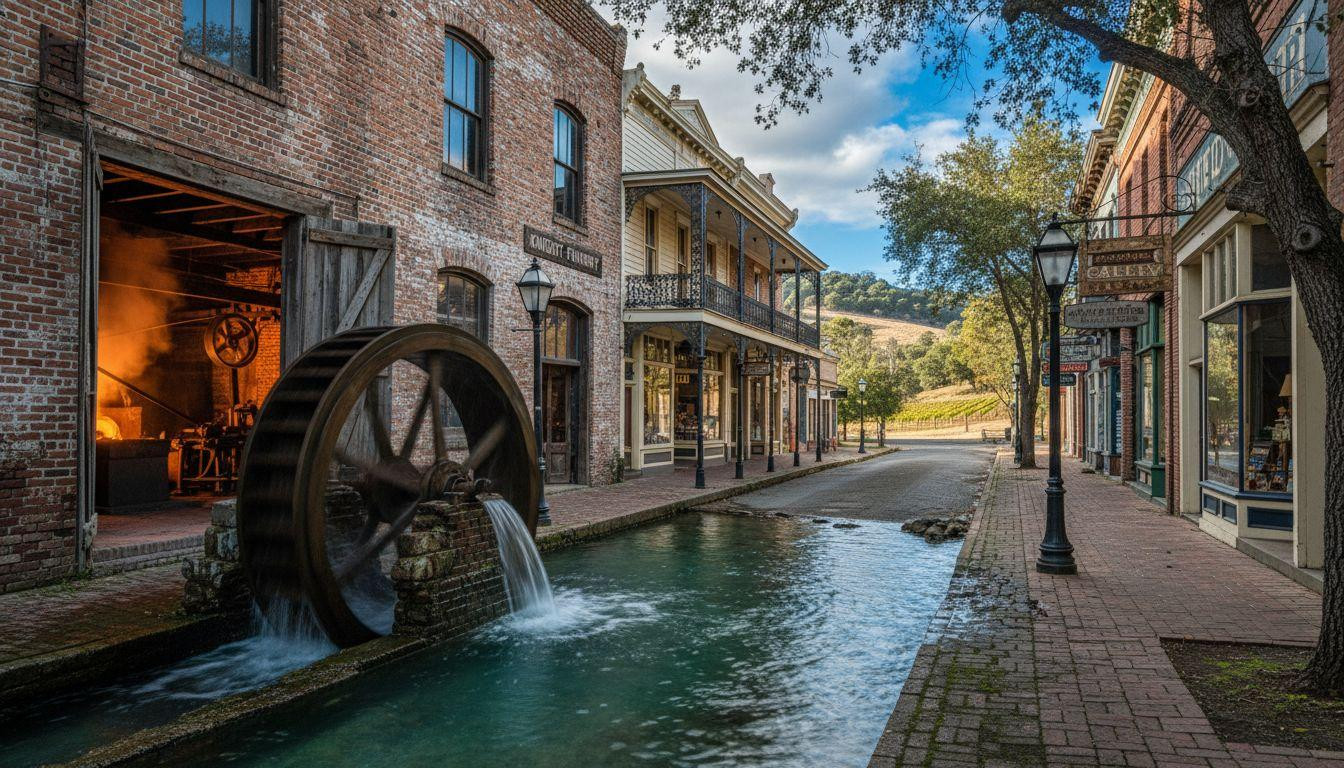
The rhythmic clang of hammer on anvil echoes through California’s Sierra Foothills as steam rises from the Knight Foundry’s forge. This is Sutter Creek, where water-powered machinery has operated continuously since 1873, making it America’s last functioning foundry of its kind. Victorian storefronts line Main Street with ornate iron balconies unchanged from Gold Rush days, while bronze mining statues stand eternal guard over artifacts in Miners’ Bend Park.
Where gold built California’s most authentic mining town
Founded during the 1849 California Gold Rush, Sutter Creek transformed from placer mining camp to hard rock mining powerhouse by the 1860s. The Kennedy Gold Mine plunged 5,912 feet deep, producing $34 million in gold before closing in 1921. Victorian architecture emerged as mining fortunes grew, creating the filigreed balconies and stone facades that earned National Historic Places designation.
The town sits 60 miles southeast of Sacramento along Highway 49, accessible in one hour by car. Population remains steady at 2,500 residents, preserving the intimate scale that larger Gold Country towns have lost. Winter temperatures hover between 40-55°F, ideal for exploring without summer’s 95°F heat.
The foundry that refused to die
Water-powered industry in motion
Knight Foundry operates on the 2nd and 4th Saturdays monthly, demonstrating sand-casting techniques using original 1873 machinery. The 42-inch Knight Wheel channels Amador Canal water at 120 psi pressure through line shafts and belts to power lathes, planers, and saws. Admission costs $15 for adults, $5 for students, free for children under 5.
December demonstrations include December 13 and 27, January 10 and 24. Docents explain how mining equipment was forged here and tested before heading to mines throughout California.
Living industrial heritage
The foundry produced everything from mining machinery to San Francisco streetlights during its 123-year operational period ending in 1996. Recent visitor surveys show the sand-casting demonstrations consistently rank as the most memorable Gold Country experience. Unlike dramatic Western landscapes, Sutter Creek offers hands-on industrial history visitors can touch and hear.
Walking through 150 years of Main Street
Victorian architecture preservation
Main Street stretches four blocks of original 19th-century storefronts with cast-iron balconies and detailed cornices. Sutter Creek Gallery showcases regional art jewelry while the historic Cheese Shoppe offers Amador County artisanal products. Free parking lines the streets, and walking from one end to the other takes 10 minutes.
The Monteverde Store Museum displays an 1896 general store that stocked everything from dynamite to dry goods, serving as the area’s commercial hub for decades.
Mining artifacts transformed
Miners’ Bend Park occupies a former parking lot now filled with bronze statues of gold miners and authentic mining equipment from the Argonaut and Sutter Gold Mines. Similar to preserved New England fishing villages, Chinese rock walls built by 19th-century immigrant laborers create picnic areas where families gather among history.
Wine country’s quieter alternative
Sierra Foothills American Viticultural Area surrounds Sutter Creek with wineries specializing in Zinfandel and Barbera varietals. Scott Harvey Wines offers tastings steps from Main Street, with bottle prices 20-30% below Napa Valley equivalents. Farm-to-table restaurants serve Amador County steaks with local cheese plates averaging $15-25 per meal.
Compared to Napa’s commercialized wine tourism, Sutter Creek maintains authentic small-town charm without crowds. Bed and breakfast accommodations range from $100-150 nightly, significantly less than wine country averages.
Your questions about Sutter Creek answered
When should I visit for the best experience?
Fall (September-November) offers mild 60-80°F temperatures with vineyard harvest colors and fewer crowds. Winter provides holiday-decorated Main Street with temperatures around 40-55°F, perfect for foundry demonstrations without summer heat. Spring brings wildflowers and 50-70°F weather, while summer reaches 95°F but offers the longest daylight hours.
How does it compare to other Gold Country towns?
Sutter Creek receives 200,000 annual visitors compared to Nevada City’s higher tourism volume, creating more authentic local interactions. Like European heritage villages, it preserves working traditions rather than just displaying artifacts. Costs average 15-25% below California state averages due to small-town scale.
What makes the foundry demonstrations special?
Knight Foundry represents the only water-powered foundry still operating in the United States. Visitors witness sand-casting using cupola furnaces and original belt-driven machinery exactly as miners experienced in 1873. The demonstrations accommodate 20-30 people per session, ensuring intimate group experiences with knowledgeable volunteers who explain each step of the metalworking process.
Morning light filters through oak canopies as the foundry wheel turns slowly in the canal water. Steam rises from the forge while hammers ring against anvils, continuing rhythms that have echoed through these Sierra Foothills for over 150 years.