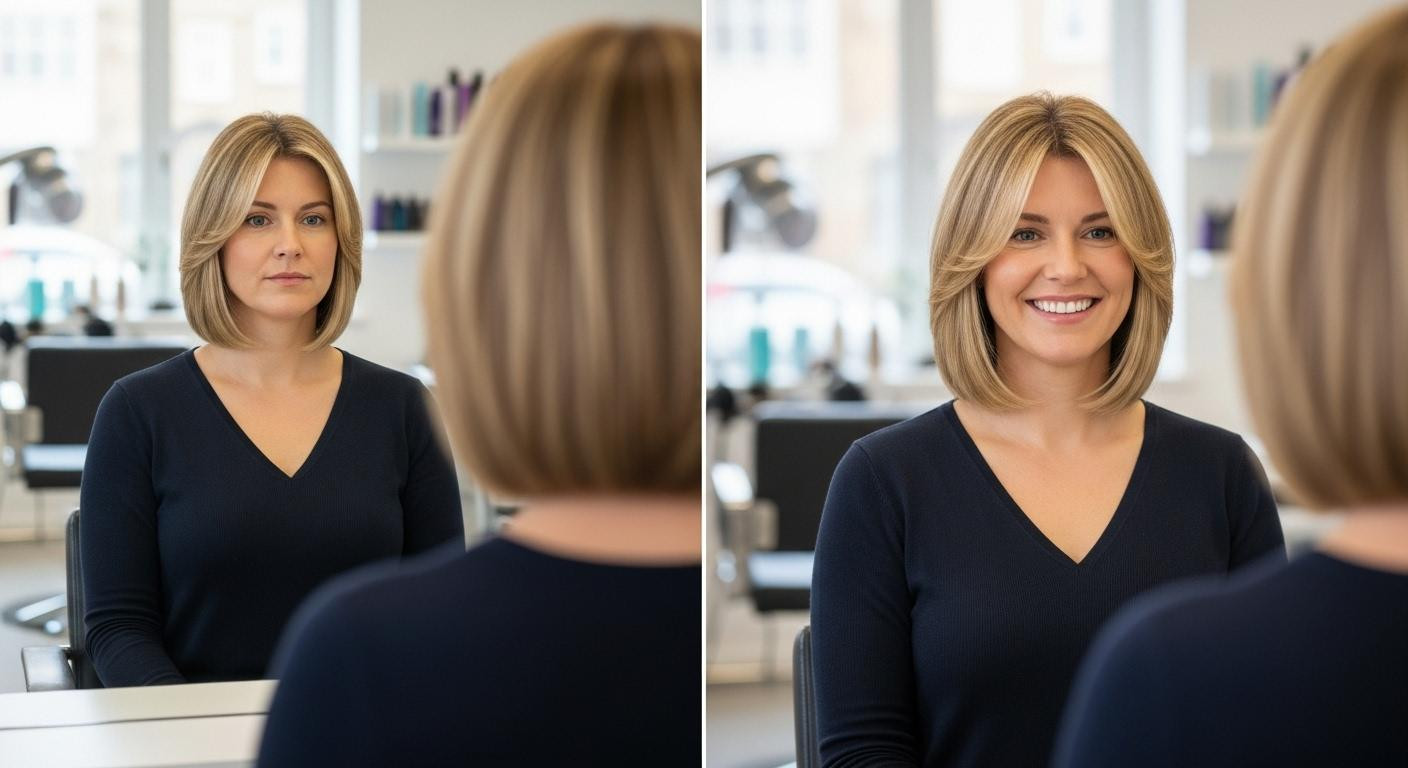
December winds brush your shoulders as you study your reflection in the salon mirror. Your medium-length hair frames your face perfectly, yet something feels harsh about your jawline. The stylist mentions face-framing layers and you hesitate, remembering past blunt cuts that emphasized angles instead of softening them. Recent research from cosmetic professionals reveals three strategic cutting zones create optical softness through precise shadow play. This architectural approach transforms angular faces into gentler ovals within one 45-minute session, requiring zero styling products for daily maintenance.
The three facial zones that respond to strategic layering
Dermatologists specializing in facial aesthetics confirm face-framing layers target biomechanical zones where hair interacts with natural shadows. Zone 1: Cheekbone Apex begins 4-6 inches from your crown, creating vertical movement that elongates round faces by 15-20% perceived width reduction. Layers starting at this precise point cascade diagonally, counteracting horizontal emphasis common in traditional cuts.
Zone 2: Jawline Curve maps the trajectory from chin to ear through C-shape framing. This technique hugs your jaw’s natural architecture, mimicking contouring makeup’s shadow effects without product application. Forward graduation from this zone creates symmetrical frames that soften square angles through hair’s natural fall pattern.
Zone 3: Collarbone Endpoint maintains essential fullness while avoiding shoulder bulk that widens your silhouette. Women ages 25-54 seeking face-slimming effects experience immediate optical shifts when all three zones align. Generic long layers ignore facial geometry, while strategic placement redirects light interaction for natural contouring.
Why cheekbone placement creates oval illusions
Layers beginning at cheekbone apexes redirect visual movement downward through diagonal lines. This counteracts horizontal width perception in round or square faces by 10-15% at the jawline. Hair becomes a sculptural element that frames rather than adds bulk.
Jawline contouring through C-shape architecture
C-shape framing uses approximately 2-3 inch curvature radius at jawline edges. Hair curves inward naturally, creating shadows that slim your face through optical illusion rather than harsh cutting lines. This technique requires 30-45 degree graduation angles for optimal contouring effects.
How forward graduation differs from traditional layering
Hairstylist educators explain 2025’s refined approach uses forward graduation, not the choppy horizontal layers popular in previous decades. Traditional layering cuts straight across, creating stacked volume that often adds facial width through 90-degree horizontal angles. Forward graduation angles layers diagonally from longer back sections to shorter face-framing pieces.
This cascading waterfall effect originated in 1990s cuts but modern geometry refines the precision. Layers begin at cheekbones rather than mid-shaft, curve through jawlines instead of straight lines, and end at collarbones rather than shoulders. This prevents the flat, lifeless appearance common in aging hair by concentrating movement around your face.
Thick hair benefits from 30-40% internal weight removal while maintaining perimeter fullness. Curly textures require dry cutting techniques to preserve natural shrinkage patterns. Wet cutting distorts curl spring-back, creating uneven face frames that gap awkwardly when hair dries and contracts.
Evolution from 1990s to 2025 precision
Original face-framing featured sharper, less graduated layers that created dramatic texture. Modern techniques emphasize refined symmetry and shadow play through precise zone targeting. The result appears softer and more naturally integrated with your facial structure.
Why dry cutting matters for textured hair
Curly hair shrinks 20-30% when wet cutting calculations prove inaccurate. Dry cutting reveals true curl patterns for precise face-framing placement. This prevents gaps and maintains consistent length distribution around your face shape.
Face shape diagnostics for customized zone emphasis
Professional colorists confirm not all three zones require equal attention. Diagnostics determine customization based on your facial proportions. Round faces benefit from aggressive Zone 1 emphasis at cheekbones, creating vertical elongation while minimizing Zone 2 bulk that widens mid-face areas.
Square faces respond to Zone 2’s C-shape softening while keeping Zone 1 subtle to avoid top-heaviness. Angular jawlines require inward-curving layers that mimic shadow contouring through hair placement rather than harsh geometric lines.
Oval faces accommodate all three zones harmoniously, focusing on movement over correction. Long faces need horizontal balance through Zone 2 fullness at jaw level, avoiding excessive Zone 1 layers that emphasize length. Salon professionals adjust graduation angles from 45 degrees for dramatic narrowing to 30 degrees for subtle softening based on these facial diagnostics.
Round to oval transformation mechanics
Steep 45-degree angles create maximum elongation effects for round faces seeking oval illusions. Hair placement redirects eye movement vertically, reducing perceived width through strategic shadow placement around cheekbones.
Square jaw softening through strategic curves
Inward-curving layers at jaw edges eliminate harsh angles through natural hair fall patterns. This mimics professional contouring techniques without daily makeup application, creating permanent softening effects.
Maintenance reality versus social media promises
Professional hair educators confirm face-framing layers require consistent maintenance despite social media’s effortless promises. Growth patterns become uneven within 6-8 weeks, demanding trims every 2 months to maintain precise zone targeting. Bleached face-framing pieces need hydrating treatments to prevent 50% increased breakage common without moisture protocols.
Styling varies significantly by texture. Straight hair achieves tousled effects in 12 minutes using quality blow-dryer brushes, while curly textures require diffusing techniques to prevent frizz. The wash-and-go aesthetic requires architectural precision during cutting plus consistent maintenance routines.
Your questions about face-framing cuts for softer looks answered
Will face-framing layers work for fine hair lacking volume?
Zone 1 layers at cheekbones create crown lift through strategic weight reduction. Avoid over-layering Zone 3 at collarbones which removes necessary fullness. Point-cutting technique adds texture without excessive thinning of fine hair ends.
How does this differ from octopus cuts trending in 2025?
Octopus cuts integrate face-framing with dramatic crown fullness and mullet elements for overall volume. Face-framing isolates cheekbone and jawline zones for subtle contouring without major length commitments, appealing to women wanting shorter hair benefits without dramatic changes.
Can any salon perform this technique properly?
Request stylists experienced in forward graduation and face-shape diagnostics. Not all cosmetologists train in optical geometry principles. Professional tutorials and visual references ensure clear communication about three-zone placement for optimal results.
Six weeks later, you run fingers through jawline layers that curve inward naturally. No styling products needed, no morning routine required. Your mirror reflects softer cheekbone shadows and gentler jaw angles through architectural precision most women never realize exists in strategic cutting zones.