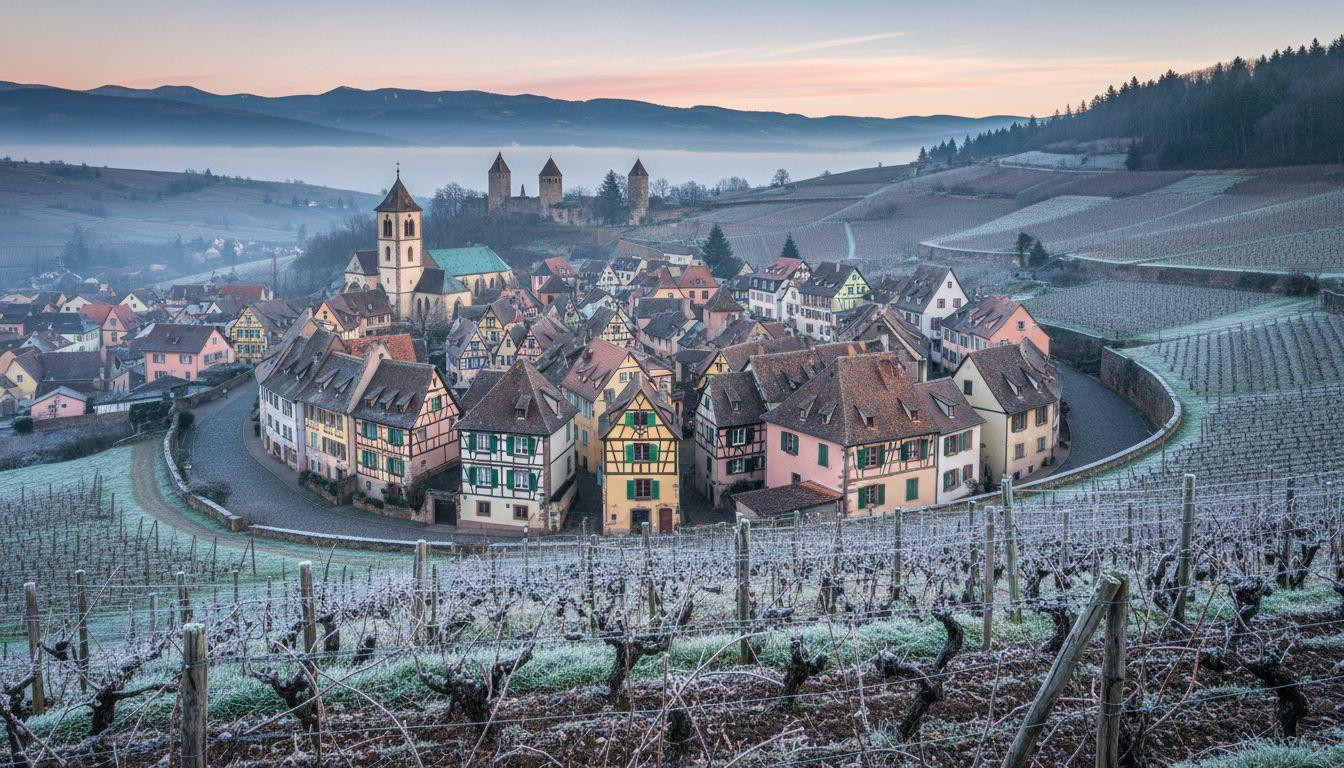
Morning mist rolls through frost-covered vineyards as half-timbered houses emerge from the December silence. Eguisheim wraps its pastel walls in winter calm, where 1,735 residents guard cobblestone circles that have spiraled outward from an 8th-century castle for over 1,200 years. This Alsace village transforms December’s chill into storybook magic.
The air carries scents of damp earth and fermenting grapes from Grand Cru vineyards. Stork nests crown chimney tops like natural Christmas ornaments. European villages with distinctive architecture rarely preserve such intimate medieval authenticity.
Where medieval streets meet vineyard hills
Concentric rings fan outward from Place du Château in perfect circles. The original octagonal castle anchors streets that curve like ripples in stone. Pastel houses bloom in soft pinks, yellows, and oranges against December’s silver light.
Renaissance fountain marks the village heart with Pope St. Leo IX statue. The 13th-century ramparts trace defensive walls along Rue du Rempart-Sud. Walking the complete circle takes 20 minutes through passages that narrow to single-file width.
Vosges Mountains rise 10 miles east as backdrop to Eichberg and Pfersigberg vineyards. The village sits at 682 feet elevation, perfectly positioned for Grand Cru grape cultivation. Total area spans 5.5 square miles with the historic center measuring half a mile across.
Winter transforms the vineyards
Frost patterns on bare vines
December temperatures hover between 32-41°F as morning frost silvers dormant vine rows. Mist settles in valley pockets before sunrise reveals terraced hillsides stretching toward Colmar. Christmas markets operate November-December with mulled wine tastings by fireplace warmth.
Tourist crowds drop 80% from July-August peaks. The Alsace Wine Route connects villages every 6-12 miles along 105 total miles. Historic European destinations rarely offer such peaceful winter access to cultural heritage.
Stork legends and stone fountains
White storks nest atop medieval chimneys year-round as symbols of good fortune. Local legend promises prosperity to households hosting active nests. Village Cigogne d’Alsace maintains public stork park with viewing platforms.
Church of Saints Peter and Paul dates to 1220 with bell tower marking prayer hours. The village earned “Village Préféré des Français” designation in 2013. Birthplace of Pope St. Leo IX (1002) adds pilgrimage significance to wine tourism appeal.
Tasting room experiences
Riesling by candlelight
Winstubs (wine taverns) offer $18-28 tasting flights featuring Riesling, Gewürztraminer, and Klevener varieties. Eichberg and Pfersigberg Grand Cru producers open cellars for private tours. Crackling wood fires accompany wine education sessions during winter months.
Mulled vin chaud warms hands between vineyard walks. Wine regions offering alternatives to crowded destinations provide more intimate cultural immersion. Bottles range $15-45 with Grand Cru selections reaching $80.
Local food traditions
Baeckeoffe stew costs $28 at traditional restaurants featuring slow-cooked beef, lamb, and potatoes. Tarte flambée appears on every menu at $22-25 with caramelized onions and local cheese. Choucroute garnie combines sauerkraut with regional sausages for $30.
Communal dining encourages “Bon appétit” greetings at shared tables. Hand-painted pottery and vineyard honey make authentic souvenirs. Sunday vineyard walks follow unmarked trails between village and surrounding hillsides.
The quiet season promise
December through February offers 75% fewer visitors than peak summer months. Train service from Paris takes 2.5 hours for $55 via TGV to Colmar. Regional buses connect villages every 30 minutes for $6 rides.
Accommodation ranges from $65-100 B&Bs to $280 vineyard hotels. Preserved European destinations maintaining authentic character become increasingly rare. Morning walks through mist-covered vineyards restore rhythms lost to modern urgency.
Your questions about European fairytale villages surrounded by vineyards answered
When is the best time to visit Alsace wine villages?
November-December offers Christmas markets with minimal crowds while September-October provides harvest season colors. Winter temperatures range 32-41°F with occasional light snow creating storybook scenes. July-August brings peak tourism with 300% higher visitor numbers and accommodation costs.
How do Alsace villages compare to Tuscany for wine tourism?
Accommodation costs run 20-25% lower than Italian wine regions with similar architectural charm. Germanic-French cultural fusion creates unique tasting experiences versus Mediterranean traditions. Winter accessibility proves superior through efficient train infrastructure connecting major European cities.
Can you visit multiple vineyard villages in one trip?
Villages cluster 6-12 miles apart along designated wine routes. Eguisheim, Riquewihr, and Ribeauvillé form convenient triangle for 3-day itineraries. Car rental costs $35 daily while regional trains provide $5-55 connections between major stops.
Church bells echo across frosted vineyards as evening light fades behind medieval ramparts. December’s silence settles over cobblestone circles where centuries of winemaking tradition continues in quiet defiance of time.