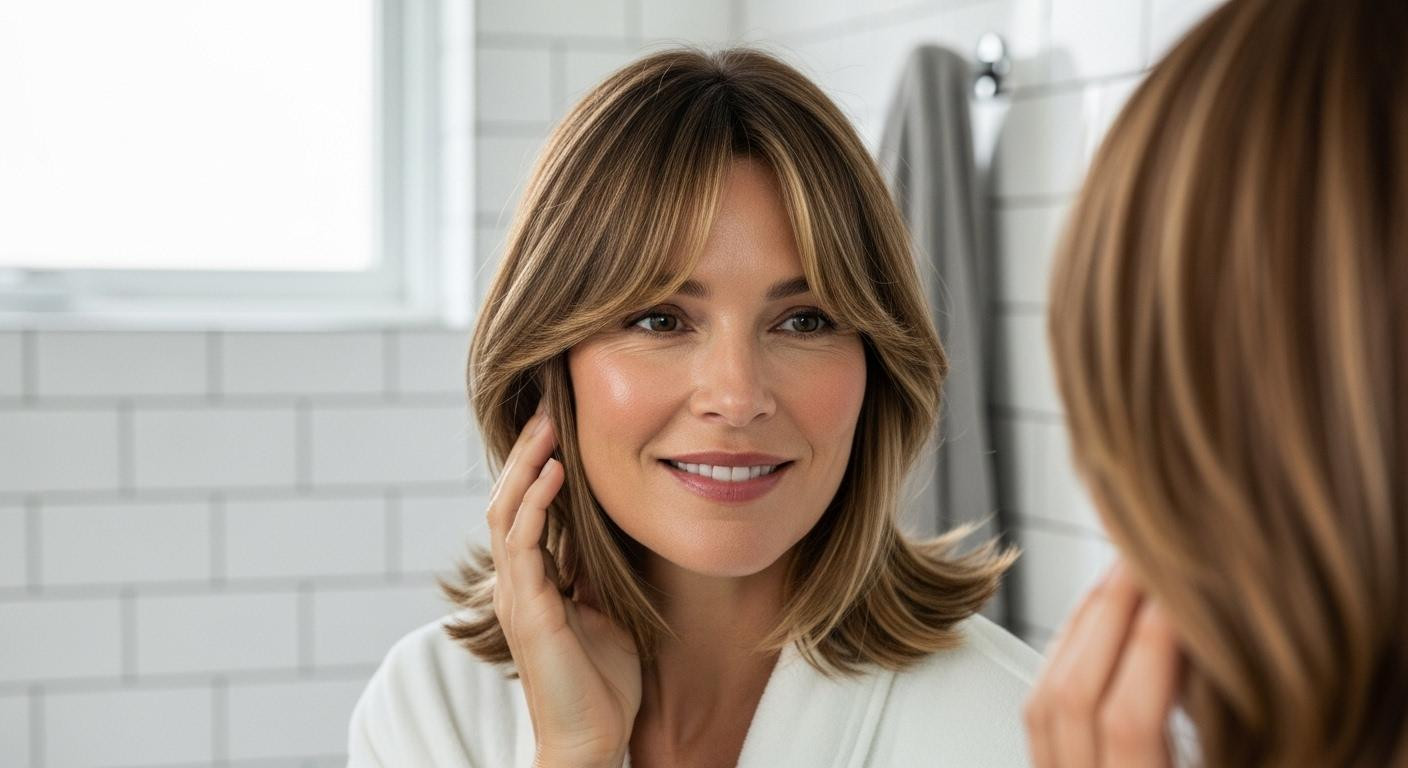
You hold your phone displaying 17 saved images of wispy bangs. Brigitte Bardot’s iconic fringe, Dakota Johnson’s curtain variation, TikTok’s blended layers. The paralysis strikes: will bangs make my high forehead look worse with a harsh line? Stylist warnings echo about committing to daily styling. Yet personal development coaches and face-shape consultants confirm three specific forehead proportions respond exceptionally to blended techniques that full bangs can’t achieve. These create graduated coverage that traditional fringe actually exaggerates rather than conceals.
The three forehead profiles where blended bangs create optical balance
High foreheads aren’t uniform in their proportions or styling needs. Facial geometry specialists identify three distinct proportions where blended layering outperforms traditional fringe consistently. The first profile involves oval faces with elongated foreheads where hairline sits 3 inches or more above brows. Blended bangs break vertical length without adding horizontal bulk that widens face structure.
The second profile encompasses rectangular faces where forehead width matches jawline measurements precisely. Graduated fringe softens angular proportions through asymmetrical coverage that traditional bangs simply cannot provide. The third profile includes long faces with balanced width but extended chin-to-hairline measurement exceeding standard proportions.
Layered bangs reduce perceived length while maintaining natural movement and flow. Each profile shares one key characteristic: full blunt bangs create harsh demarcation that emphasizes the forehead boundary. Blended techniques diffuse attention through varied lengths and strategic transparency.
Why blending hides foreheads better than full coverage
Blended bangs create 3-4 distinct length layers from brow-grazing wisps to cheekbone-length pieces. This graduated density allows scalp to show through selectively, creating soft shadowing rather than solid coverage. Optical perception studies confirm viewers’ eyes track movement and transparency more than complete coverage.
The graduated opacity principle
The varied lengths redirect focus from forehead size to dynamic framing effects. Traditional full bangs create sharp horizontal lines at forehead level. This forms the exact boundary you want viewers to ignore completely. Blended techniques eliminate this line through feathered endpoints and point-cut texturing throughout.
The softened-edge illusion
Face-shape consultants confirm the human eye perceives “frame” rather than “forehead” when edges fade gradually. The illusion succeeds because attention flows along tapered lengths rather than stopping at abrupt termination points. Transparency creates movement that draws focus away from forehead proportions.
Technical execution that maintains the blend
Achieving true blending requires vertical point-cutting rather than horizontal shears throughout the process. Stylists trained in layered fringe confirm scissors must angle 45-90 degrees to create varied lengths within each section. This produces the wispy, separated strands essential for graduated coverage effects.
Point-cutting versus blunt-cutting mechanics
Blunt cutting creates uniform density that defeats the transparency principle entirely. Every strand terminates at identical length, forming the solid line blended techniques avoid. Point-cutting creates natural separation that mimics organic hair growth patterns.
Section isolation for natural integration
Superior blended bangs require separating forehead fringe from side temple pieces during cutting. Face-framing specialists isolate a triangular section from mid-pupil points converging at crown. This allows bangs to blend into longer side layers through length graduation. The integration creates seamless transition where observers can’t identify where bangs end.
Maintenance advantages over traditional bangs
Blended bangs extend trim cycles from 3-4 weeks for traditional styles to 5-6 weeks consistently. The varied lengths mean no single layer creates “too long” urgency at once. Different pieces reach styling limits at different times throughout growth cycles. Growing out blended fringe requires zero awkward phases because longest pieces already integrate with face-framing layers.
Styling versatility increases dramatically with blended techniques offering multiple looks. Center-part creates soft curtain effects, side-sweep produces asymmetrical drama, slicked-back maintains options traditional blunt bangs eliminate. Daily maintenance drops to 3 minutes with texturizing spray versus 8-10 minutes round-brushing solid fringe.
Your questions about blended bangs for high foreheads answered
Can blended bangs work with curly or wavy hair textures?
Absolutely, texture actually enhances the graduated effect significantly. Curly hair naturally creates varied lengths as individual spirals bounce differently. Request dry cutting so stylist sees actual curl pattern. The key adjustment involves slightly longer initial lengths since curls contract during styling. Wavy textures from 2A to 2C benefit most because waves create organic separation.
How does blended fringe compare to Korean see-through bangs?
Similar transparency principle but different execution approaches entirely. Korean see-through bangs use fewer, thinner sections creating deliberate scalp visibility. Blended bangs incorporate more hair through graduated lengths for fuller appearance while maintaining softness. Choose see-through for minimal commitment, blended for more coverage.
Will blended bangs require daily heat styling like traditional fringe?
No, the varied lengths mean imperfect pieces blend naturally rather than sticking out uniformly. Air-drying with texturizing spray works for most hair types effectively. Only perfectly straight, fine hair benefits from occasional round-brush work. Even then, only longest center pieces need attention. Most textures embrace natural movement that blended cuts enhance.
You run fingers through new blended layers, feeling how each wispy section falls differently across your forehead. The mirror reflection surprises you. Not because your forehead disappeared, but because your eyes now track the soft, graduated framing instead of seeking the boundary you once monitored obsessively.