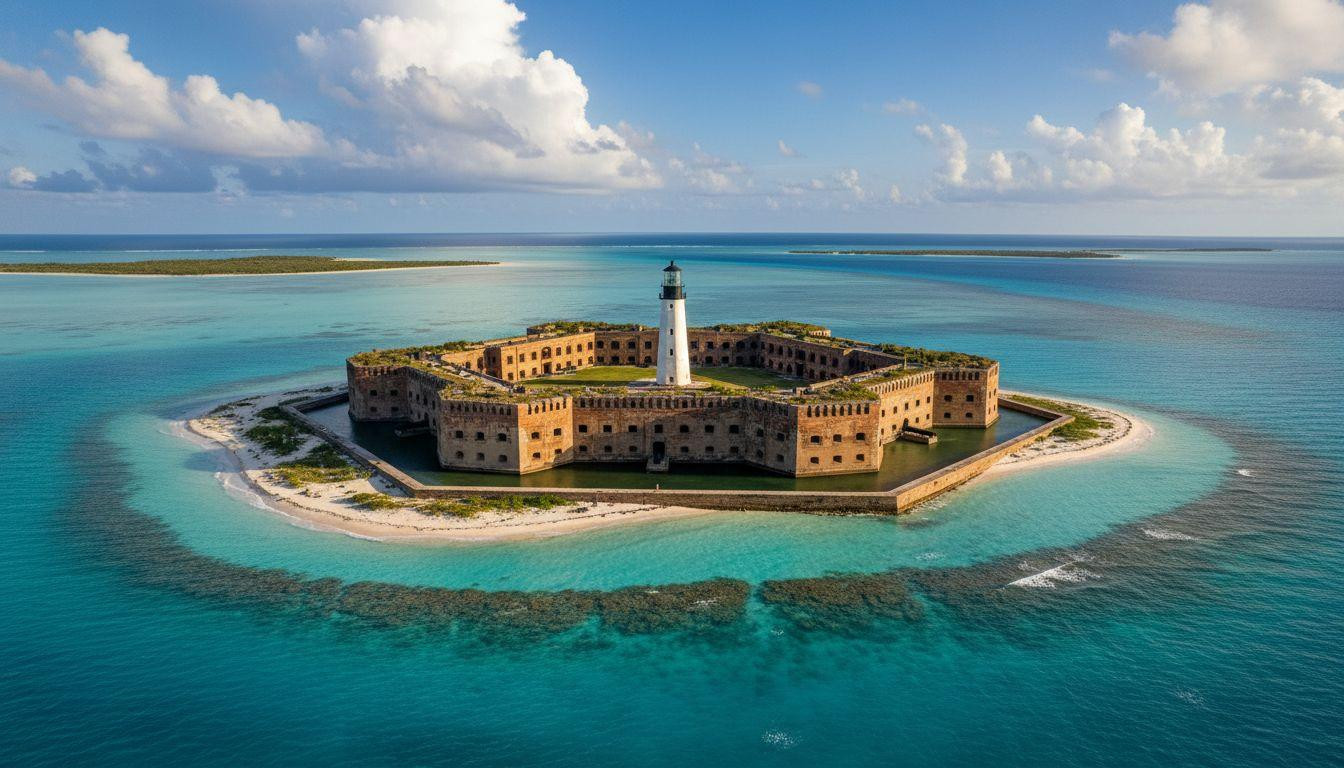
This fort sits on coral islands where Victorian brick walls rise from turquoise Gulf waters, 70 miles beyond Key West’s crowds. Fort Jefferson stands as America’s largest masonry structure on Garden Key, surrounded by seven remote islands where fewer than 230 visitors arrive daily. The hexagonal fortress contains 16 million bricks in walls that reach 50 feet high, creating a cinematic vision of isolation that few Americans ever witness.
The fortress rising from Gulf waters
Morning light reveals Fort Jefferson’s golden-yellow brick walls emerging from crystal-clear shallows. The fortress occupies 16 acres of Garden Key with a distinctive hexagonal design that housed 450 gun positions during its 19th-century military peak. Construction began in 1846 but was never completed, leaving this massive Victorian-era structure as both engineering marvel and historical mystery.
The fort’s two-tiered casemate design features walls measuring 325 to 477 feet per side, with 8-foot-thick masonry that has withstood Gulf storms since the 1800s. A brick lighthouse from 1826 rises 65 feet above the fortress, serving as the only vertical landmark visible across endless aquamarine waters.
What makes this architecture unique
Among U.S. coastal forts, only Fort Monroe in Virginia and Fort Adams in Rhode Island exceed Fort Jefferson’s overall size. The fortress contains a 13-acre interior parade ground that once housed barracks, hospitals, and powder magazines. Granite spiral staircases in corner bastions lead to gun rooms where cannons never fired a shot in anger.
The lighthouse that guided ships through coral reefs
The Garden Key Light predates the fort itself, built to guide vessels through treacherous coral formations that claimed countless ships. Its whitewashed brick exterior contrasts sharply with the fort’s golden masonry, creating the architectural drama that defines this remote outpost.
Seven islands, seventy miles from anywhere
Dry Tortugas National Park encompasses 100 square miles, mostly ocean surrounding seven small keys where no permanent residents live. Garden Key serves as the exclusive visitor landing site, originally measuring 8 acres before fort construction permanently altered its footprint. This Caribbean sandbank floats 7 miles offshore captures similar isolation, but Dry Tortugas offers fortress architecture no other remote destination provides.
The Yankee Freedom ferry departs Key West daily at 8 AM for the 2.5-hour journey across open Gulf waters. Ferry capacity limits and weather dependencies restrict daily visitation to levels comparable with small regional museums rather than major national parks.
Why the remoteness matters
With only 84,000 annual visitors in 2023, Dry Tortugas ranks as America’s least-visited national park. This extreme isolation preserves pristine coral reefs and nesting bird colonies that would suffer under typical tourist pressures. The 4-hour island visit window creates intentional urgency that transforms casual sightseeing into focused exploration.
The journey becomes part of the experience
Seaplane alternatives cost $466 for 40-minute flights that offer spectacular aerial approaches to the fortress. This Bahamas beach keeps turquoise water calm requires similar transportation planning, but Fort Jefferson’s historical significance elevates the logistical challenge into adventure.
Where coral meets history
The fort’s moat creates unique snorkeling opportunities where tropical fish swim between 19th-century brick foundations. Water temperatures range from 68°F to 82°F during winter months, with visibility extending 60 feet through gin-clear Gulf waters. Coral formations grow directly against fortress walls, creating underwater architecture found nowhere else in America.
Garden Key’s beaches stretch 1-2 miles of white sand where visitors swim in waters that feel more Caribbean than continental U.S. The shallow flats surrounding all seven islands average 10-15 feet deep, creating the turquoise color that photographs like premium tropical destinations.
The unexpected underwater fort
Snorkeling around Fort Jefferson’s exterior walls reveals the fortress extending below water level. Fish species typically found in Caribbean reefs inhabit the moat, while sea turtles (the islands’ namesake) patrol deeper waters beyond the shallows.
Beyond the fort walls
Bush Key closes May through October when sooty terns and brown noddies nest by the thousands. This Massachusetts harbor hides granite shores offers similar coastal heritage, but Dry Tortugas provides tropical bird watching impossible in northern waters.
Winter silence on the islands
December through March delivers ideal conditions with calm seas, minimal rainfall, and comfortable 77°F daytime temperatures. Hurricane season ends, ferry cancellations drop to 10%, and winter sun creates golden hour photography impossible during summer’s harsh light. The profound quiet (no motor vehicles, commercial noise, or urban sounds) amplifies natural elements: wave lapping against brick, distant bird calls, wind through fort corridors.
Recent visitor surveys from 2025 consistently describe the experience as “rewarding isolation” where most tourists explore the fortress alone while others snorkel. This Oregon tunnel carved through basalt provides similar solitary discovery moments, but Fort Jefferson’s tropical setting creates year-round accessibility.
Your questions about Dry Tortugas answered
How do you actually get there?
The Yankee Freedom ferry costs $235 per adult including park entrance fees, breakfast, lunch, and snorkel gear. Departures occur daily at 8 AM from Key West with 2.5-hour travel time each direction. Seaplane services charge $466+ for 40-minute flights but provide only limited seat availability and weather-dependent reliability.
Can you stay overnight?
Primitive camping permits cost $15 per night per site, but campers must bring all food, water, and supplies as no services exist on the islands. Most visitors base themselves in Key West with accommodation ranging from $150 budget motels to $600 luxury resorts, then take day trips via ferry or seaplane.
Why visit over Key West beaches?
Key West receives millions of annual visitors while Dry Tortugas averages 230 daily. The fortress provides historical architecture absent from typical beach destinations, while Gulf water clarity exceeds most accessible Caribbean alternatives. Ferry-only access preserves authentic isolation impossible at drive-to beaches throughout Florida.
Late afternoon light transforms Fort Jefferson’s golden bricks into glowing amber against endless turquoise. Bird silhouettes circle the lighthouse while gentle waves lap against moat walls in rhythmic silence.