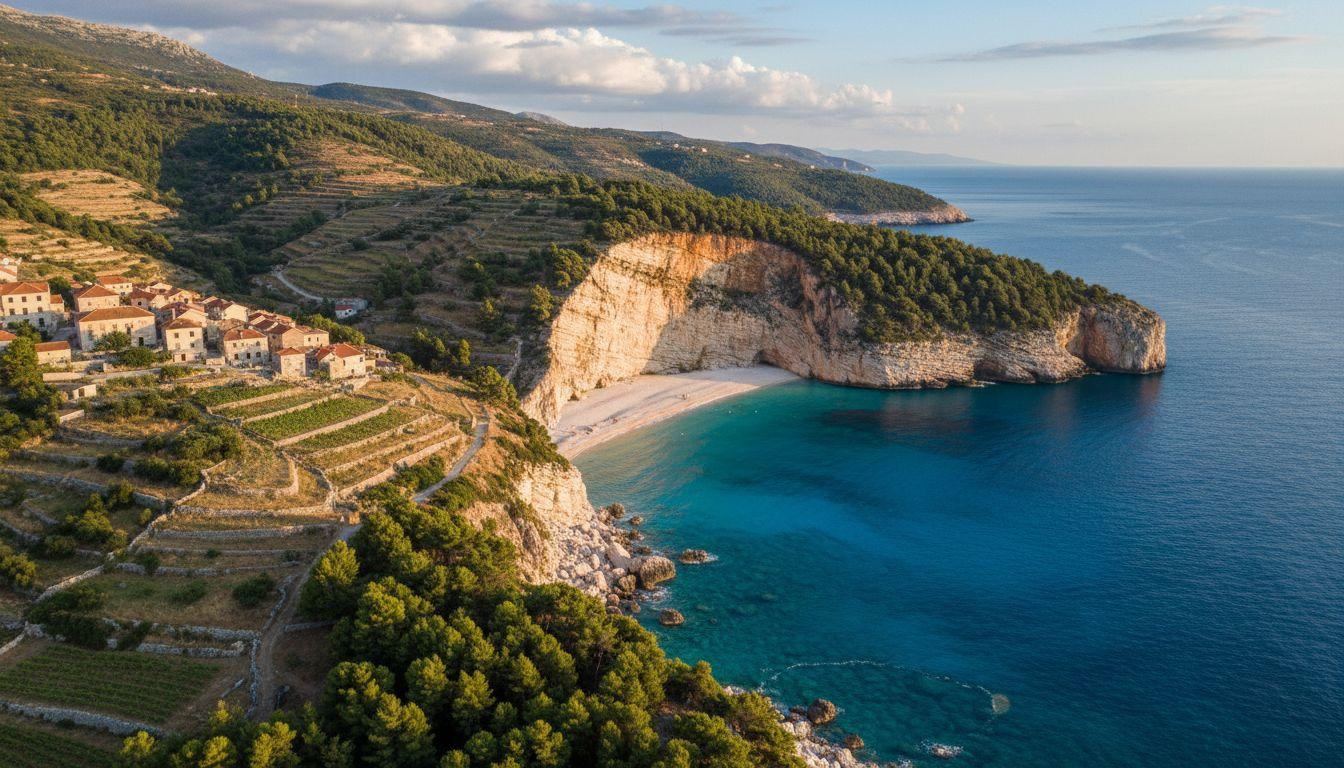
The ferry from Split cuts through morning Adriatic waters for 90 minutes. Ahead, an emerald dot rises from deep blue sea. Vis Island emerges like a secret kept for decades, its green hills and golden stone villages untouched by the crowds that swarm neighboring Hvar. This tiny Croatian island stayed closed to the world from 1953 to 1989, creating accidental preservation that mass tourism destroys elsewhere.
The Yugoslav military’s 36-year lockdown preserved what developers demolished across Dalmatia. No hotels lined pristine coves. No resorts replaced fishing villages. Vis remained frozen in time while Croatia’s coast transformed into tourist corridors.
The island time forgot to ruin
Yugoslav forces claimed Vis as a naval base in 1953. Foreigners couldn’t visit. Even Yugoslavs needed military permits. Over 30 facilities dotted the island: submarine pens, missile bases, 12 miles of underground tunnels. Tito himself hid here during World War II, in caves now open to hikers seeking panoramic sea views.
The military departed in 1992, leaving ghost barracks and untouched landscapes. Early visitors in the 1990s found a time capsule: terraced vineyards, stone fishing villages, emerald hills without a single resort. Vis opened to tourism when Hvar already hosted luxury yachts and party crowds.
Today, Vis welcomes 100,000 annual visitors compared to Hvar’s millions. Limited ferry schedules naturally control crowds. This Italian island with quarry coves shares similar fishing heritage but lacks Vis’s military preservation story.
Where two blues meet green
The water geography
Stiniva Cove exemplifies Vis’s natural drama. White pebbles line a 330-foot beach enclosed by 165-foot limestone cliffs. Turquoise water meets emerald terraced hillsides dotted with pine forests. The contrast creates Mediterranean perfection without Mediterranean crowds.
Nearby Biševo’s Blue Cave glows electric blue at midday when sunlight hits underwater openings. Speedboat tours from Komiža harbor cost $110-140 per person. Book one day ahead during peak July-August season.
Venetian bones, dalmatian soul
Vis Town’s Kut quarter preserves 17th-century golden stone houses with red terracotta roofs. Venetian architecture meets Croatian fishing culture in narrow alleys where cats outnumber tourists. The village baker’s family has operated the same stone oven since 1953, according to local residents who remember pre-tourism days.
Komiža harbor showcases authentic Dalmatian life. Fishing boats return at 5am with fresh catches. Sunset paints the harbor gold at 9pm in June, 7pm in September. This Greek island’s quiet coves offer similar unhurried maritime rhythms.
The rhythms that survived
What military isolation preserved
Family vineyards cover 20% of Vis Island’s 35 square miles. Plavac Mali grapes thrive in volcanic soil, producing bold red wines with 13-15% alcohol content. Winery tastings cost $11-22 per person. September harvest brings island-wide celebrations locals have maintained for centuries.
Traditional lamb peka slow-cooks for 4-6 hours under metal bells. Restaurant prices average $17-27 for authentic preparations, compared to $38 equivalent meals on Hvar. Black risotto with cuttlefish ink remains a Komiža specialty prepared by fishermen’s families.
The new slow tourism
Military tunnel tours explore 12 miles of underground passages. The Stupišće missile base near Komiža now hosts wine cellars and historical exhibits. Entry costs $16 per person for guided exploration of Cold War relics.
A new 133-room eco-hotel opens in Komiža in 2026, featuring solar power and infinity pools. This Mediterranean island’s extreme isolation provides even more dramatic solitude for travelers seeking complete escape.
Earning this island
Vis rewards intentional travelers. No airport means flying into Split, then taking ferries that depart 2-4 times daily versus Hvar’s 10+ daily connections. The 90-minute journey filters out casual visitors seeking Instagram shots.
June and September offer optimal conditions: water temperatures of 72-77°F, 20-30% fewer crowds than peak July-August, and accommodation prices $55-165 per night versus $330+ Hvar villas. Shoulder seasons preserve Vis’s contemplative atmosphere while providing comfortable swimming conditions.
Car rentals cost $44-88 daily for exploring the 7-mile drive between Vis Town and Komiža. Taxi rides cover this distance for $16-22. This budget-friendly Mediterranean alternative provides similar savings for price-conscious travelers.
Your questions about Vis answered
When should I visit Vis?
June and September provide ideal conditions with warm seas averaging 72-77°F and minimal crowds. July-August sees peak visitors but remains manageable compared to other Croatian islands. Winter offers extreme solitude with temperatures averaging 46-54°F, perfect for contemplative walks through olive groves and vineyard terraces.
How much does Vis cost compared to Hvar?
Accommodations run 20-30% cheaper than Hvar, with guesthouses costing $55-88 nightly versus boutique hotels at $165-330. Meals average $17-33 compared to Hvar’s $38+ equivalent dishes. Ferry tickets from Split cost $22-33 one-way, with catamaran services slightly higher.
What makes Vis different from other Croatian islands?
Military closure from 1953-1989 prevented mass development that transformed neighboring islands. Vis opened to tourism later, creating intentional visitor culture focused on fishing heritage, family vineyards, and preserved architecture. Limited ferry access naturally controls crowds while maintaining authentic island rhythms.
Morning mist rises from Stiniva Cove as fishing boats navigate Komiža harbor. Cicadas chorus through pine-scented hills where terraced vineyards catch first light. Vis Island emerges from decades of isolation as Croatia’s quietly preserved emerald dot, rewarding travelers who choose the longer journey with authentic Mediterranean solitude.