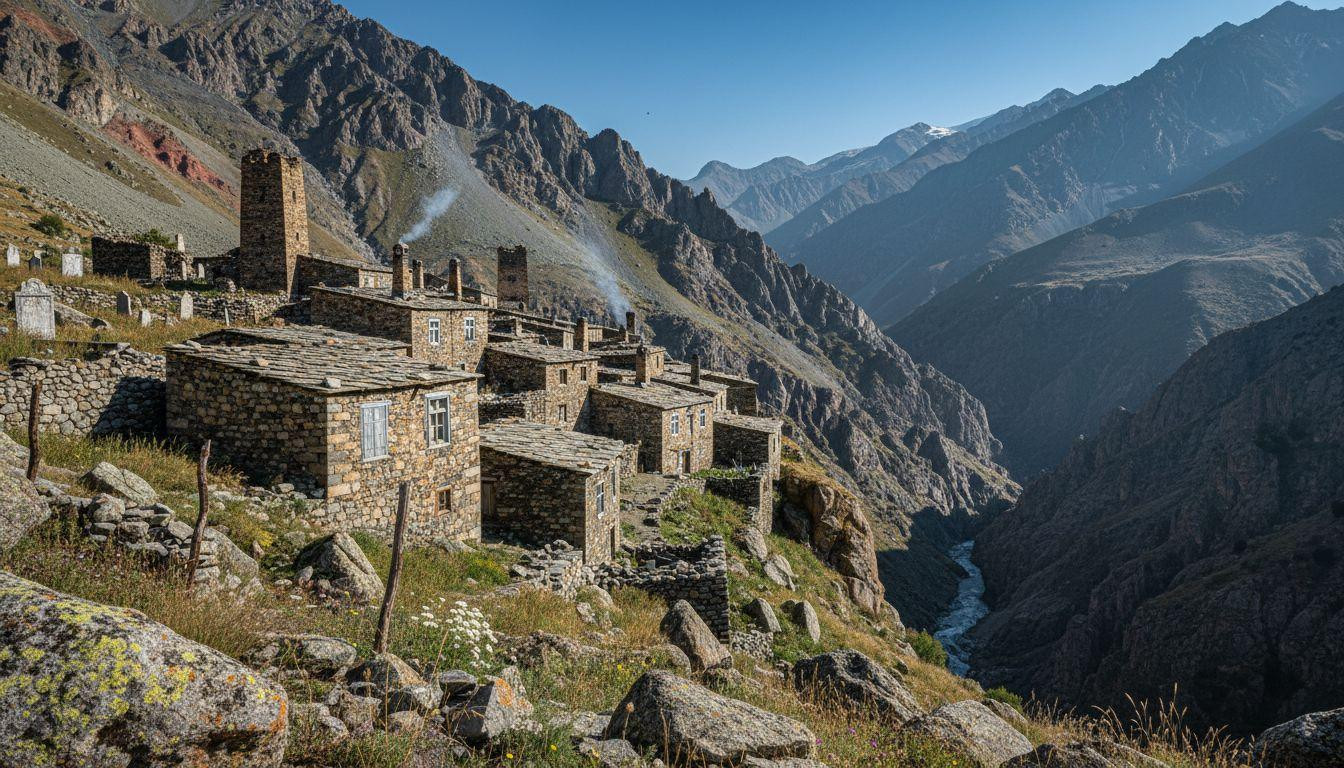
In Azerbaijan’s remote mountains, villagers gather at dawn to repair stone walls that have sheltered families for centuries. This collective ritual happens without permits, committees, or tourism boards. Community members simply appear with tools and locally quarried stone, maintaining structures their ancestors built to resist wind, earthquakes, and time itself.
These preservation efforts reflect a quiet revolution happening across nine villages worldwide. Residents actively protect traditional architecture against modern pressures, choosing cultural survival over convenience.
The stone compact
Buduq Village sits 5,000 feet above sea level in Azerbaijan’s Quba District. Gray stone houses blend seamlessly into rocky mountainsides, their thick walls designed for extreme weather. Local tourism boards confirm fewer than 5,000 visitors arrive annually, compared to millions flooding popular destinations.
Seasonal repairs happen through unspoken agreements. Families contribute labor and materials during brief summer months when mountain access permits heavy work. The community maintains traditional building techniques passed down through generations, refusing concrete or steel reinforcement.
Similar resistance appears 3,000 miles away in Shirakawa-go, Japan. This UNESCO World Heritage site limits resident numbers to preserve authentic village life. Better than Williamsburg where tickets cost $45 and 14 towns keep living history free through local festivals, these Japanese farmers continue inhabiting 250-year-old thatched farmhouses.
When preservation costs money
Economic sacrifice drives these conservation efforts. Traditional materials cost significantly more than modern alternatives. Shirakawa-go residents pay premium prices for specialized thatch, while Buduq families quarry stone by hand rather than purchasing concrete blocks.
The economic sacrifice
Fengwu Village in China’s Anhui Province demonstrates government-supported preservation. The Rural Memory Museum, completed in 2023, serves as a community gathering space using traditional lime plaster and carbonized wood. Local officials funded this $200,000 project to revitalize heritage without destroying authenticity.
Tourist revenue provides some compensation. Homestays in Buduq charge $30-60 per night, generating income while maintaining cultural integrity. However, most families earn far less than urban counterparts.
The generational divide
Aging populations threaten continuation. Gaojiatai Village in China’s Taihang Mountains faces declining residents as young people migrate to cities. Cliff-dwelling families struggle to maintain stone houses carved into ravines without sufficient labor.
Winter isolation compounds challenges. 8 coves where Ithaca keeps water like blue silk 20 minutes from Kefalonia shows how Mediterranean villages face similar pressures, though with better year-round access.
Architecture as resistance
Building materials become cultural identity markers. Each village developed unique techniques responding to local conditions: bamboo flexibility in earthquake-prone Indonesia, dry-stone construction in France’s Provence, terraced cliff dwellings in Italy’s Cinque Terre.
Building materials as identity
Segenter Traditional Village in Lombok showcases Sasak architecture using bamboo and thatch. Homes resist seismic activity through flexible construction, proving traditional methods often surpass modern engineering. Recent visitor surveys conducted in 2025 reveal growing appreciation for earthquake-resistant indigenous design.
Gordes in France maintains Europe’s largest collection of Bories, dry-stone huts built without mortar. These 17th-century structures demonstrate masonry skills requiring years to master. This French Caribbean archipelago hides turquoise coves 25 minutes from Guadeloupe reveals similar colonial preservation efforts in overseas territories.
Modern pressures they resist
Tourism development threatens authentic character. Manarola in Italy’s Cinque Terre restricts modern additions to maintain cliff-dwelling integrity. Colorful facades stack impossibly on sea cliffs, defying gravity through centuries-old engineering.
Climate adaptation presents new challenges. Rising temperatures and extreme weather patterns stress traditional structures designed for historical conditions. Villages adapt gradually, reinforcing foundations while preserving visual authenticity.
The quiet victory
These communities prove cultural preservation requires active choice, not passive inheritance. Daily decisions to maintain traditional methods, source local materials, and resist modernization reflect collective determination to preserve identity.
Morning smoke rising from stone chimneys represents ongoing commitment. Better than Sintra where palaces cost $270 and Piódão keeps blue door slate villages for $65 demonstrates how Portuguese mountain villages achieve similar preservation at fraction of tourism hotspot costs.
Success appears in unchanged skylines, traditional craftsmanship continuing, and communities choosing heritage over convenience. These villages protect something increasingly rare: authentic cultural landscapes shaped by human hands working in harmony with natural materials.
Your questions about places locals protect answered
Why don’t they modernize interiors while keeping exteriors traditional?
Visual integrity matters for community identity and tourism revenue. Many villages discovered that partial modernization creates slippery slope toward complete transformation. Residents fear losing cultural authenticity that attracts respectful visitors while deterring mass tourism.
Who actually enforces these architectural rules?
Community pressure and social contracts prove more effective than formal laws. UNESCO designation helps in places like Shirakawa-go, but most preservation happens through neighbors helping neighbors. Festival participation and communal work projects serve as informal enforcement mechanisms.
How do residents afford expensive traditional maintenance?
Tourism homestay revenue, government heritage grants, and communal labor traditions reduce individual costs. Villages often source materials locally: stone from nearby quarries, thatch from village fields, bamboo from community forests. Shared skills mean families exchange labor rather than hiring contractors.
Dawn breaks over Buduq’s stone houses, smoke curling from chimneys into crystalline mountain air. Residents begin another day choosing tradition over convenience, preservation over profit, cultural survival over modern efficiency.