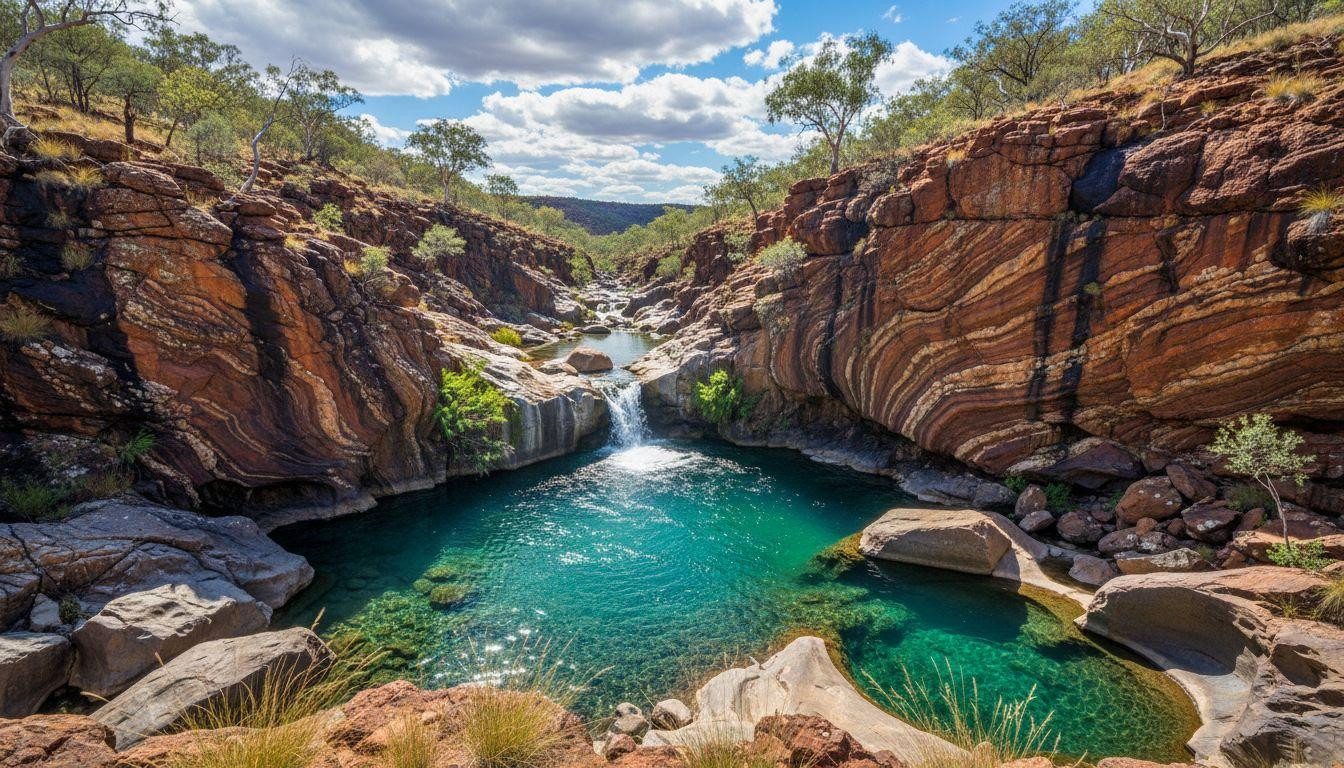
The 4WD track ends at Karijini’s northwest edge. Red dust settles as you approach Hamersley Gorge, where ancient Earth reveals itself in bands of color no postcard captures accurately. Two and a half billion years ago, these iron-rich layers formed on an ocean floor. Tectonic forces folded them like fabric, pushing geological history vertical where visitors now touch stone older than complex life.
The amphitheater setting
Hamersley Gorge spreads wider than Karijini’s famous slot canyons. The approach lookout reveals a natural amphitheater where banded ironstone sweeps in visible curves. Red, orange, and golden layers buckle across the gorge walls in patterns that make no sense until you understand plate tectonics bent these horizontal beds 90 degrees.
Morning light catches each mineral band differently. Hematite glows rust-red, silica shines golden, magnetite adds purple depth. The stepped waterfall at the gorge base creates three distinct pools, each reflecting sky against ancient stone.
This isn’t erosion alone. This is Earth’s crust folded, exposed, and filled with permanent water 1,312 feet from the parking area. Karijini’s famous Fortescue Falls keeps permanent water 25 miles from Hamersley, but lacks these dramatic rock folds.
The geological revelation
Reading the rock folds
Stand at the Waterfall Walk base and you’re reading 2.5 billion years of history with your eyes. Each colored band represents a different mineral deposition period when this landscape lay underwater. The dramatic curves show exactly how tectonic pressure folded these layers during the Ophthalmia Orogeny 2.2 billion years ago.
Geologists call these synclines and anticlines, but what matters is the visceral experience of seeing rock behave like fabric. The folds create natural shade pockets where ferns grow in gorge microclimates. Recent research from Curtin University confirms iron enrichment occurred 1.4-1.1 billion years ago, much later than previously thought.
The turquoise mystery
The permanent pools appear artificially turquoise against red rock. Mineral content from dissolved limestone and silica creates the color. Unlike temporary desert waterholes, Hamersley’s pools stay year-round, fed by underground seeps through fractured ironstone.
The water clarity lets you see every pebble at 6-foot depths. Ningaloo Reef shows whale sharks in turquoise water 3 hours west of Karijini, but here you swim among geological formations 2.5 billion years old.
The spa pool experience
Navigating the gorge floor
The 0.6-mile trail descends via stairs to the amphitheater floor. Turn right at the base and scramble 164 feet upstream over smooth boulders. A metal ladder assists over the final rock chute into the Spa Pool, a small circular basin carved by seasonal floods.
The pool stays waist-deep for adults, rock walls creating a natural jacuzzi effect. December through February brings flash flood risk. May through October offers safest conditions with air temperatures 68-82°F, water slightly cooler but swimmable.
Park entry costs $15 per vehicle. Fuel up in Tom Price before the 56-mile drive on unsealed roads. This Utah wash carves winter light through Navajo walls accessible by 4WD from Hanksville, offering similar geological drama but without swimming opportunities.
What makes it remote
Hamersley sits 56-81 miles from Tom Price via sealed then unsealed roads. No facilities exist at the gorge. Bring all water and food. The isolation means you might share the Spa Pool with only 2-3 other visitors on winter weekdays.
According to recent visitor surveys, those who make the journey report complete tranquility. Local tourism boards confirm Hamersley receives one-tenth the visitors of Weano Gorge due to access challenges. This California river mouth hides 200 seals in December fog 90 minutes from San Francisco, providing another remote swimming experience closer to American cities.
The timeless emotion
Sitting in the Spa Pool, gorge walls rising 328 feet overhead, you feel geological time physically. The banded iron formations above you formed before atmospheric oxygen existed. The folds happened during continental collisions that predated all recognizable life.
Yet the water is warm, the rocks smooth from millennia of floods, the experience utterly accessible. This isn’t museum geology behind glass. You’re swimming in the gap between folded layers that were ocean floor when Earth was young.
The silence, broken only by trickling water, amplifies the scale. Tourism data shows visitors spend an average of 3 hours at the site, longer than any other Karijini location. The remoteness transforms a swim into meditation on deep time.
Your questions about Hamersley Gorge answered
How do I reach Hamersley Gorge?
Drive 56-81 miles northwest from Tom Price via Tom Price-Karijini Road, then unsealed Hamersley Road. High-clearance 4WD recommended for final 19 miles. Alternative access includes a 4-hour drive from Port Hedland, or 15.5 hours from Perth covering 932 miles.
When should I visit?
May-October brings mild days at 68-86°F with low crowds and safe swimming. Avoid December-February due to 104°F+ heat and flash flood risk. Peak crowds occur June-August. Visit May or September for the emptiest experience with perfect weather.
How does it compare to other Karijini gorges?
Wider and easier access than Weano or Joffre gorges, but farther from main park areas. Offers swimming without technical climbing. Less crowded than Fortescue Falls. Similar geological drama to Dales Gorge but with more pronounced rock folding and permanent pools.
Dawn light filters through the amphitheater in golden streams, catching mineral bands in the ancient rock. The Spa Pool reflects sky between stone folds older than life itself. You float in geological time made tangible, surrounded by Earth’s earliest chapters written in iron and silence.