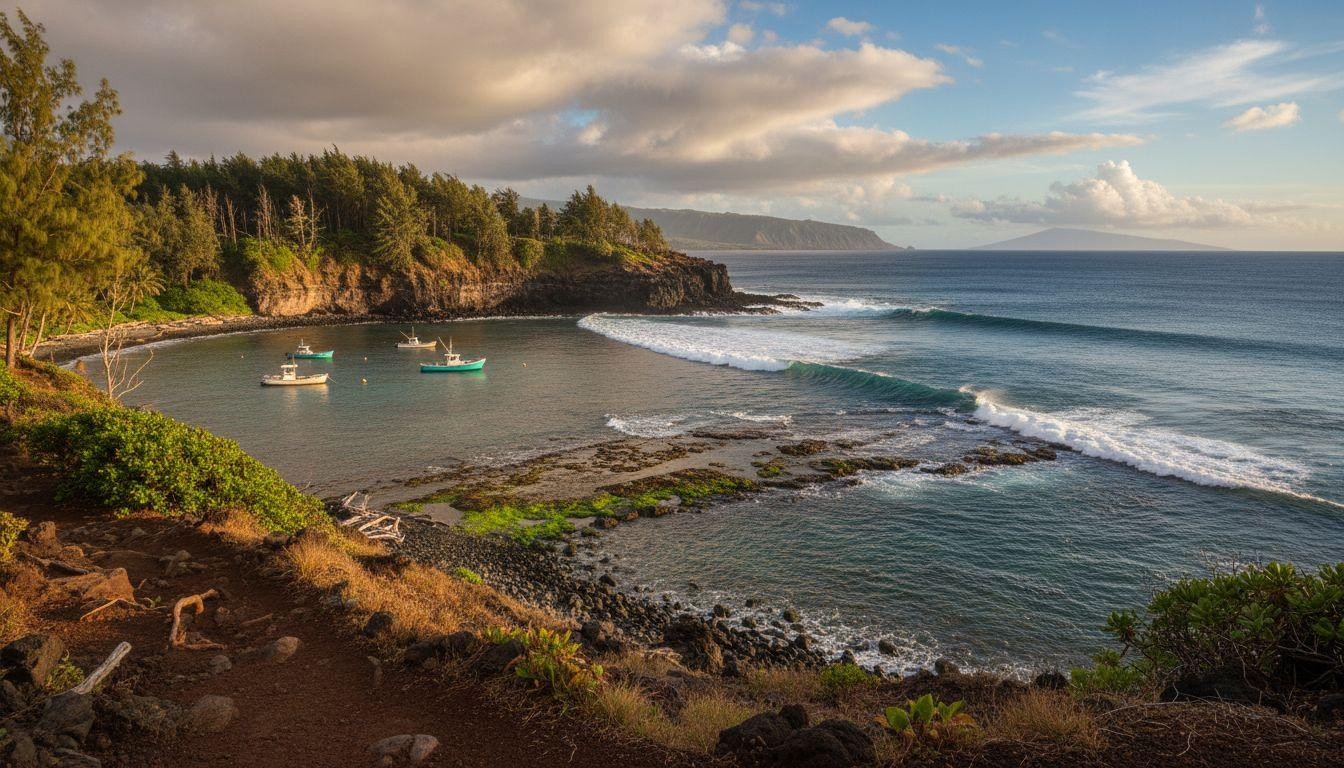
December swells build across the North Pacific, and Maui’s northwest coast waits. Honolua Bay sits quiet most mornings, glassy water reflecting ironwood trees, a few fishing boats anchored offshore. Then the right swell arrives. Within hours, a perfect right-hand point materializes along the rocky headland, waves peeling for 400 yards in crisp winter light. This is Maui’s most selective surf spot, a conservation-protected cove where the wave only breaks when conditions align exactly right.
The swell window that makes or breaks Honolua
Most surf spots work on various swell directions. Honolua demands precision. The reef angle and point geography require North-to-Northwest groundswells between specific degrees. A single-degree shift transforms perfect barrels into flat water.
Winter months from December through February offer the best odds. North Pacific storms generate groundswells that travel 2,500 miles to reach Maui’s northwest shore. Local surf forecasters track these systems 5 days out, watching swell direction like meteorologists watch hurricanes.
The waiting game defines Honolua culture. Surfers check forecasts obsessively, knowing only a handful of winter days deliver optimal conditions. When the angle aligns, word spreads quickly through Maui’s tight surf community. The bay transforms from sleepy cove to world-class surf destination overnight.
When perfect rights line up the headland
The visual moment surfers wait for
Golden hour light illuminates the rocky point at 6am. Glassy waves peel along the reef in perfect sequence, each section connecting to the next. The water clarity reveals coral gardens 15 feet below the surface. Forested volcanic cliffs rise behind the bay, creating a amphitheater effect that amplifies the sound of breaking waves.
Photography captures only fragments of Honolua’s magic. The wave’s quarter-mile length unfolds in real time, right-hand barrels opening and closing along distinct sections: Coconuts, Outside, Cave, and Keiki Bowl. Each section requires different timing and positioning skills.
What the marine conservation district protects
Honolua Bay lies within the Honolua-Mokulē’ia Marine Life Conservation District, established in the 1990s through community-led conservation efforts. No-take rules prohibit fishing, feeding marine life, and touching coral. Fines start at $500 for violations like spearfishing or anchoring on reefs.
This protection maintains water clarity that surfers and snorkelers depend on. Reef fish populations thrive without fishing pressure. Native birds like ‘apapane honeycreepers nest in ironwood trees along the coastal trail. Conservation rangers patrol daily during peak winter months.
Beyond the break
Watching from the cliff trail
A half-mile coastal path climbs 100 feet above the bay through ironwood and koa forest. The viewpoint offers the best perspective for non-surfers to appreciate Honolua’s wave mechanics. Morning light creates ideal photography conditions from 7-9am.
The trail connects to Kapalua’s resort paths, making it accessible for visitors staying in luxury accommodations that cost $600-1,500 per night. Budget travelers find vacation rentals starting at $200 nightly in nearby Napili or Lahaina communities.
Snorkel windows between swells
When winter surf subsides, Honolua reveals exceptional snorkeling conditions. Reef-safe sunscreen requirements are strictly enforced, with $250 fines for non-compliance. The marine conservation district protects over 50 fish species and pristine coral formations.
Shore entry points require careful timing around wave sets. Local dive shops offer guided snorkel tours for $60-120 per person. Private charters cost $300-800 depending on group size and duration. Water temperatures hold steady at 70-75°F throughout winter months.
The quiet season between big swells
Flat days at Honolua reveal the bay’s other identity. Local fishermen launch small boats from the rocky shore. Residents walk dogs along the coastal trail. The only sounds are gentle waves lapping volcanic rock and native bird calls from the forest.
This rhythm teaches patience to visitors accustomed to guaranteed attractions. Honolua operates on nature’s schedule, not tourism demands. The unpredictability makes catching perfect conditions feel earned rather than purchased. Kahului Airport sits 45-60 minutes away via Honoapiilani Highway, connecting this remote cove to global travelers seeking authentic Hawaiian experiences.
Your questions about Honolua Bay answered
When should I visit to see big surf?
December through February offers optimal timing for winter swells. Check Surf-Forecast or Surfline 3-5 days ahead for North-Northwest groundswells. Morning glass-off conditions from 6-10am provide the best wave quality before trade winds arrive. Only 20% of winter days produce truly exceptional surf at Honolua.
Can I surf Honolua as a beginner?
Absolutely not during winter surf season. Advanced skills are required due to shallow reefs, strong currents, and sea urchin hazards. Typical winter days see 20-50 experienced surfers in the lineup. Beginner alternatives include Napili Bay for gentle waves or Launiupoko Beach Park for protected learning conditions.
How does this compare to Oahu’s north shore?
Honolua offers smaller crowds and stricter conservation rules compared to Pipeline or Sunset Beach. Oahu’s north shore sees 100+ surfers on peak days with extensive media coverage. Honolua maintains a local-to-visitor ratio of 60:40, with protective surf etiquette enforced through aloha protocol rather than aggressive localism.
Dawn light touches the point as another swell approaches from the northwest. The bay holds its breath, waiting to transform once again from quiet cove to perfect wave, teaching reverence to those who understand its selective nature.