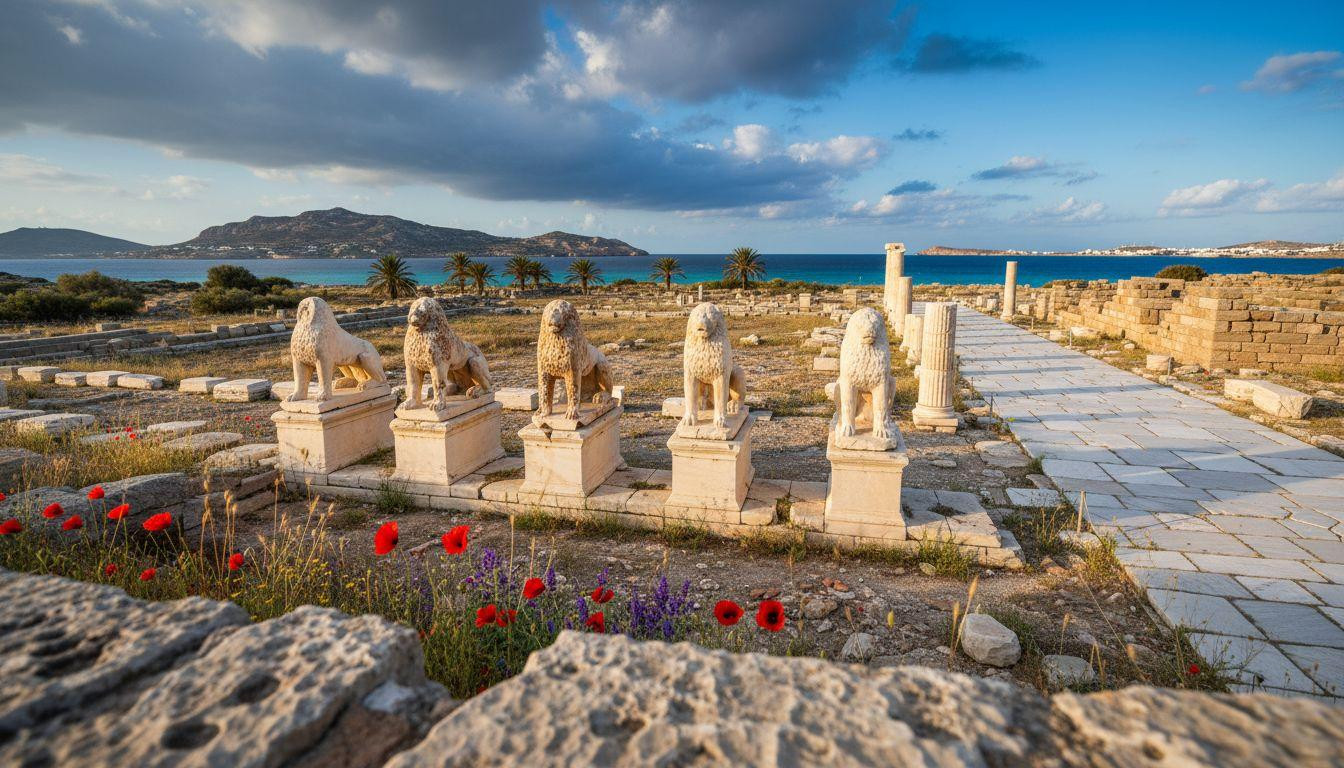
A 30-minute boat ride from Mykonos reveals something extraordinary. Ancient marble columns rise directly from turquoise Aegean waters on an island where no one has lived for 1,300 years. This is Delos, a UNESCO World Heritage site where 3,000-year-old ruins meet the sea in perfect solitude. December brings fewer than 50 daily visitors to explore temples, mosaics, and sacred statues that once welcomed 30,000 residents. Here, borrowed time takes physical form.
Where Apollo’s birthplace meets winter silence
Delos sits just 2 miles northwest of Mykonos, covering 1.3 square miles of barren limestone hills. No hotels, restaurants, or permanent residents disturb this sacred ground. The Greek government maintains strict protection: day visits only, last boat at 3 PM.
Morning ferries depart Mykonos Old Port around 9 AM for $25 round-trip. Winter schedules reduce to 1-2 boats daily, weather permitting. December temperatures hover around 57°F, perfect for exploring unshaded ruins without summer’s blazing heat. Wind whispers through marble columns where Apollo and Artemis allegedly entered the world.
The boat approaches a simple concrete pier. No commercial development mars the horizon. This Greek island delivers Caribbean turquoise water 50 minutes from Athens, but Delos offers something rarer: absolute archaeological authenticity.
Ancient marble meets turquoise waters
The lions that guard empty shores
Five sphinx-like marble lions face the dried Sacred Lake, 400 yards from the harbor. Originally nine to twelve statues lined this terrace in the 7th century BC. Naxian sculptors carved each lion from single marble blocks, standing 10 feet tall.
Morning light transforms these guardians. Their weathered faces catch golden rays while turquoise water sparkles beyond temple foundations. Photographers capture this juxtaposition: ancient mythology meeting endless blue. The lions have watched empires rise and fall for 2,700 years.
Merchant houses where time stopped
Beyond the Sacred Way, excavated neighborhoods reveal Delos’s cosmopolitan past. The House of Dolphins preserves intricate floor mosaics showing fish swimming in geometric patterns. Colorful stones still gleam after 2,000 years.
Peristyle courtyards open to sky where merchant families once gathered. The House of Hermes displays god figures in pristine tesserae. Walking these rooms feels like private archaeology. Winter’s solitude amplifies the sensation of discovery. 8 coves where Ithaca keeps water like blue silk 20 minutes from Kefalonia offer similar Greek island magic, but none match Delos’s frozen-in-time authenticity.
Standing where civilizations fell
The sacred way to nowhere
A marble-paved path leads from harbor to temple complex. Five different Apollo temples mark construction spanning centuries. The largest foundation stretches 90 feet, built with massive limestone blocks. Doric columns lie scattered like fallen giants.
Mount Cynthus rises 370 feet above the ruins, offering 360-degree views. The climb takes 25 minutes on rocky paths. From the summit, Mykonos appears as a white speck. Rineia and Syros islands stretch across azure horizons. This perspective explains why ancients considered Delos the center of their world.
The lake that holds no water
The Sacred Lake was intentionally drained in modern times to prevent malaria. Now visitors walk the oval basin where swans allegedly appeared for Apollo’s birth. Grass grows where sacred water once reflected temple columns. The emptiness feels profound, matching Delos’s uninhabited status.
Nearby, the Exedra of Dionysus displays rare phallic symbols carved in marble. These explicit monuments survived Christian centuries when most were destroyed. This Greek island where Saint John wrote Revelation in a cave open to winter silence shares similar religious significance, though Delos predates Christianity by centuries.
December light on abandoned streets
Winter transforms Delos into something ethereal. Low-angle sunlight casts long shadows between fallen columns. Temperatures around 57°F allow comfortable exploration without summer’s crushing heat. Wind carries salt air across empty amphitheater seats where 5,000 spectators once gathered.
December brings 95% fewer visitors than July peaks. Afternoons offer complete solitude among ruins worth millions in archaeological value. The site closes at 3 PM sharp, creating urgency. Every moment feels borrowed from eternity. Tourist surveys consistently report winter visits as more emotionally powerful than crowded summer experiences.
This Thailand archipelago where 11 uninhabited islands keep 98 foot visibility year round offers tropical uninhabited beauty, but Delos combines emptiness with 3,000 years of human history.
Your questions about this tiny island hiding ancient ruins by the sea answered
How much time do you need on Delos?
Allow 4 hours minimum for main sites including the museum. Serious archaeology enthusiasts need 6 hours for the complete circuit including Mount Cynthus. Boat schedules limit visits since last return ferries depart around 3 PM. Entry costs $13 including museum access. No food or water available on island.
Can you actually walk on the ruins?
Designated paths allow access to 70% of excavated areas. Rope barriers protect fragile mosaics and unstable walls. Visitors can enter merchant house courtyards and climb temple foundations. The terrain involves uneven stones and moderate elevation changes. Wheelchairs cannot navigate the rocky paths.
How does it compare to Pompeii or Ephesus?
Delos receives 500,000 annual visitors versus Pompeii’s 4 million, ensuring intimate experiences. Less restoration means more authentic archaeological atmosphere. Size covers 66 acres compared to Pompeii’s 163 acres, making it more walkable. Active French excavations continue revealing new discoveries, unlike fully developed sites.
Golden marble fragments catch afternoon light as waves crash against temple foundations. Seabirds circle empty columns where priests once burned sacred fires. This intersection of ancient civilization and eternal sea creates profound quiet. In December’s crystalline air, even footsteps seem too loud for such sacred ground.