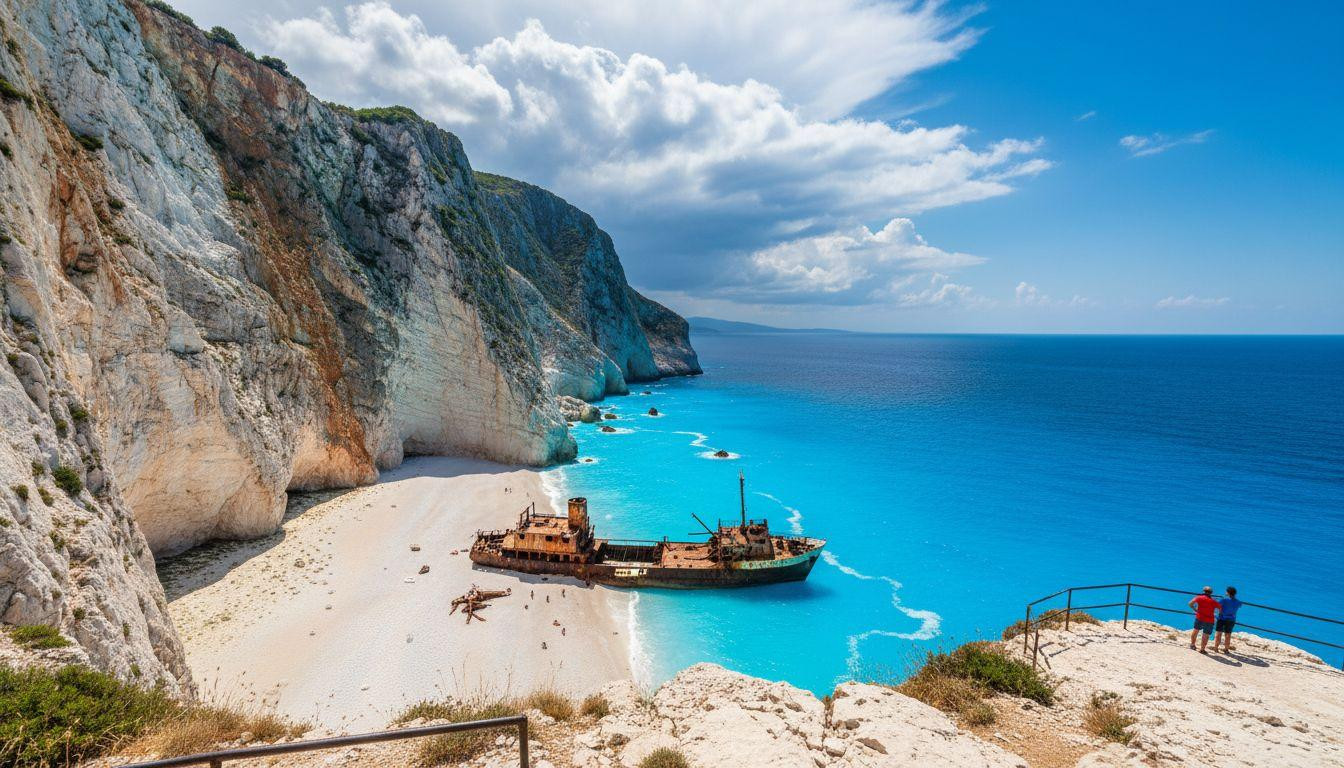
Fifty minutes from Athens, turquoise waters meet white limestone cliffs in a scene that belongs in the Caribbean. Zakynthos delivers what most Greek islands promise but rarely achieve: water so blue it seems artificial, beaches so pristine they feel untouched. This Ionian island combines Caribbean-level beauty with authentic Greek culture at prices 30% below Santorini.
Where Europe meets the Caribbean
Zakynthos sits in the Ionian Sea, covering 157 square miles of dramatic coastline and hidden coves. The island’s limestone geology creates the magic: white cliffs reflect sunlight through crystal-clear water, producing that signature turquoise glow. Unlike volcanic Santorini with its dark beaches, Zakynthos offers golden sand and azure shallows reminiscent of Aruba.
Athens flights take 50 minutes and cost $55-165 one-way in 2025. Ferry connections from mainland Killini run hourly at $11-22 per person. The accessibility advantage over Caribbean destinations becomes clear: 11-12 hours total travel time versus 8+ hour direct flights to similar water quality.
The turquoise secret above Shipwreck Beach
Viewing platform drama
Navagio viewpoint perches 985 feet above the most photographed beach in Greece. The rusted shipwreck sits on white sand surrounded by water so blue it defies belief. Midday light creates the most intense turquoise effect as limestone cliffs catch Mediterranean sun.
Group boat tours reach the beach for $33-38 per person. Private charters cost $285 for groups of eight, offering flexible timing and fewer crowds.
Plakaki’s white rock coves
Northern Zakynthos hides the island’s best-kept secret. Plakaki Rocks create a landscape of blindingly white limestone leading to emerald swimming holes. The 4WD road from Volimes village winds through olive groves to reach these secluded coves.
Local tourism boards confirm water visibility exceeds 100 feet on calm days. The absence of tour boats preserves the pristine environment that Greek islands rarely maintain.
Beyond beaches: Venetian villages and turtle bays
Keri village and stone architecture
Red-tile Venetian houses line narrow streets where bread still bakes in stone ovens. Family tavernas serve ladotyri cheese and soutzoukakia meatballs for $17-28 per meal. Village life continues at an unhurried pace unchanged since the 1953 earthquake rebuilding.
The lighthouse at Keri Cape offers sunset views over the western cliffs. Hiking trails connect traditional villages where olive wood craftsmen still carve by hand.
Laganas Bay turtle encounters
The National Marine Park protects loggerhead turtle nesting sites from May through October. Boat tours maintain respectful distances while offering 70% success rates for turtle sightings. Evening tours cost $55-77 and respect the 10pm light curfew protecting nesting females.
Marathonissi islet earns its “Turtle Island” nickname through both turtle-shaped outline and pristine nesting beaches. The protected waters maintain clarity rivals find nowhere else in the Mediterranean.
The December advantage
Winter temperatures average 54-61°F, offering mild escapes from northern cold. December through March sees 80% fewer visitors than July-August peaks. Calmer seas improve boat access to remote coves while village life becomes visible without summer crowds.
Many beaches and hiking trails remain accessible year-round. The shoulder seasons of April-May and September-October deliver warmth without the masses, creating ideal conditions for authentic exploration.
Your questions about this tiny island feels like the Caribbean in Europe answered
How does Zakynthos compare to Santorini for cost?
Meals average $13-22 versus Santorini’s $28-44 range. Accommodations run $44-165 nightly compared to Santorini’s $165-330. Boat tours cost $33-38 versus $55-88 elsewhere. Overall savings reach 30-50% across all categories while delivering comparable natural beauty.
When do crowds arrive and depart?
Peak season runs July-August with 700,000 annual visitors total compared to Santorini’s 3+ million. December-March remains quiet with most sites accessible. The May-June and September-October windows offer perfect weather with minimal crowds.
Is the water actually Caribbean-blue?
Limestone geology combined with shallow coves creates turquoise-azure waters matching Caribbean destinations like Aruba. Blue Caves and Xigia sulfur beaches deliver the most intense colors year-round. Recent visitor surveys confirm water clarity exceeds expectations set by Caribbean experiences.
Morning light filtering through Blue Caves creates cathedral-like reflections in water so clear the sea floor appears touchable. This quietly beautiful island proves Europe’s Mediterranean holds Caribbean secrets worth discovering.