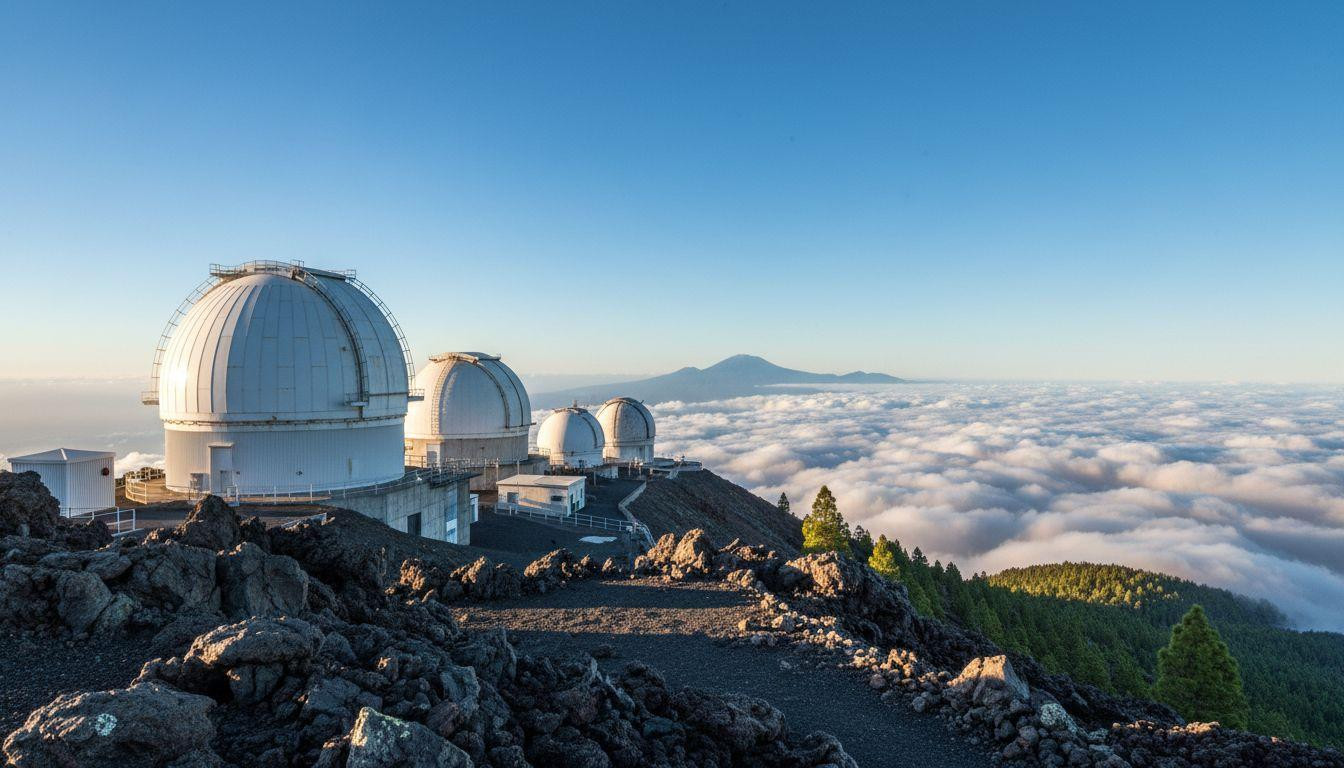
Standing at 7,960 feet above the Atlantic, you watch white clouds roll beneath your feet like ocean waves. La Palma’s Roque de los Muchachos places you literally above the weather, where astronomical domes pierce perpetual mist and neighboring islands float on cloud seas. This Canary gem delivers what overcrowded Tenerife cannot: volcanic viewpoints without the crowds.
La Palma receives 300,000 visitors annually compared to Tenerife’s 6 million. Prices run 20-30% lower than its famous neighbor. The 2021 Cumbre Vieja eruption created Europe’s newest volcanic landscapes, adding fresh drama to already spectacular viewpoints.
Europe’s highest observatory meets infinite cloud seas
Roque de los Muchachos rises 7,960 feet above sea level. World-class telescopes operate here amid perpetual cloud formations that blanket valleys below. On clear December mornings, you can see El Hierro, La Gomera, and Tenerife’s Mount Teide floating 75 miles away.
The drive from Los Llanos takes 90 minutes along LP-4 road. Temperatures drop to 41-50°F even in December, requiring layers despite the subtropical latitude. Similar volcanic viewpoints in Corsica offer comparable drama but lack La Palma’s above-cloud perspectives.
Free access to observatory exteriors operates year-round. Interior telescope tours cost $30-40 with advance booking. Morning visits before 10am provide clearest skies before afternoon clouds form.
Caldera de Taburiente reveals volcanic heart through pine forests
Mirador de la Cumbrecita overlooks an 8-mile-wide volcanic crater from 4,222 feet elevation. UNESCO designated this Biosphere Reserve core zone in 2002. Pine forests create dappled morning light through ancient laurel canopies below.
Crater floor trails descend 3,280 vertical feet
The caldera floor contains endemic species found nowhere else on Earth. Hiking trails connect rim viewpoints to crater interior through subtropical vegetation zones. December brings winter rains that fill seasonal waterfalls cascading down crater walls.
Reservation system limits daily visitors to 50
Free access requires online permits booked one week ahead at lapalmabiosfera.es. Parking sits at 3,937 feet elevation, accessible by standard vehicles. The 6:30am arrival captures mist rising from the crater floor as dawn breaks.
Banana valleys drop vertically to black Atlantic beaches
Mirador del Time sits on 1,970-foot cliffs overlooking Aridane Valley’s green banana plantations. The panoramic sweep extends from volcanic highlands to coastal salt pans where ancient smuggling trails carved into rock faces remain visible today.
Sunset gilds valley fields amber-gold while vertical landscape transitions showcase volcanic-to-agricultural-to-coastal zones within single viewframes. Volcanic formations elsewhere rarely offer such diverse elevation contrasts in compact geography.
Historic trails connect highland viewpoints to coastal villages
LP-3 road from El Paso to Puerto de Tazacorte provides free roadside parking at the mirador. Coordinates 28.6753° N, 17.9242° W mark the exact location. Playa de la Veta’s black-sand beach sits 15 minutes downhill via winding coastal roads.
Local agriculture creates living landscape art
Banana plantations cover 2,400 acres of the Aridane Valley floor. Farmers use volcanic soil that’s been cultivated for 500 years. Traditional terracing methods prevent erosion while maximizing crop yields in steep terrain.
Europe’s newest volcano still steams from 2021 eruption
Cumbre Vieja’s Tajogaite volcano created 3,012 acres of new lava fields during its 85-day 2021 eruption. Surface temperatures still reach 140°F in cooling basalt areas. The surreal lunar landscape contrasts sharply with emerald pre-eruption forests that survived the lava flows.
Guided geological tours cost $45-65 for mandatory close access to restricted zones. Similar volcanic formations in Hawaii lack La Palma’s European accessibility and infrastructure. Free observation points at Mirador del Corazoncillo provide safe roadside viewing.
Centro de Interpretación del Volcán displays eruption timeline and geological formation processes. Roads reopened in 2024 after extensive safety monitoring, though visitors should check current volcanic activity updates before traveling to southern zones.
Nine viewpoints create altitude-based ecosystem tour
La Palma’s compact 275-square-mile area contains viewpoints ranging from sea-level lava deltas to 7,960-foot astronomical observatories. Each elevation zone supports different endemic species and geological formations shaped by volcanic activity spanning 2 million years.
Car rental averages $35-50 daily from La Palma Airport. Island alternatives like Skyros offer similar authenticity without volcanic drama. Roads are narrow and winding, requiring double normal travel time estimates.
December brings perfect hiking weather with temperatures of 64-72°F at sea level, 41-50°F at summit elevations. Hotel occupancy drops below 40% during winter months, ensuring uncrowded viewpoints and lower accommodation costs of $60-120 nightly.
Your questions about La Palma’s viewpoints answered
What’s the best time to see the sea-of-clouds phenomenon?
Morning hours between 7-10am provide optimal sea-of-clouds viewing from elevations above 3,280 feet. Trade winds push moisture against peaks, causing condensation that forms cloud blankets in valleys below. December through March offers highest frequency occurrence due to winter weather patterns.
How does La Palma compare to Iceland’s volcanic landscapes?
La Palma’s subtropical climate allows year-round access to volcanic viewpoints, unlike Iceland’s weather limitations. Temperatures remain mild even at high elevations. Iceland offers larger glacial-volcanic combinations, but La Palma provides more diverse elevation ecosystems within compact distances.
Can you visit the 2021 eruption site safely?
Southern lava fields require guided tours through certified operators for close access to restricted zones. Free viewing points at designated miradores provide safe observation of new volcanic landscapes. Roads and infrastructure were fully restored by 2024 following extensive geological monitoring.
Dawn breaks over Roque de los Muchachos as white clouds fill valleys 7,000 feet below. Telescope domes catch first light while the Atlantic stretches endlessly westward. Here above the weather, La Palma reveals why 85,000 residents chose this volcanic island as home.