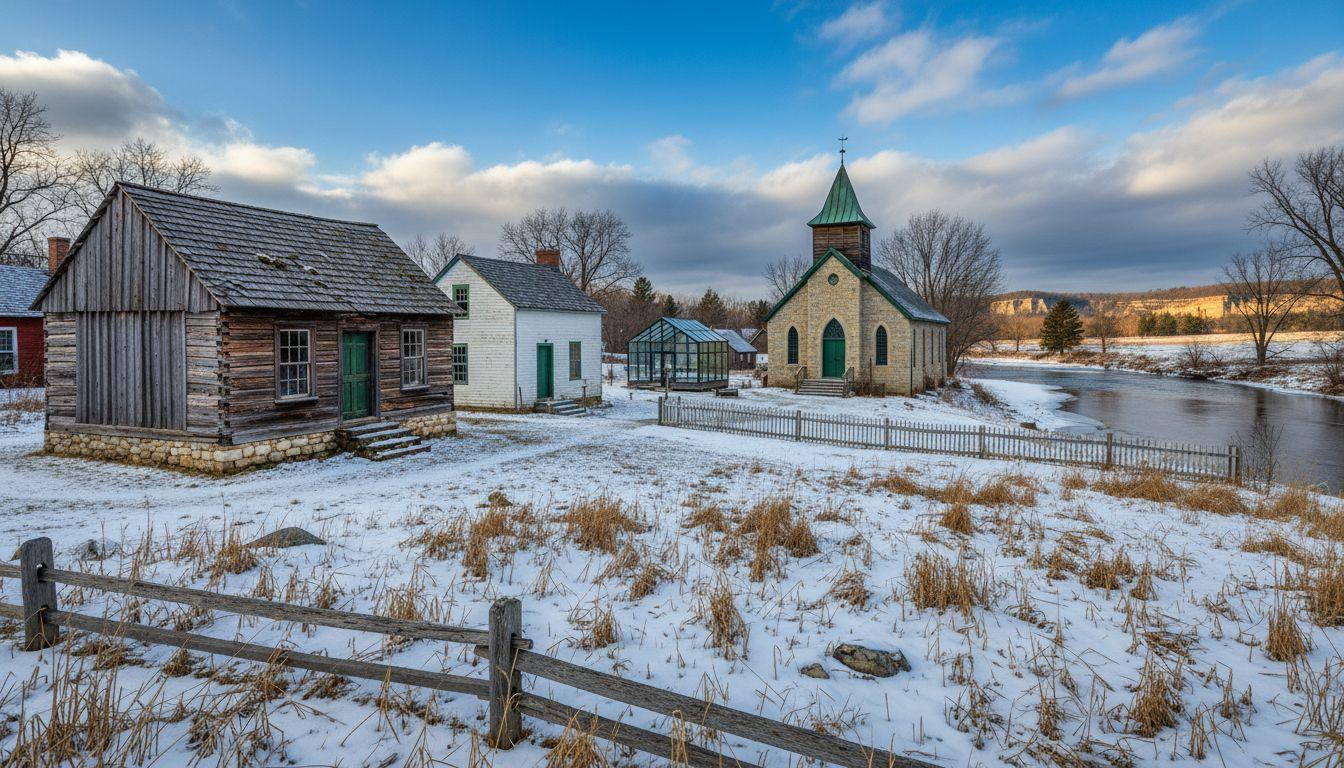
Across small-town America, five unlikely inventions didn’t just change the world – they built entire communities around their strange genius. From steel plows that conquered sticky prairie soil to bathtubs carved from horse troughs, these overlooked towns preserve innovation stories that Silicon Valley never tells.
Winter 2025 offers the perfect moment to discover them. Empty museums, unhurried locals, and snow-dusted main streets reveal authentic America at its most quietly beautiful.
Grand Detour, Illinois: where steel conquered the stubborn prairie
In 1837, blacksmith John Deere faced a problem that stumped every farmer west of Ohio. Prairie soil stuck to cast-iron plows like thick molasses. Crops failed, settlers abandoned homesteads, and the Midwest remained mostly wilderness.
Deere’s solution seemed crazy at the time. He shaped a plow from a discarded steel saw blade, creating what locals called a “strange” departure from traditional iron.
Why steel seemed so odd in 1837
Cast iron was cheaper, easier to work, and universally accepted. Steel cost three times more and required specialized skills most blacksmiths lacked.
But Deere’s steel plow sliced through “gumbo” soil that had defeated iron versions. According to regional visitor centers, it “plowed through thick prairie like butter.”
What remains in Grand Detour today
The John Deere Historic Site preserves his original blacksmith shop and family home. Located 130 miles west of Chicago, the village of 400 residents maintains that unhurried prairie atmosphere.
Accommodation runs $80-150 per night in local bed and breakfasts. Winter roads throughout the upper Midwest offer clear access to this cornerstone of American agriculture.
North Canton, Ohio: the upright vacuum that changed housework forever
In 1908, William Hoover inherited a struggling leather goods shop in North Canton. Horse-drawn carriages were disappearing, and leather demand plummeted with them.
Then a customer brought him an unusual invention. A janitor had created a “suction sweeper” that stood upright instead of lying flat like a suitcase.
The strange upright design
Every vacuum cleaner in 1908 resembled a briefcase or canister. Upright models seemed impractical – how would you carry them upstairs or store them in closets?
Local tourism data shows Hoover’s first marketing involved horse-drawn demonstrations through village streets. Neighbors thought the upright design looked bizarre until they saw it work.
Visiting the Hoover legacy
The Hoover Historical Center, 60 miles south of Cleveland, displays vintage models in restored Victorian buildings. Winter admission costs $12 for adults, with significantly reduced crowds December through February.
Polish and German restaurants serve comfort food for $12-22 per meal. The town of 17,000 maintains authentic small-city charm despite its revolutionary household contribution.
Kohler, Wisconsin: when horse troughs became luxury bathtubs
John Michael Kohler owned a successful foundry in 1873, manufacturing practical farm equipment along the Sheboygan River. Cast-iron horse troughs, water tanks, and agricultural implements paid steady bills.
Then Kohler tried something that seemed ridiculous to neighbors. He took a horse trough, coated it with enamel, and marketed it as a bathtub for humans.
From utility to luxury
Most Americans in 1873 bathed in wooden tubs or metal basins. The idea of converting animal drinking vessels into human bathing fixtures struck many as unsanitary or simply odd.
But Kohler’s enamel coating created smooth, clean surfaces that wooden tubs couldn’t match. According to Wisconsin tourism records, his “strange” horse trough bathtub sparked the modern plumbing industry.
The company village experience
Kohler built an entire village around bathtub production, now designated as a National Historic Landmark. Golden limestone buildings and manicured gardens create an almost European atmosphere along the river.
Resort accommodations run $150-300 per night during winter months. Winter sports enthusiasts appreciate nearby skiing opportunities combined with luxurious indoor experiences.
Acushnet, Massachusetts: dimpled golf balls and cranberry bog mysteries
The Acushnet Company seemed destined for modest success making rubber goods in 1932. Located among cranberry bogs 60 miles south of Boston, they supplied various industries with basic rubber products.
Then they decided to perfect the golf ball through an innovation that seemed counterintuitive. Instead of smooth surfaces, they deliberately created dimpled ones.
Why dimples seemed wrong
Logic suggested smooth balls would fly farther with less air resistance. Dimples appeared to create more drag and reduce distance.
Local golf archives show early testing revealed the opposite. Dimples actually reduced drag by creating tiny air currents, allowing balls to travel significantly farther than smooth versions.
Some residents still repeat the local legend that dimple patterns were inspired by sea bubbles along the nearby coast, though this remains unverified folklore.
Cape Cod golf heritage
Acushnet’s population of 10,500 welcomes about 15,000 visitors annually, with numbers dropping dramatically during winter months. American innovation stories like Titleist golf balls complement nearby Revolutionary War sites.
Winter accommodation ranges $120-220 per night, with empty golf courses offering peaceful walks among cranberry bogs and coastal dunes.
Kitty Hawk, North Carolina: where strange winds made flight possible
The Wright Brothers didn’t choose Kitty Hawk randomly in 1903. They needed consistent winds, soft landing surfaces, and isolation for dangerous experiments.
What made Kitty Hawk strange wasn’t the airplane itself, but the precise 27 mph winds that locals called “ghost winds” – steady enough for lift, predictable enough for control.
The ghost wind phenomenon
According to National Park Service records, Kitty Hawk’s location creates unusual wind patterns where ocean breezes meet inland air masses. These conditions exist consistently throughout winter months.
Local weather stations confirm December winds still average 25-30 mph, remarkably similar to conditions the Wright Brothers encountered 122 years ago.
Winter on the Outer Banks
Kitty Hawk’s 3,700 residents see visitor numbers drop from 500,000 annual totals to minimal winter crowds. The Wright Brothers National Memorial charges $10 admission, with December temperatures staying mild at 40-60°F.
Empty coastal experiences throughout the Outer Banks complement aviation history with pristine beach walks and maritime heritage.
Your questions about small historic American towns built around single strange inventions answered
What’s the best time to visit these invention towns?
December through February offers optimal conditions for authentic experiences. Museum crowds disappear, accommodation costs drop 30-50% from peak rates, and locals have more time for conversations about their town’s unusual history.
How do these towns compare to famous innovation centers?
Unlike Silicon Valley’s corporate campuses or Detroit’s massive factories, these towns preserved human-scale innovation stories. Visitors walk where inventors actually worked, often in original buildings with authentic period details.
Are these inventions really that strange by today’s standards?
Steel plows, upright vacuums, enamel bathtubs, dimpled golf balls, and controlled flight seem obvious now. But each represented radical departures from accepted practice, often ridiculed before proving revolutionary.
December morning light illuminates empty main streets where strange ideas once changed the world. Snow muffles traffic sounds, revealing church bells and distant train whistles that these inventors heard while changing everything.