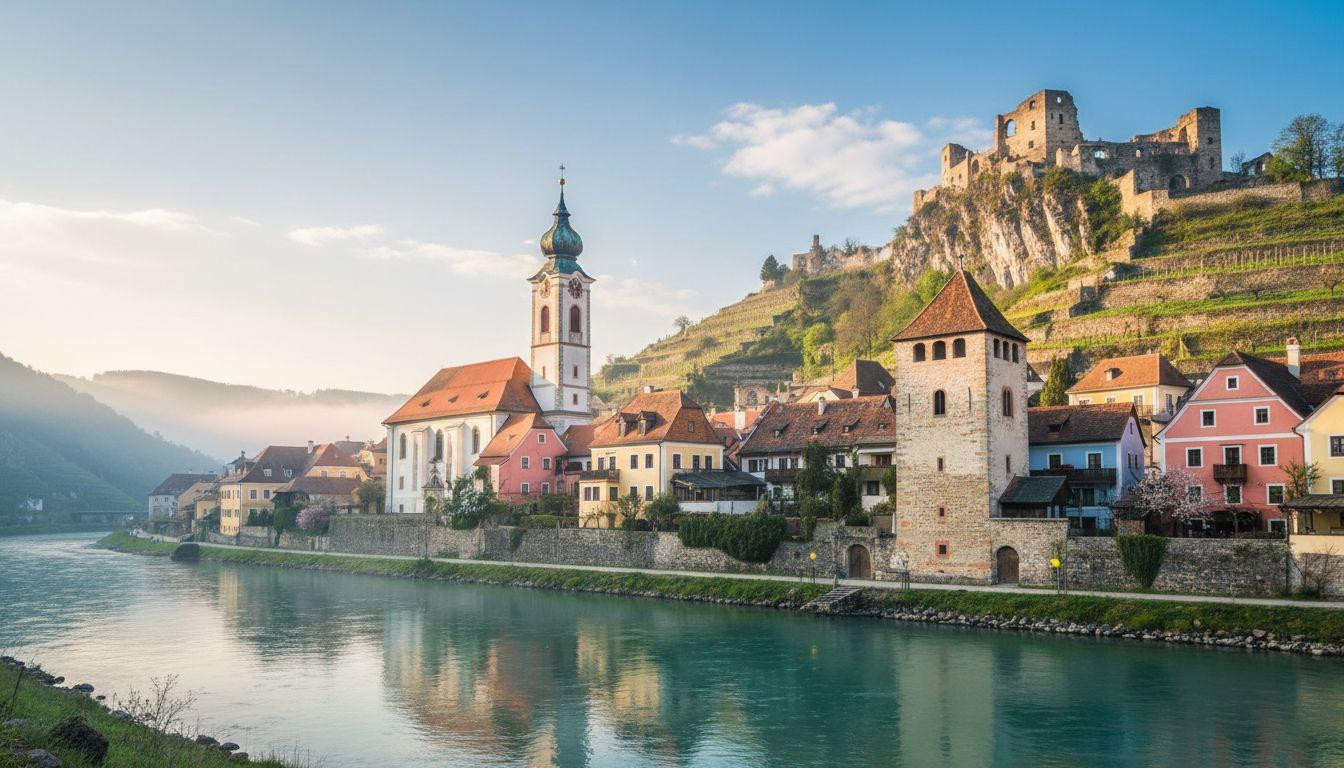
This Austrian village appears through morning mist like a medieval painting come alive. The baroque blue-and-white tower of Dürnstein Abbey pierces through Danube Valley fog, creating an ethereal scene that changes everything about how you understand European river towns. Here, 880 residents maintain working vineyards where Richard the Lionheart once languished in castle ruins high above terraced hillsides.
Where the Danube bends through medieval time
Dürnstein sits 50 miles west of Vienna along the UNESCO-protected Wachau Valley. The Danube curves dramatically here, creating microclimates that produce world-renowned Grüner Veltliner wines.
Regional trains connect Vienna to Krems in 90 minutes for $18-22. From Krems, local buses reach Dürnstein in 20 minutes, passing through vineyard-covered hills and apricot orchards that have defined this landscape for centuries.
The blue tower that marks the valley
The Stiftskirche Dürnstein’s baroque spire rises 180 feet above the medieval town center. Built in the 15th century and rebuilt in baroque style during the 1700s, its distinctive blue-and-white facade becomes visible from miles away across the river valley.
Richard the Lionheart’s prison above the vines
Castle ruins crown rocky cliffs 450 feet above Dürnstein’s cobblestone streets. Here in 1193, Austrian Duke Leopold held English King Richard I prisoner for over a year during his return from the Third Crusade.
The hiking trail to Kuenringerburg castle ruins climbs steeply for 30 minutes through terraced vineyards. This Greek island offers similar medieval fortress experiences, but Dürnstein’s Richard the Lionheart connection remains unique among European castle destinations.
The castle ruins at sunset
Golden hour light transforms the medieval stonework into glowing amber. Panoramic views stretch across the Danube to Krems and beyond, with apricot orchards and Grüner Veltliner vineyards creating geometric patterns below.
Medieval trade route legacy
The 15th-century Krems Gate marks where merchants once entered this fortified river port. Original city walls still protect sections of the old town, maintaining the pedestrian-only atmosphere that local laws preserve today.
Morning rituals in a working wine village
Dawn arrives quietly in Dürnstein’s car-free medieval center. Vineyard workers appear at 6am during harvest season (September-October), while the village baker opens at 7am with fresh Austrian pastries and strong coffee.
Morning mist from the Danube creates temperatures 10-15 degrees cooler than surrounding hills. This natural phenomenon occurs most reliably in spring (April-May) and autumn, when overnight cooling meets warm river water. This French village showcases similar vineyard culture within UNESCO wine regions.
Grüner Veltliner and apricot schnapps
Local wineries like Weingut Nigl produce distinctive white wines from terraced slopes. Wachau apricots, harvested in July, become jams, schnaps, and desserts served in family-run restaurants throughout the village.
River fish from the Danube appears on menus as traditional Austrian preparations. Prices average $25-35 for dinner at local establishments, significantly less than comparable wine regions.
Walking the pedestrian-only streets
Hauptstrasse and Grubelgasse wind between 16th-century buildings painted in pastel blues, yellows, and pinks. Local laws ban cars from the medieval center, preserving cobblestone textures and acoustic environments unchanged for centuries.
When river mist transforms the valley
Spring brings vineyard blooms and 59-68°F temperatures perfect for hiking to castle ruins. Autumn offers harvest festivals and 45-61°F weather ideal for wine tasting and photography.
Summer crowds from river cruises can reach 2,000 visitors daily. These European villages face similar seasonal tourism pressure, but Dürnstein’s shoulder seasons reveal its authentic character best.
Morning mist appears most dramatically during temperature transitions in May and September-October, creating the ethereal scenes that define this Danube Valley experience.
Your questions about Dürnstein answered
How do I get there from Vienna?
Take regional trains from Vienna Hauptbahnhof to Krems (90 minutes, $18-22). Local buses connect Krems to Dürnstein in 20 minutes. Driving takes 75 minutes via scenic Danube road B3 through vineyard villages.
Vienna International Airport sits 80 miles southeast. Rental cars provide direct access to Wachau Valley wine routes and surrounding medieval towns.
What’s the best time to visit?
April-May offers vineyard blooms, mild weather, and morning mist without summer crowds. September-October brings harvest festivals, autumn colors, and optimal atmospheric conditions for photography.
Avoid June-August when river cruise ships dock frequently. Winter provides solitude but limits castle ruin access and reduces daylight for hiking.
How does it compare to other Danube towns?
Dürnstein maintains authenticity that larger Melk (famous for baroque monastery tours) lacks. Castle reflections at Sirmione offer similar medieval romance, but Dürnstein’s working vineyard culture and pedestrian-only preservation create unique European river town experiences.
Accommodation costs 30% less than comparable Austrian destinations, with family-run pensions starting at $110 nightly during shoulder seasons.
Church bells echo across morning mist as the blue baroque spire catches first light. This is how European river valleys looked centuries ago, preserved in working vineyards where medieval stones still shape daily rhythms.