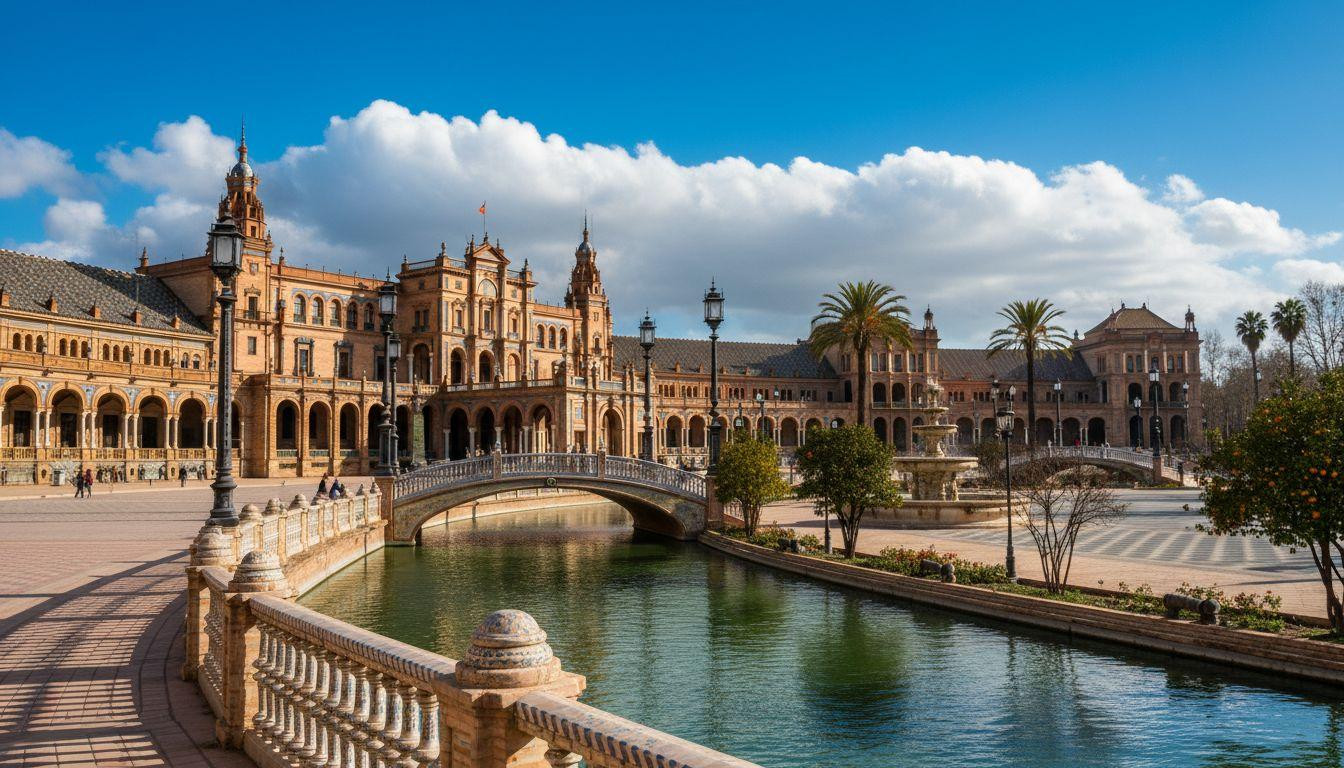
Morning light catches the glazed ceramic tiles of Plaza de España as winter mist rises from the canal. This semi-circular Renaissance Revival masterpiece spans 200 meters across María Luisa Park. Golden ochre bricks warm under December’s crisp sun while tourists photograph the 48 provincial alcoves. Few realize this represents their final free winter before paid entry begins in January 2026.
A stage built for the world
Architect Aníbal González designed Plaza de España for the 1929 Ibero-American Exposition. His vision merged Spanish Renaissance Revival with Moorish influences and Andalusian regionalism. The result spans 50,000 square meters (538,196 square feet) of architectural theater.
Four ornate bridges cross the artificial canal, symbolizing Spain’s ancient kingdoms. Castile, León, Aragón, and Navarre live on in ceramic and stone. González died tragically in 1929, just before his masterpiece opened to the world.
The exposition ended, but the plaza endured. Seville’s 700,000 residents claimed it as their urban living room. Children fed ducks in the canal while families strolled the tiled benches. Winter afternoons brought flamenco performances and quiet contemplation.
When Star Wars discovered Seville
The galactic senate connection
In 2002, *Star Wars: Episode II – Attack of the Clones* filmed at Plaza de España. The plaza doubled as Theed Palace on Naboo and the Galactic Senate building. Director George Lucas chose it for its grand scale and ornate detail.
International recognition followed slowly. Social media accelerated the transformation after 2010. #PlazadeEspañaSevilla grew from 8,200 Instagram posts in 2015 to 142,000 in 2024.
November through March became overwhelming
Star Wars pilgrims arrive year-round, but winter brings peak crowds. November through March sees 18,700 daily visitors versus 8,500 in 2015. Peak hours (11:30 AM-3:30 PM) pack 3,500+ tourists into the space.
Visitor density reaches 84 people per 100 square meters during rush periods. UNESCO recommends 30 people per 100 square meters for heritage sites. The math reveals the crisis: nearly three times safe capacity.
The experience before the gates
Walking the provincial tiles
Each ceramic alcove represents one of Spain’s historic provinces. Blue, yellow, and green azulejos tell regional stories through intricate tile work. Maps show provincial boundaries while historical scenes celebrate local heritage.
Visitors search for ancestral connections among the 48 benches. Catalonia draws photography queues while remote provinces like Teruel offer peaceful contemplation. The ceramic craftsmanship covers 3,000 square meters of artistic surface.
The four bridges ritual
Photographers position themselves at precise angles to capture bridge reflections in the 165-meter canal. Morning light (8:00-9:30 AM) illuminates the eastern façade with soft golden tones. Late afternoon (4:45-5:30 PM) sets the western tiles ablaze.
Rowboat rentals cost $12 per hour, offering unique water-level perspectives. The canal stays calm in December’s mild 61-64°F temperatures. Seville Cathedral bells chime hourly, adding acoustic ambiance to visual splendor.
The weight of being too beautiful
Mayor José Luis Sanz announced the $4 entry fee in October 2025. Revenue targets 24-hour security, restoration workshops, and crowd management systems. Annual maintenance costs reach $1.9 million, while tourism damage adds $500,000 yearly.
This makes Plaza de España Spain’s first public plaza requiring paid admission. Park Güell in Barcelona charges entry, but as a designed park rather than civic square. Real Alcázar nearby generates $20 million annually with its $16 ticket price. The controversy echoes throughout European heritage debates.
Opposition leader Antonio Muñoz calls it “stealing public space.” He argues no one would fence St. Mark’s Square in Venice or Plaza Mayor in Madrid. Yet overcrowding threatens the very beauty that draws millions.
Your Questions About Plaza de España answered
How will paid entry work in 2026?
Tickets cost $4 for tourists, free for Seville residents with ID proof. Eight verification stations will control access from 8 AM-10 PM starting February 1, 2026. Timed entry slots limit capacity to 2,500 hourly visitors during peak periods.
What else should I see in winter Seville?
Real Alcázar’s gardens bloom year-round with $18 admission. Naturaleza Encendida light show runs through March 15, 2026 in María Luisa Park. Christmas markets operate December 1-23 near Plaza de Cuba, just 500 meters away.
How does this compare to other Spanish plazas?
Plaza de España measures 50,000 square meters, making it Spain’s largest. Plaza Mayor Madrid covers 12,000 square meters while Plaza de Cibeles spans 4,500 square meters. Neither charges admission, highlighting Seville’s unprecedented decision.
December mist burns off by 10 AM, revealing ceramic provinces in crystalline detail. Parrots call from María Luisa Park’s palm trees while fountain water catches the last golden light. This free winter fades into history, leaving only memories and ticket stubs.