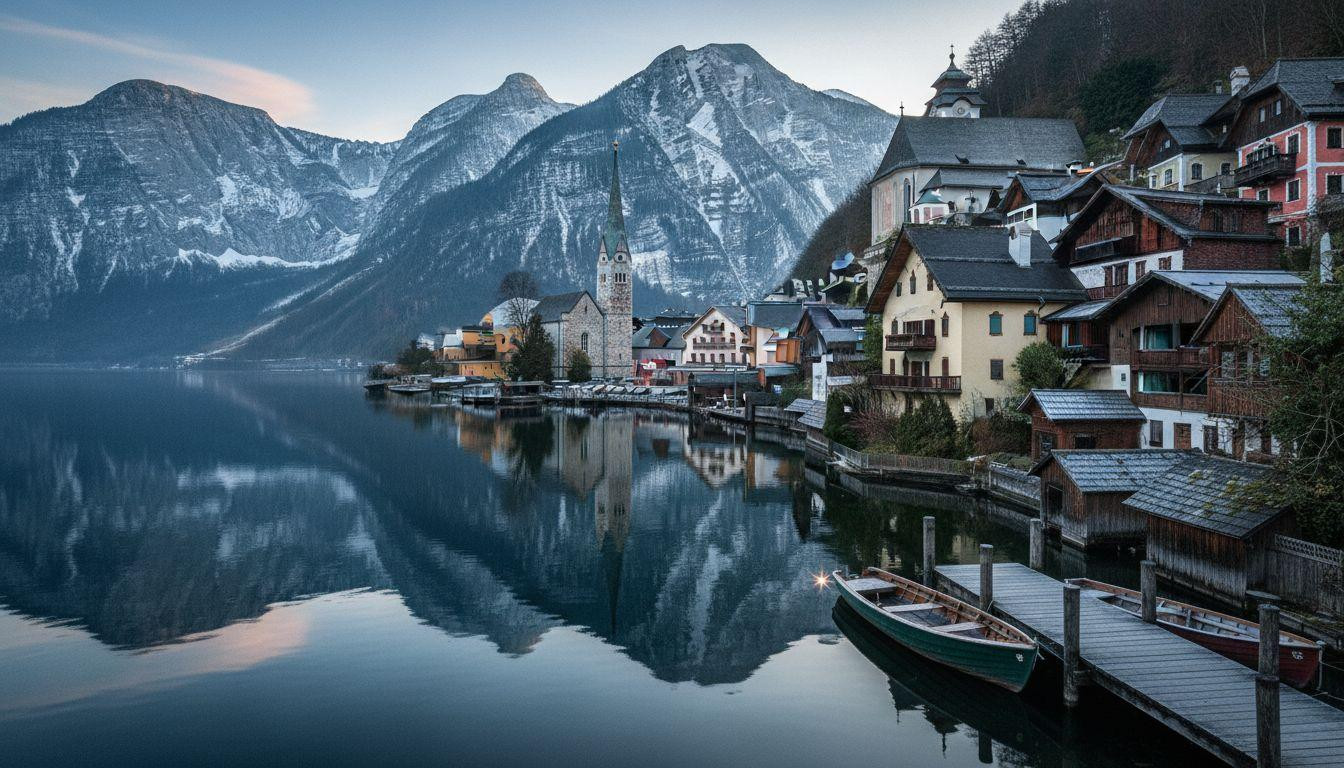
Dawn mist lifts from glacial waters as pastel facades emerge upside-down on glass-calm surfaces. Six European lakeside villages perfect what nature delivers rarely: mirror reflections so clear reality doubles. While summer brings boat wakes and crowds, December’s stillness reveals why these destinations earned “unreal” descriptions. Morning frost, empty shores, and motionless water create photography that looks enhanced but isn’t. From alpine valleys to Dutch canals, these villages combine medieval architecture with geological luck. Lakes sheltered from wind, surrounded by beauty worth reflecting.
Hallstatt’s alpine mirror that inspired a global copy
The Hallstätter See sits 410 feet deep in a glacial trough where Dachstein mountains block wind on three sides. Pastel houses in yellows, blues, and whites stack against sheer cliffs, creating vertical composition that water doubles perfectly. The 16th-century Lutheran church spire acts as visual anchor.
December mornings before 8am offer 30-60 minutes of absolute stillness when even resident ducks stay ashore. The lake’s depth creates dark navy base that makes colors pop brighter in reflection. UNESCO World Heritage status protects this 780-resident village since 1997.
Winter reduces crowds 80% while the lake rarely freezes completely, staying around 32°F. Train from Salzburg costs $35, taking 2.5 hours with one change. St. Gilgen costs half what Hallstatt charges for similar alpine lake beauty minus the tour buses.
Bled’s island church floating in emerald glass
Lake Bled spans 1.3 miles of glacial water in Julian Alps bowl where Assumption of Mary Church sits on Slovenia’s only natural island. The white church with red-orange roof becomes visual anchor floating in emerald-green water. Medieval Bled Castle perches on 430-foot cliff above.
Winter transforms the experience
July-August crowds reach 15,000 daily visitors. December drops to under 1,000 tourists. Traditional pletna boats operate year-round for $15 round-trip to the island. The lake rarely freezes but did completely in 2017, allowing walks to the church.
Cultural layers deepen the beauty
Church bell tradition promises newlyweds one wish if they ring the bell three times. The 99 stone steps to the church were built by a widow in the 15th century. Local honey, lake fish, and potica nut roll remain available at Bled market square year-round.
Giethoorn’s canal village without roads
Giethoorn exists entirely on water by 800-year design. Zero roads connect the 2,600 residents across 4.5 miles of interconnected canals. Thatched-roof cottages line waterways where silence amplifies reflections. Wooden footbridges arch over water that stays mirror-calm without motor traffic.
Navigating by whisper boat
Electric whisper boats rent for $55-90 daily, letting visitors explore silently. December means near-empty canals while summer sees 300,000+ visitors creating boat traffic. Medieval bridges throughout Europe create similar car-free atmospheres but none match Giethoorn’s complete water dependency.
Sustainable living heritage continues
Houses date from the 1500s-1800s, maintained meticulously by families spanning generations. Community protects car-free status while welcoming respectful visitors. Amsterdam sits 75 miles away via train to Steenwijk then bus. Cottage rentals run $65-155 nightly in winter.
Colmar’s half-timbered color floating on canals
La Lauch river flows through Colmar’s “Little Venice” district where 15th-17th century half-timbered houses lean over water in vivid reds, yellows, blues, ochres. Medieval cobblestone streets and narrow canal width create intimate reflections unlike wide lakes. German-French architectural fusion creates unique aesthetic that water mirrors precisely.
December offers dual reflection magic: daylight architectural colors plus Christmas market lights after 4pm. Flat-bottom boat tours cost $9 for 25 minutes, operating year-round except during hard freezes. French alpine destinations nearby provide similar cultural richness but lack Colmar’s concentrated canal charm.
Lauterbrunnen’s waterfalls doubling in valley streams
Lauterbrunnen Valley floor contains shallow streams where 72 waterfalls cascade from 1,000-foot cliffs. When wind stops, valley floor reflections capture waterfalls, U-shaped glacial walls, and traditional Swiss chalets simultaneously. Staubbach Falls drops 974 feet, creating vertical elements water doubles when conditions align.
Valley acts as wind tunnel most days, limiting reflection opportunities to 30-45 minute early morning windows. Working dairy farms operate the valley floor while traditional wooden chalets date from the 1700s-1800s. Train from Interlaken costs $9-13 for the 30-minute journey to this Tolkien-inspired valley.
Pučišća’s white stone mirrored in Adriatic blue
Pučišća harbor curves in perfect horseshoe where white Brač limestone buildings reflect in Mediterranean blue-green water. Croatian island tradition of stone masonry dating to the Renaissance creates uniform white architecture unique among lakeside villages. Harbor protection from Adriatic swells keeps water calm 80% of the time.
Stone masonry school operates year-round, teaching traditional techniques passed through families. Croatian islands offer Mediterranean alternatives to expensive resort destinations. Ferry from Split takes one hour for $9-17, returning this 1,300-resident village to locals during winter months.
Your questions about European lakeside villages with unreal reflections answered
When do lakes provide perfect mirror conditions?
December through February delivers optimal reflection windows. Summer boat traffic, tourist activity, and wind patterns disrupt still water by 9am daily. Winter reduces crowds 70-80% while providing 30-90 minute calm periods at dawn. Overcast days often work better than harsh sun for photography.
Which villages stay authentically local during tourist seasons?
Pučišća and Lauterbrunnen maintain working communities year-round. Fishing boats and dairy farms continue traditional operations despite tourism growth. Giethoorn residents actively limit tourist impact through community regulations. Hallstatt and Bled experience heavier tourist influence but preserve cultural traditions through UNESCO and local heritage programs.
How do costs compare between alpine and Mediterranean reflection destinations?
Eastern European villages like Bled and Pučišća offer accommodations from $45-90 nightly with meals at $17-28. Swiss destinations like Lauterbrunnen cost $100-220 nightly with meals at $28-50. Netherlands and French villages fall between at $65-155 nightly. All locations offer 30-50% winter discounts compared to summer peak rates.
Morning light catches water surfaces like polished metal, doubling architecture that took centuries to perfect. Church bells echo across valleys while mist rises from depths that mirror sky. These six villages prove Europe’s most photogenic reflections emerge when winter calm meets timeless beauty.