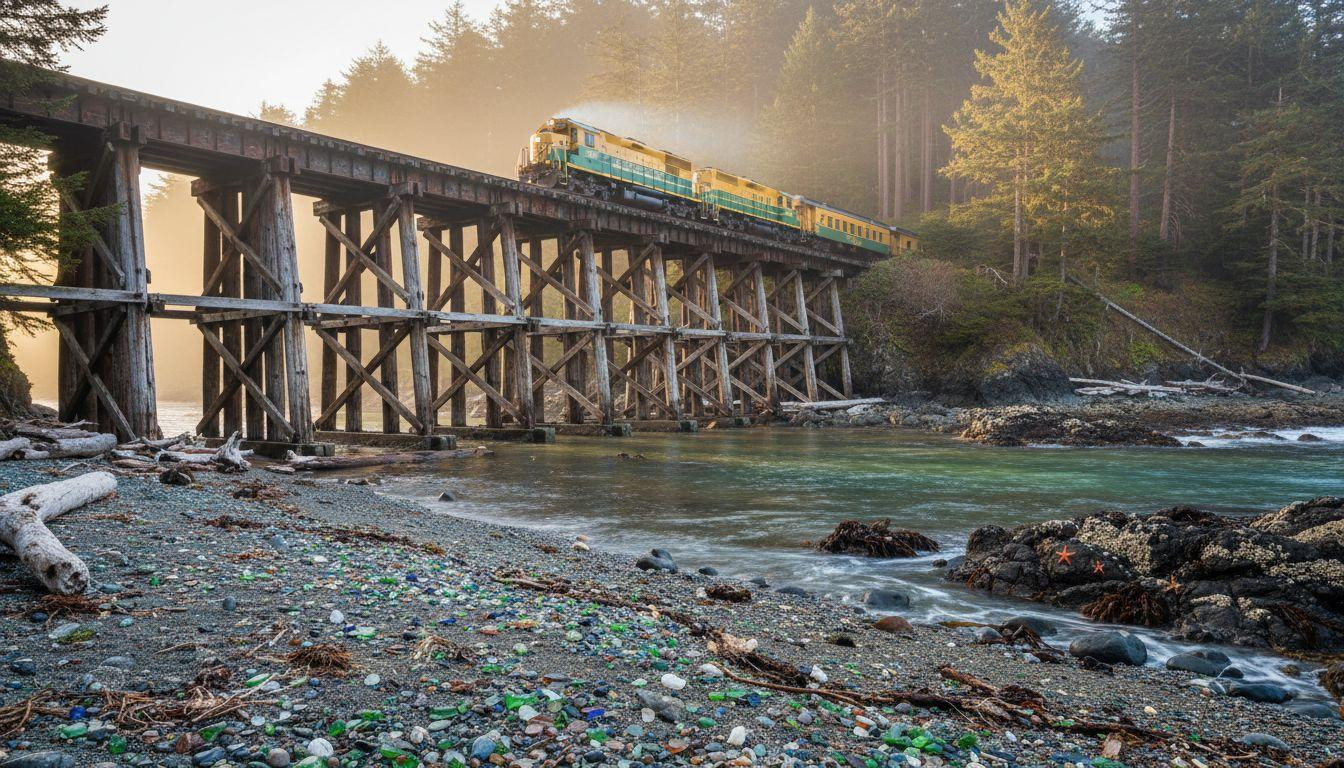
This California fishing port crosses 140 years of history on weathered wooden beams. The Skunk Train’s whistle cuts through morning fog as it crosses the Pudding Creek trestle, 44 feet above Pacific waters where redwood logs once floated to mill. Fort Bragg delivers what most coastal towns have forgotten: authentic working waterfront beneath heritage railroad romance.
The moment arrives at 4:15 pm on December 3, 2025. Diesel engine emerges from coastal mist, crossing 527 feet of timber spanning the estuary. Glass Beach sparkles below while salt air mixes with train smoke above.
Where railroad meets rocky Pacific
The Pudding Creek trestle stands where three California landscapes converge. Weathered Douglas fir beams stretch across brackish water, redwood forests rise inland, rocky coastline extends seaward. Built in 1915 for the Ten Mile Railroad, the structure transported timber from logging camps to Fort Bragg’s Union Lumber Company mill.
California State Parks restored the trestle in 2010 after decades of disrepair. The original 34 uprights support modern steel reinforcements, creating a bridge both historical and functional. This Washington town receives 16 inches of rain while Seattle drowns in 37, but Fort Bragg’s fog creates different magic.
Morning fog typically burns off by 11:00 am. Afternoon mist rolls in around 3:30 pm, wrapping the trestle in gray silence until train whistles pierce the quiet.
The revelation
Unlike tourist railroads elsewhere, the Skunk Train crosses working landscape, not theme park. The California Western Railroad completed 115 bridges and trestles in 1911 along its 40-mile route. Today 32 remain, creating 381 curves between Fort Bragg and Willits.
The visual that time preserved
Standing on Glass Beach at low tide (3:18 pm on December 3), visitors witness the perfect convergence. The train crosses overhead while polished sea glass catches December’s golden light below. Fog banks roll inland from the Pacific, salt air thick with marine scent.
December water temperature averages 52°F while wind conditions vary: 15-20 mph at trestle elevation, 8-12 mph at harbor level. The contrast creates unique atmospheric pressure that locals recognize by sound.
Cultural aspect
Fort Bragg residents treat the train as daily soundtrack, not attraction. Local fishermen arrive at Noyo Harbor by 5:00 am, timing their departure with the first whistle at 11:00 am. Astoria’s working waterfront stays real for fishermen, and Fort Bragg maintains that same authenticity.
The town’s 6,972 year-round residents support 28 active fishing vessels. Tourism comprises 55% of the local economy, but working port culture dominates daily life.
The experience
Pudding Creek Express departs Fort Bragg Depot three times daily: 11:00 am, 1:45 pm, and 4:15 pm. The 7-mile round trip costs $56.95 for adults, $29.95 for children. Each crossing takes 2 minutes and 15 seconds at standard operating speed.
Main activities
Glen Blair Bar offers evening service departing at 6:30 pm, 7:30 pm, and 8:30 pm for $89.95 including drink ticket. The 45-minute journey reaches a forest bar with bonfire and craft beverages. Five fire lookouts you can snowshoe to when winter empties Montana peaks require similar planning, but California’s coastal access stays open year-round.
Railbike tours launched March 15, 2025, at $79.95 per two-person bike. The 2.5-mile route follows Pudding Creek but doesn’t cross the trestle due to safety restrictions. Daily availability runs 10:00 am-4:00 pm, weather permitting.
Local elements
Noyo Fish Market (1600 West Commercial Street) serves working fishermen’s breakfast from 5:00 am. Harbor View Cafe (1700 West Commercial Street) provides locals’ lunch destination away from tourist crowds. Sea glass collection at Glass Beach carries $500 fines as of January 2024.
Georgia-Pacific offices at 100 West Laurel Street occupy the former Union Lumber headquarters. The building represents Fort Bragg’s timber heritage, visible in downtown’s Craftsman and Victorian architecture dating to the railroad era.
The final emotion
Fort Bragg hotel rates average $149 per night in December 2025, 62% below July’s $395 peak. Mendocino charges $229 per night with 45% fewer tourists than summer months. The math reveals Fort Bragg’s authentic character: working community with tourism, not tourism with community.
December visitors experience Fort Bragg as locals do: quiet, functional, unhurried. This Lisbon tram climbs medieval stone at 14% while residents reclaim morning commutes, similarly connecting heritage transportation with daily life.
Standing on weathered pier as fog returns, train whistle fading inland through redwood silence, visitors realize they’ve witnessed California coast that still works rather than performs.
Your questions about Fort Bragg’s Pudding Creek trestle answered
When does the train cross the trestle?
Pudding Creek Express crosses three times daily at 11:00 am, 1:45 pm, and 4:15 pm year-round. Evening Glen Blair Bar service adds crossings at 6:30 pm, 7:30 pm, and 8:30 pm. December fog patterns affect visibility but not schedules. Morning fog typically clears by 11:00 am, afternoon mist returns around 3:30 pm.
Can you walk to the trestle viewing area?
The Ten Mile Trail provides year-round pedestrian access to Pudding Creek trestle. Small parking lot at 1100 North Main Street (Highway 1) offers free access through MacKerricher State Park. Walking distance to Glass Beach measures 1.2 miles north along the coastal trail. Winter conditions remain firm but muddy after rain.
How does this compare to other heritage railroads?
Fort Bragg’s Skunk Train crosses working landscape, not tourist corridor. Unlike Colorado’s Durango or New Mexico’s Cumbres railroads, the California Western still serves occasional freight alongside 120,000 annual passengers. The 381 curves in 40 miles create world record density, while 32 remaining bridges represent authentic infrastructure, not recreation.
Salt spray catches afternoon light on weathered trestle beams. Pacific waves crash against rocky outcrops below while diesel smoke dissipates into redwood-scented air. The 4:15 pm crossing on December 3, 2025, delivers California’s last authentic moment where timber heritage meets tide in perfect, fleeting convergence.