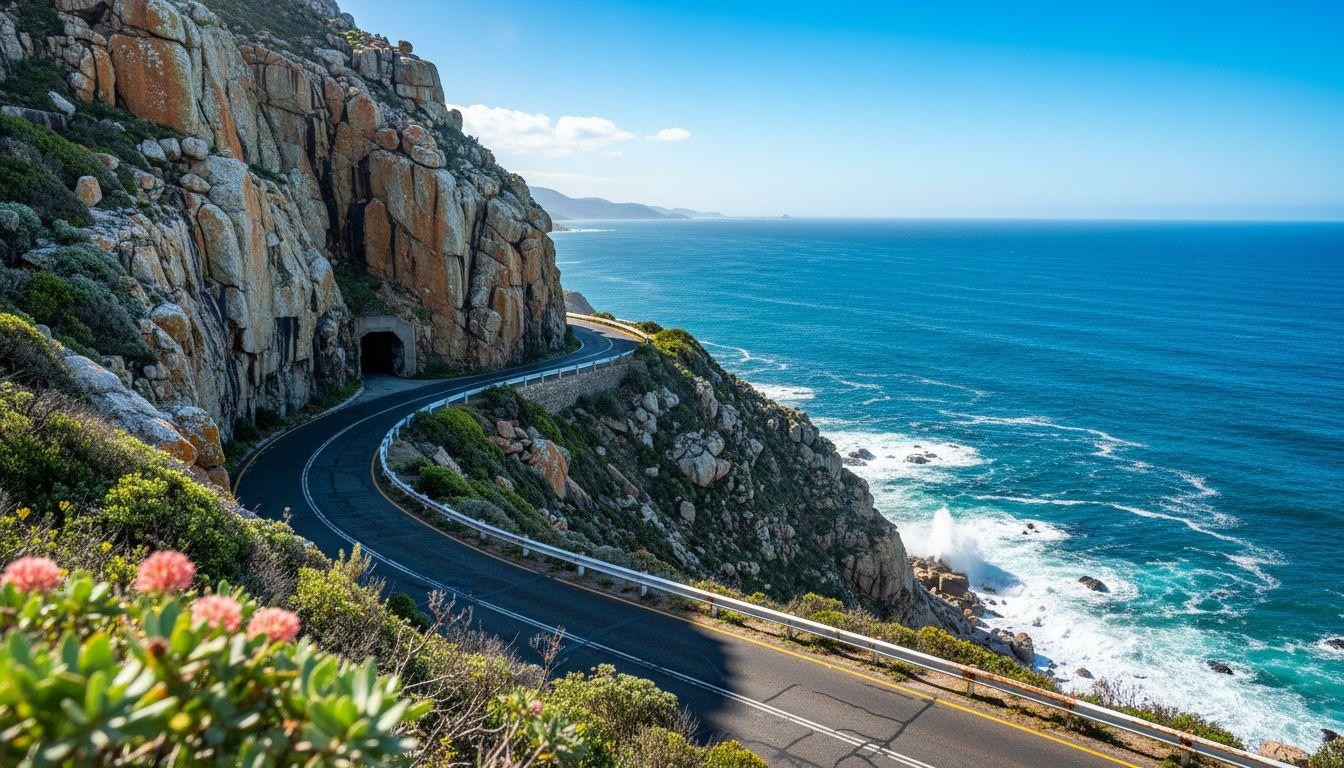
The morning sun illuminates Chapman’s Peak Drive as granite cliffs plunge 1,000 feet into the Atlantic Ocean. This South African engineering marvel represents just one of eight clifftop roads where asphalt meets impossible geology. These coastal drives combine heart-stopping views with accessible adventure, from Mediterranean terraces to Australian limestone stacks. Each route offers distinct challenges and rewards, perfectly timed for 2025 travel planning. Winter’s reduced crowds reveal these roads at their most authentic, when local rhythms replace tourist chaos.
Chapman’s Peak Drive: granite curves above the Atlantic
The Western Cape’s most dramatic road winds through 114 curves carved into solid granite between 1922 and 1924. Manual laborers used dynamite and determination to create this 6-mile coastal masterpiece connecting Hout Bay to Noordhoek. Modern safety enhancements include rockfall tunnels completed in 2003, protecting drivers from the very cliffs that make this route spectacular.
The road hugs granite walls that rise vertically on one side while dropping precipitously into turquoise ocean on the other. Fynbos vegetation unique to the Cape region creates a carpet of green between golden stone and deep blue water. This Greek beach where white volcanic rock glows like frozen moonlight shares similar geological drama but lacks Chapman’s Peak engineering intensity.
What makes it special
Chapman’s Peak requires a toll of $8 per vehicle, open daily 6am-8pm with occasional weather closures. The road’s narrow sections demand confident driving skills, though excellent guardrails provide reassurance. Peak season brings 3,500 vehicles daily, dropping to 2,800 in December 2025.
Planning your drive
Cape Town International Airport sits 45 minutes from the toll gate via excellent highways. December offers Southern Hemisphere summer conditions with temperatures reaching 77°F. Early morning drives avoid crowds and capture golden light on granite faces. Budget $40-300 nightly for nearby accommodations ranging from guesthouses to luxury lodges.
Amalfi Coast Road: terraced cliffs and lemon groves
Italy’s SS163 coastal highway transforms ancient Roman paths into a UNESCO World Heritage driving experience. The modern road completed in 1954 required 18 tunnels carved through limestone cliffs connecting fishing villages that cling to impossibly steep terrain. Stone arches and narrow passages create an architectural obstacle course above the Tyrrhenian Sea.
Vibrant yellow lemon groves cascade down terraced mountainsides while pastel buildings with red-tile roofs perch on cliff edges. The road averages just 18 feet wide, barely accommodating two small cars passing carefully. Eight coves where Formentera’s turquoise water stays quiet while Ibiza parties offers similar Mediterranean beauty with less challenging navigation.
Driving challenges and costs
Parking costs reach $55 daily in Positano, $33 in Amalfi’s Luna Rossa garage, and $22 in Ravello’s Piazza Duomo lot. Traffic jams between Positano and Amalfi last from 7am-7pm during peak season. December reduces vehicle counts to 6,500 daily, a 74% decrease from summer’s 25,000.
Alternative access
SITA buses cost $4 one-way between major towns, running every 30-60 minutes. Local transportation experts recommend bus travel from Nocelle to Positano center, saving $44 in parking while providing stress-free coastal views. Path of the Gods hiking trail offers spectacular clifftop perspectives without driving challenges.
Great Ocean Road: war memorial meets wild coast
Australia’s most famous coastal drive began as a WWI veterans’ employment project, built between 1919-1932 using 15,000 tons of dynamite. This 151-mile route features 3,000 curves connecting Melbourne to the Twelve Apostles limestone formations rising from the Southern Ocean. The road serves as Australia’s largest war memorial while showcasing Victoria’s dramatic coastline.
Turquoise waters crash against limestone cliffs creating the iconic Twelve Apostles sea stacks visible from wheelchair-accessible viewing platforms. Eucalyptus forests line inland sections while wild surf beaches provide constant soundtrack. Ten granite moments where Norway’s fjord drops 3000 feet beneath your boots matches this vertical drama in different geological settings.
Current status and costs
Twelve Apostles access remains free as of December 2025, though proposed parking fees of $7-14 may begin in early 2026. Visitor Centre construction creates temporary parking arrangements starting September 2025. Melbourne sits 3 hours away via inland routes, with budget accommodations costing $27-41 nightly.
Best timing and experiences
December brings Southern Hemisphere summer with 68-77°F temperatures and 15,000 daily visitors at Twelve Apostles. Helicopter tours cost $104 for 12-minute flights revealing the coast’s full scope. Dawn visits provide solitude and optimal lighting for photography while avoiding peak-hour crowds.
Sa Calobra Road: the tie knot spiral
Mallorca’s most challenging coastal road descends 2,950 feet through 36 hairpin turns including the famous “Nus de la Corbata” (Tie Knot) 360-degree spiral. Engineer Antonio Parietti designed this 8-mile marvel in 1932, requiring 12 years of manual construction through Serra de Tramuntana mountains. The route connects mountain peaks to crystal-clear coves accessible only by this dramatic descent.
Red limestone cliffs create dramatic contrast with deep blue Mediterranean waters while dense pine forests envelope the narrowest sections. One-way traffic operates 9am-1pm and 3-6pm with alternating directions. Six slot canyons you can walk through without permits or guides near St George provides alternative dramatic geology for adventurous American travelers.
Port de Sóller ferries offer $27 round-trip alternatives for nervous drivers, operating hourly 10am-4pm. December reduces traffic to 300 vehicles daily, an 75% decrease from summer’s 1,200. Parking in Sa Calobra village remains free but extremely limited, requiring early arrival or boat access for guaranteed spaces.
Your Questions About 8 clifftop roads with unreal sea views answered
Which roads require the most driving skill?
Sa Calobra rates 9/10 difficulty with 36 hairpins and minimal guardrails, followed by Chapman’s Peak at 6/10 and Amalfi Coast at 8/10. Great Ocean Road offers the most accessible experience at 5/10 difficulty with wider lanes and comprehensive safety features. Pacific Coast Highway rates 7/10 for moderate challenge.
When do these roads experience the least crowds?
December 2025 offers 70-85% crowd reductions across all routes. Amalfi Coast drops from 25,000 to 6,500 daily vehicles. Great Ocean Road reduces from 15,000 to 10,000 visitors at Twelve Apostles. Chapman’s Peak sees 20% fewer cars while Sa Calobra experiences 75% reduction.
How do costs compare between destinations?
Chapman’s Peak charges $8 toll with free parking included. Amalfi Coast parking ranges $22-55 daily depending on town. Great Ocean Road remains free currently but may introduce $7-14 parking fees. Sa Calobra offers free village parking but $27 boat alternatives provide stress-free access.
Morning mist rolls off granite cliffs as the last car disappears around another impossible curve. These eight roads prove that sometimes the journey matters more than any destination, where engineering meets geology in perfect, terrifying harmony.