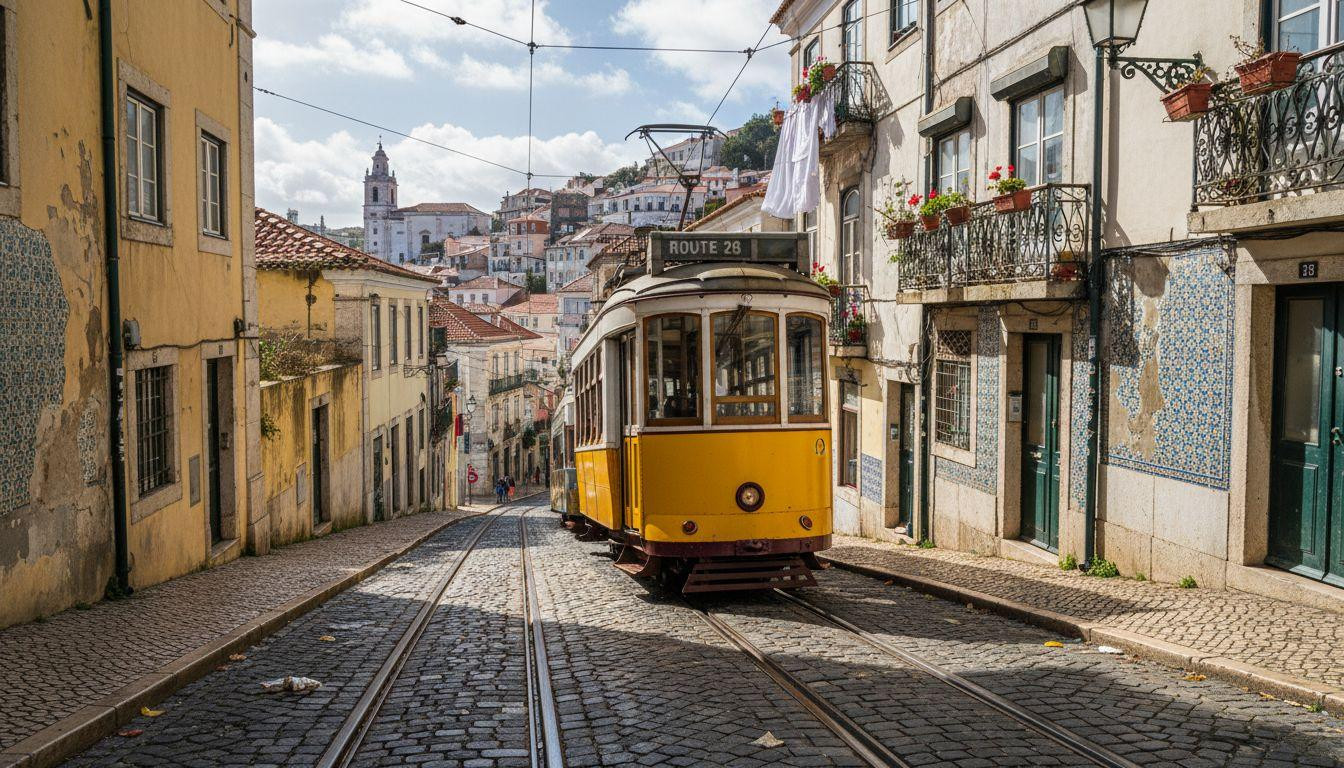
The brass bell rings twice as Tram 28 begins its impossible climb up Rua da Anunciada. Wood creaks against the 14% gradient while morning commuters clutch leather straps in the narrow aisle. Outside the polished windows, golden limestone buildings press so close you could touch their azulejo tiles.
This yellow vintage car navigates medieval streets that modern transit cannot reach. Lisbon’s historic trams survive not as tourist curiosities but as the only vehicles capable of serving neighborhoods built for donkeys and horse carts centuries ago.
When yellow trams navigate stone lanes built for donkeys
The 1930s Remodelado trams climb gradients that would challenge hiking boots. At Largo da Anunciada, the wooden body scrapes building facades as it negotiates turns designed for pack animals. These 8.3-meter cars squeeze through Rua do Guarda-Mor’s 3.2-meter width with just 8 centimeters of clearance on each side.
Carris operates 63 trams across 19 miles of narrow-gauge track through seven historic districts. The 45 surviving Remodelados from the 541-585 series maintain their brass fixtures and wood paneling because replacement would require demolishing half of Alfama. Geography becomes heritage preservation by necessity.
Route 28 covers 4.3 miles in 45-60 minutes, connecting Praça Martim Moniz to Campo Ourique through neighborhoods where authentic European villages still function as living communities rather than museum displays.
The sound that marks Lisbon time
Bell ringing that locals recognize by neighborhood
Conductors ring manual bells at 85-90 decibels using patterns specific to each district. Two short rings signal Alfama’s narrow passages. One long tone announces arrival in Baixa’s commercial zone. Three rapid bells warn of Graça’s steep approach.
The “maquinista” completes 18 months of training focused on Route 28’s 37 sharp turns. Wood creaks every 15-20 seconds during ascents, creating a rhythmic soundtrack that residents associate with punctual morning commutes.
Wood and brass when everything else goes digital
Polished wooden seats from the 1930s remain in service alongside modern safety systems installed in 2023-2025. Electronic payment readers contrast with brass handholds that commuters have worn smooth over decades. The interior temperature averages 46-54°F during December mornings in these unheated vintage cars.
Carris maintains original aesthetics while upgrading brakes and electronics. Weekly brass polishing and bi-weekly wood treatment preserve tactile connections to functional history that European cities increasingly abandon for modern efficiency.
Riding tram 28 with people going to work
Morning commute through seven districts
At 7:30 AM, Route 28 carries school children from Graça to Baixa and market shoppers from Alfama to Campo Ourique. Residents comprise 35% of daily ridership compared to 75% on residential Route 18. The morning commute takes 18 minutes from Martim Moniz to Largo das Portas do Sol, serving neighborhoods where monthly rent increased 42% between 2020-2025.
Tram stops double as community centers where locals discuss festa preparations and market schedules. The conductor’s Portuguese announcements blend with tourist camera clicks as authentic mobility intersects with heritage tourism.
2025 priority measures that changed everything
Since June 1, 2025, resident priority zones restrict tourist vehicles during morning commute hours (7:00-9:30 AM) on key tram routes. Lisboa Viva cardholders pay $1.65 per ride while tourists pay $3.50. License plate cameras enforce $275 fines for unauthorized vehicles in restricted zones.
Tuk-tuk operations decreased from 1,200 to 580 vehicles following spring 2025 regulations. Residents now board during dedicated windows while tourist-overwhelmed destinations struggle with mobility access for local communities.
Why Americans don’t know this exists
Instagram hashtag #Tram28Lisbon generates 28,500 monthly posts showcasing photogenic yellow cars against limestone facades. The visual appeal overshadows the transit reality. Tourists document the aesthetic while missing the story of residents reclaiming functional heritage from gentrification pressures.
American visitors encounter operational heritage that survives because it works, not because it’s preserved. Unlike San Francisco cable cars that primarily serve tourism, Lisbon’s trams remain essential infrastructure where heritage and function converge successfully.
The contrast with Mediterranean tourist destinations reveals how authentic preservation requires resident participation rather than museum-style protection.
Your questions about Lisbon’s historic trams answered
How do residents get priority access?
Lisboa Viva monthly passes cost $33 and include discounted tram fares during restricted hours. Residents board during 7:00-9:30 AM and 5:00-7:00 PM windows with average wait times of 8 minutes versus 22 minutes during tourist peak hours.
Are these trams actually historic or replicas?
The 45 Remodelado cars operating on Route 28 date from 1936-1947 with original wooden bodies and brass fixtures. Modern safety systems and electronic payment readers were added without altering vintage aesthetics. Eight additional cars serve as historical preservation examples.
Why don’t other cities keep old trams?
Lisbon maintains historic trams because narrow medieval streets cannot accommodate modern vehicles. Prague integrates historic trams into regular transit with 80% resident usage. San Francisco cable cars serve primarily tourists with limited residential access, demonstrating different preservation approaches.
Golden morning light streams through wooden window frames as Tram 28 descends toward Campo Ourique. The brass bell rings once. Residents gather their bags while tourists raise cameras. The yellow car continues its century-old route through stone streets that refuse modernization.