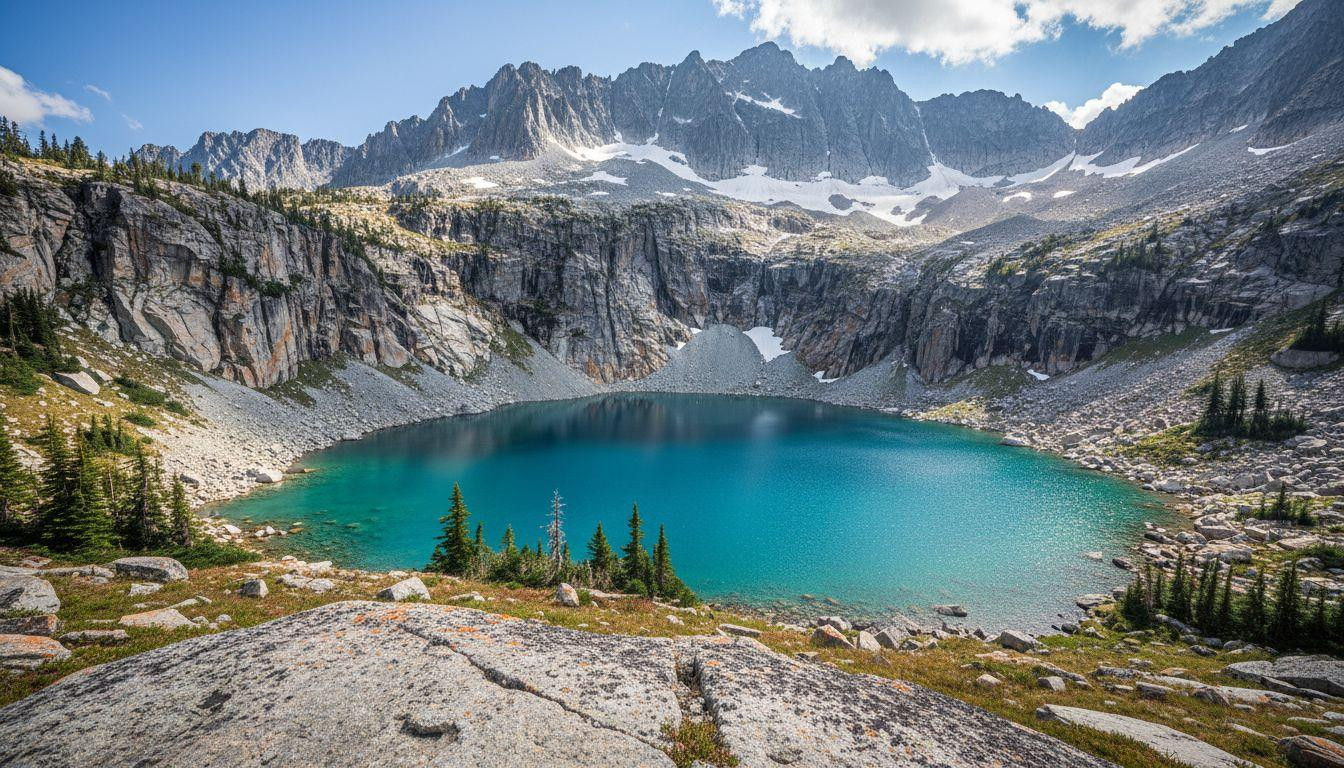
The boulder overlook appears suddenly after hours of off-trail scrambling. Below, turquoise water fills a basin carved by ancient ice. No trails descend to Lake Rowena’s shores.
This remote alpine lake sits at 5,500 feet beneath Mount Hinman’s south face. The Alpine Lakes Wilderness protects 394,000 acres and more than 700 lakes. Lake Rowena remains the most isolated point in this vast wilderness.
A basin carved by ice
Glaciers carved this cirque thousands of years ago. Steep granite cliffs rise 1,000 feet above the water. Mount Hinman’s summit towers another 2,000 feet beyond that vertical wall.
The lake occupies a perfect bowl of stone. Bears Breast Mountain forms the western wall. Shovel Gorge cuts a deep notch to the north. No trail builders ever attempted to reach this fortress of rock.
Recent trip reports describe the terrain as “slippery and loose talus” with “impressive slabby cliffs on the west.” Weather changes rapidly at this elevation. Snow falls even in late October.
Why no trail reaches here
The surrounding cliffs create a natural barrier. Trail builders would need to blast through solid granite. The Forest Service designated this area as wilderness in 1976, ending all development plans.
Mount Hinman’s protective walls
The mountain’s south face drops vertically toward the lake. This cliff band filters out casual hikers. Only experienced scramblers attempt the exposed traverse above Lake Rowena.
The turquoise revelation
Glacial flour creates the water’s distinctive color. Mount Hinman’s remaining snowfields grind rock into fine powder. This sediment suspends in the water, reflecting blue and green wavelengths.
The color changes with seasons and weather. Summer meltwater brings the brightest turquoise. Winter freezes the lake into emerald ice similar to Norwegian fjords. Spring offers the clearest water as sediment settles.
Recent visitors describe the visual impact as overwhelming. One documented expedition notes: “great views of Lake Rowena below” from the boulder overlook. The contrast between gray granite and blue water creates a natural amphitheater.
What the water color tells you
The turquoise indicates active glacial processes. Mount Hinman still supports small snowfields and ice patches. These grinding forces continue sculpting the basin above the lake.
The view from above
The overlook sits on “a flat area above the cliff band.” Climbers report panoramic views across the Alpine Lakes Wilderness. The Cascade Crest stretches north and south from this vantage point.
Reaching the unreachable
Two routes lead to Lake Rowena, both requiring advanced wilderness skills. The packraft approach covers 35 miles total with 5 miles of paddling. The cliffy traverse demands Class 3 scrambling experience.
Documented expeditions describe bushwhacking through dense forest to reach Lake Rebecca. Then paddlers continue along the right shore to avoid open water crossings. The final approach requires “scrambling up the right side of a smaller waterfall.”
Most attempts require 2-3 days minimum. Overnight camping permits cost $10 per person through the Forest Service. Weather windows are critical between July and September when snow clears.
The packraft route
Seattle outdoor shops rent packrafts for $150-200 per day. The route begins at Salmon la Sac trailhead, 2.5 hours from Seattle. Pacific Northwest weather patterns can change rapidly, requiring flexible plans.
The off-trail scramble
Experienced scramblers attempt the direct approach without boats. This route involves “slippery and loose” talus fields and exposed cliff traverses. Recent reports emphasize the need for careful foot placement and weather awareness.
What remoteness preserves
Fewer than 100 people reach Lake Rowena annually. This isolation protects pristine shorelines and undisturbed wildlife habitat. The difficulty serves as a natural permit system.
The lake offers complete silence except for wind and distant waterfalls. No cell service reaches this basin. Challenging access rewards create deep satisfaction among those who succeed.
Recent documentation confirms this as “the most remote point in the Alpine Lakes Wilderness.” The designation reflects both physical distance and technical difficulty. Such places become increasingly rare near major population centers.
Your questions about Lake Rowena answered
Can I day-hike to Lake Rowena?
No maintained trail exists to Lake Rowena. The shortest approach requires 35 miles of hiking and packrafting. Most successful trips take 2-3 days minimum with overnight wilderness camping.
When is the best time to visit?
July through September offers the most reliable access. Late October expeditions encounter snow at this elevation. Water levels peak during spring snowmelt but access routes may remain blocked until mid-July.
How does this compare to Deep Lake?
Deep Lake attracts hundreds of visitors via a 4-mile maintained trail. Lake Rowena requires expedition-level commitment similar to remote ocean destinations. The difficulty gap filters 99% of Alpine Lakes visitors.
Morning light touches the granite walls above Lake Rowena. The turquoise water reflects perfect stillness. This is what earned solitude looks like in the age of crowded trails.