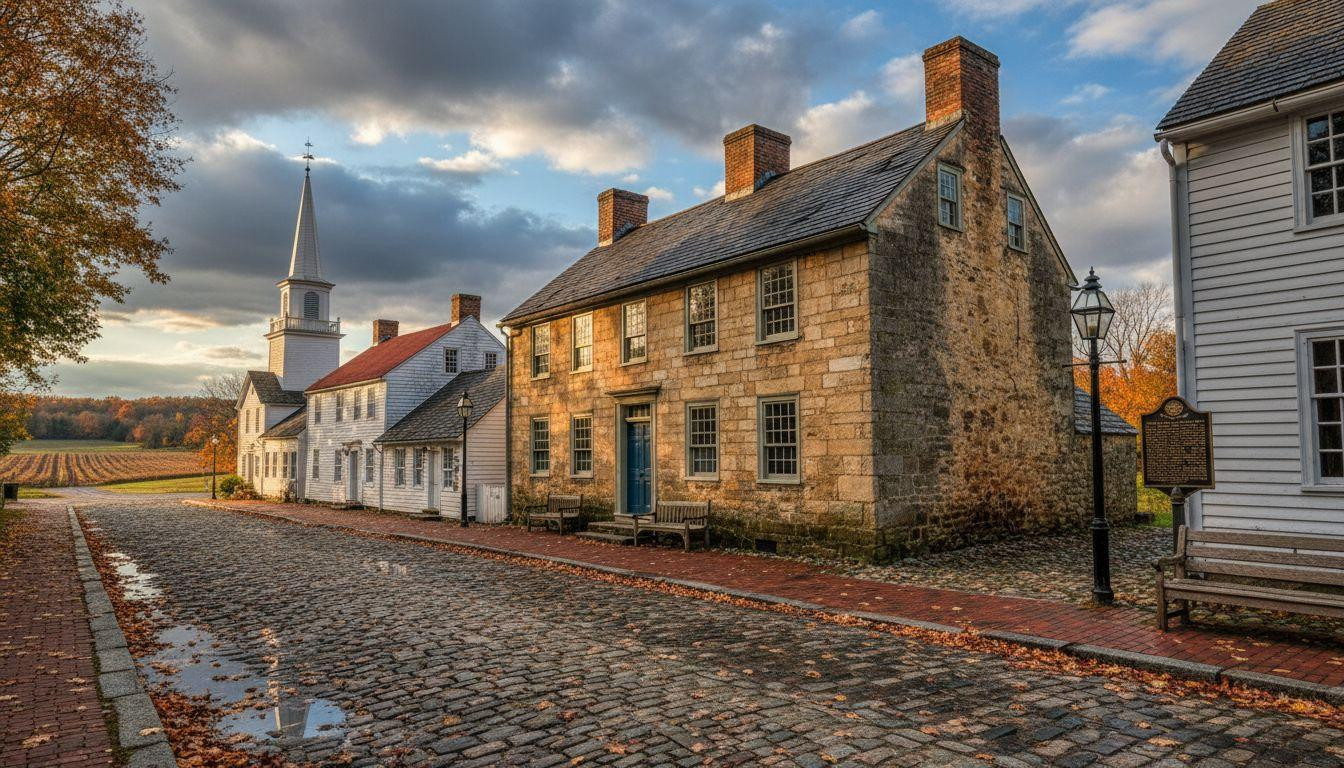
Dutch stone houses line Church Street exactly as they did when Martin Van Buren took his first breath in 1782. The eighth President’s birthplace village preserves 240 years of presidential history in golden limestone and white clapboard. Only 1,200 residents protect what Albany tourists drive past in 30 minutes.
Kinderhook means “Children’s Corner” in Dutch. Van Buren spoke Dutch before English in these same streets. The village square looks untouched by centuries.
Where presidential history stayed small
Martin Van Buren National Historic Site sits 2 miles south on Route 9H. Lindenwald estate costs $10 admission versus $25 at Mount Vernon. The 36-room mansion where America’s first Dutch-speaking President retired draws 25,000 visitors annually.
Van Buren chose Kinderhook over Washington for retirement in 1841. His nickname “Old Kinderhook” created the term “OK” in American politics. Hudson’s antique row runs four blocks from working waterfront, but Kinderhook keeps presidential legacy intimate.
Columbia County agricultural zoning protects 12,000 acres around the village. Property values stay 22% lower than Rhinebeck. Chain stores can’t penetrate historic district regulations.
Dutch colonial architecture that refused to change
The stone testament
Luykas Van Alen House anchors Dutch heritage since 1737. Golden limestone walls rise 2 stories with steeply pitched gabled roofs. Three chimneys mark separate ground-floor rooms, each with original entrances.
National Historic Landmark status since 1967 protects hand-hewn beams inside. Dutch brick bond patterns create straight gable lines, not stepped curves. The finest surviving Dutch colonial architecture in upstate New York sits on 33 acres.
Village square preservation
Church Street measures 200 by 300 feet of 18th-century storefronts. Red roofs top white clapboard homes built between 1750-1820. Reformed Church steeple rings bells at 8am, noon, and 6pm daily.
Forty-two buildings predate 1850 within the historic district. Rhinebeck’s oldest inn operates since stagecoach routes connected Dutch settlements, while Kinderhook preserves entire streetscapes. Van Buren’s birthsite marker stands on Hudson Street where his father’s tavern welcomed travelers.
The Empire State Trail connection
Where cycling tourism stays quiet
Empire State Trail enters at Kinderhook Creek, exits at Ichabod Crane Schoolhouse. Eleven miles connect to Hudson’s waterfront through wetlands and farms. Bike rentals cost $35 daily from Kinderhook Cycle.
Trail users see working dairy farms, not tourist attractions. Morning mist rises from Kinderhook Creek at 6am. Fifteen river ports where steamboat commerce froze 1850s America in brick and cobblestone includes nearby Hudson, but Kinderhook stayed agricultural.
Persons of Color Cemetery
Kinderhook African Burial Ground holds 47 documented burials from 1790-1865. Half-acre cemetery sits behind Reformed Church on Church Street. Underground Railroad routes ran along Old Post Road through Dutch stone houses.
Interpretive signage added in 2023 honors African American pioneers. Twelve documented properties housed Black families in the 1800s. The village protects stories tourism often overlooks.
When presidential legacy stays personal
Jack Shainman Gallery’s “The School” opened in 2014 in converted schoolhouse. December 2025 exhibition “Rooted: Dutch Connections” draws art collectors from Manhattan. Contemporary art dialogue enhances historic preservation rather than competing.
Red Fox Tavern serves $32 entrees named for Van Buren’s nickname. Kinderhook Diner offers $14 lunch specials since 1947. Limestone lanes unchanged since 1852 where 148 villagers guard German America 50 minutes from St Louis shares small-town preservation values. Farm-to-table restaurants use Columbia County produce exclusively.
Your Questions About Kinderhook answered
When should I visit Kinderhook?
May through October offers ideal weather for walking tours. October brings peak foliage to Columbia County maples. Winter visitors find 65% fewer crowds at Lindenwald. December temperatures average 28-38°F with 22 inches seasonal snow.
How expensive is Kinderhook compared to Hudson Valley towns?
B&B rates range $149-189 nightly in December 2025. Dinner for two averages $96 versus $142 in Hudson. Lindenwald admission costs $10 adults, half the price of nearby FDR’s Hyde Park. Local costs run 10% above national average.
What makes Kinderhook different from other historic villages?
Presidential birthplace status without commercial tourism. Dutch colonial architecture concentration exceeds New Paltz. Village population of 1,200 maintains authentic community life. Agricultural zoning prevents suburban sprawl that changed neighboring towns.
Golden hour light illuminates Dutch gables from 4:17-4:42pm December 1st. Church bells echo across farm fields. Presidential history lives quietly where it began 240 years ago.