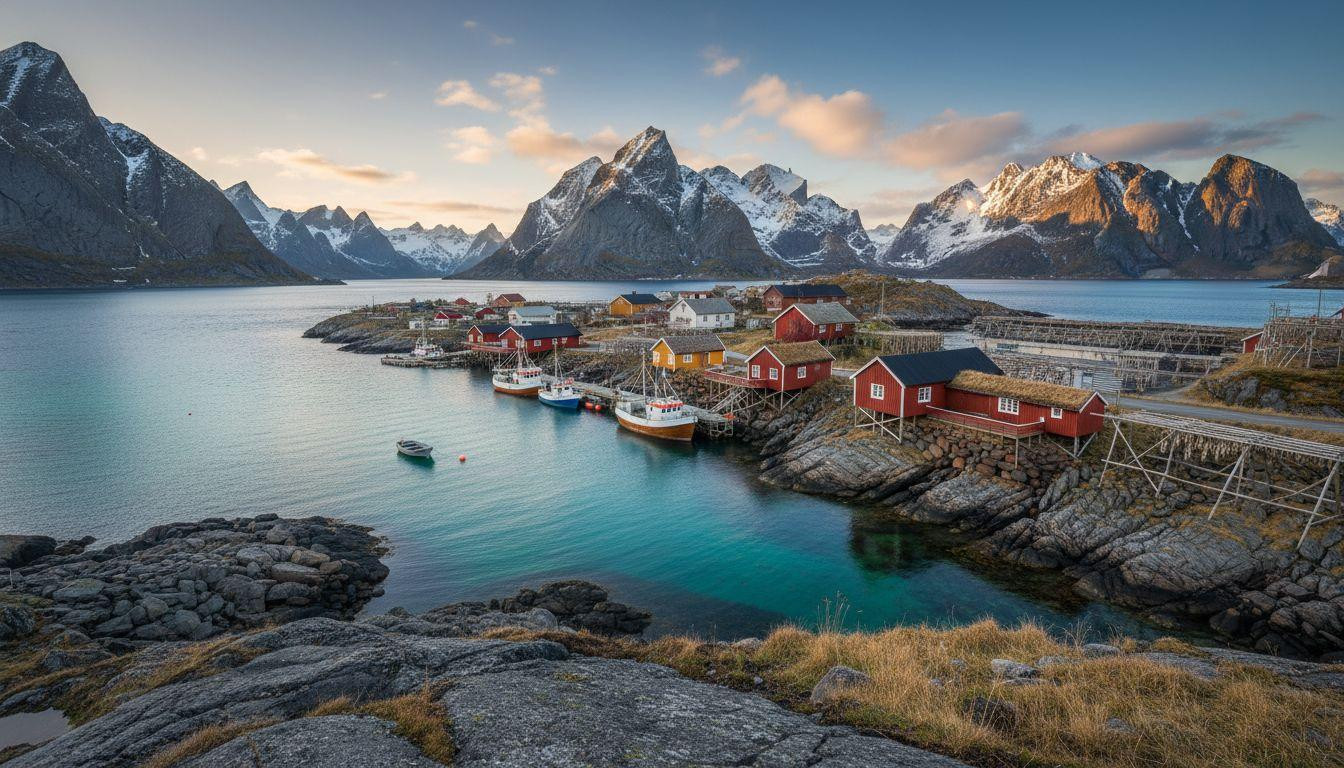
At 6:42 AM on November 18, 2025, golden Arctic light ignites the red wooden cabins of Reine, a fishing village of 300 souls perched on rocky islets 67 degrees north. Turquoise fjord waters mirror snow-dusted peaks that rise 1,029 meters straight from the sea. This is Norway’s most photographed village, where 5,500 years of human presence meets otherworldly beauty on the southern tip of the Lofoten archipelago.
The village at the edge of the world
Reine sits in Moskenes Municipality, connected by bridges across several rocky islets in the Norwegian Sea. The E10 highway brings you here after a 46-mile drive from Leknes Airport through landscapes that grow more dramatic with each mile. Hermannsdalstind peak towers 3,376 feet above the village, while razor-sharp mountains create a natural amphitheater around the harbor.
Winter temperatures hover between 28-45°F in November, with soft light lasting just 5 hours daily. The Gulf Stream keeps conditions surprisingly mild for this latitude. Alpine valleys elsewhere can’t match this Arctic drama where fishing traditions date to the Viking Age.
Where mountains pierce Arctic light
The visual symphony of rorbuer and fjord
Bright red and yellow wooden rorbuer (fishermen’s cabins) perch on stilts over deep turquoise waters. These traditional structures contrast sharply with grey-green mountains often dusted with snow. Professional photographers return repeatedly for this vertical composition where peaks plunge directly into the sea.
The famous Reinebringen viewpoint climbs 1,470 feet in 1.5 hours, revealing the entire village layout. From November through March, winter conditions require guided tours at $110 per person with specialized gear.
Living heritage in a tourist landscape
Annual skrei cod migration from the Barents Sea sustains both ancient traditions and modern tourism. Stockfish production continues on wooden drying racks visible throughout the village. Restaurant Gammelbua serves traditional fiskesuppe (fish soup) for $32, while locals maintain their fishing schedules around 50,000-70,000 annual visitors.
Unlike remote northern islands that feel abandoned, Reine pulses with authentic maritime life.
Experiencing Norway’s photogenic heart
Arctic activities beyond the viewpoint
Lofoten Kayak Tours offers 3-hour fjord excursions for $125, including thermal dry suits for winter paddling. Arctic Kayak Reine provides 4-hour coastline tours at $155 during calm December-February conditions. Northern Lights boat tours depart at 7 PM when aurora forecasts predict 70% success rates in January.
Winter ice fishing costs $110 when conditions allow. Photography guides charge $320 for full-day sessions specializing in blue hour timing and aurora positioning.
Stockfish and Arctic flavors
Sakrisøy village, 15 minutes north, displays the largest concentration of traditional drying racks. Early morning light illuminates thousands of cod hanging in geometric patterns against mountain backdrops. Bacalao Restaurant serves signature Bacalao Lofoten (stockfish stew) for $38.
Local grocery stores stock rakfisk (fermented fish) and Arctic char at $25 per kilogram. Mediterranean fishing villages offer different seafood traditions, but Reine’s Arctic specialties remain unmatched.
The anti-Geiranger experience
Geirangerfjord attracts 850,000 visitors annually with cruise ship crowds and commercialized experiences. Reine’s 65,000 yearly guests feel minimal compared to Norway’s overrun destinations. Accommodation averages $210 per night versus Bergen’s $185, but the intimate scale justifies premium pricing.
Forbes recognized Reine among 2025’s most beautiful villages, yet winter months from November through March offer crowd-free solitude. Local tourism boards report that authentic fishing village atmosphere survives where other Norwegian destinations lost their character to mass tourism. Northern European coastlines rarely combine such dramatic beauty with preserved cultural authenticity.
Your questions about Reine, Norway answered
How do I reach Reine and what does it cost?
Fly to Bodø or Leknes Airport, then drive E10 highway requiring car rental ($80-150 daily). Total journey from Oslo takes 14-16 hours with connections. Accommodation ranges from $80-120 hostels to $300+ boutique lodges. Meals average $25-45 per person. Winter car rentals include mandatory winter tires.
When should I visit for the best light and weather?
Summer (June-August) offers midnight sun and mild 50-59°F temperatures but peak crowds. Winter (November-February) provides Northern Lights viewing with 65-75% success rates but cold 28-37°F conditions and short daylight hours. March balances increasing daylight with stable weather patterns for optimal photography.
Is Reine worth the journey compared to easier Norwegian destinations?
Yes, if you value dramatic scenery over convenience. Reine delivers authentic fishing culture with manageable tourist numbers versus overcrowded Geirangerfjord. The remote location requires commitment but rewards visitors with experiences unavailable in accessible Norway. Recent visitor surveys show 85% satisfaction rates among travelers seeking intimate Nordic encounters.
Evening blue hour stretches across Reinefjord as twilight paints the water deep purple. Village lights reflect on glass-still surfaces while silence breaks only for distant seabird calls. Three hundred residents preserve this Arctic dream where mountains meet the sea in perfect vertical harmony.