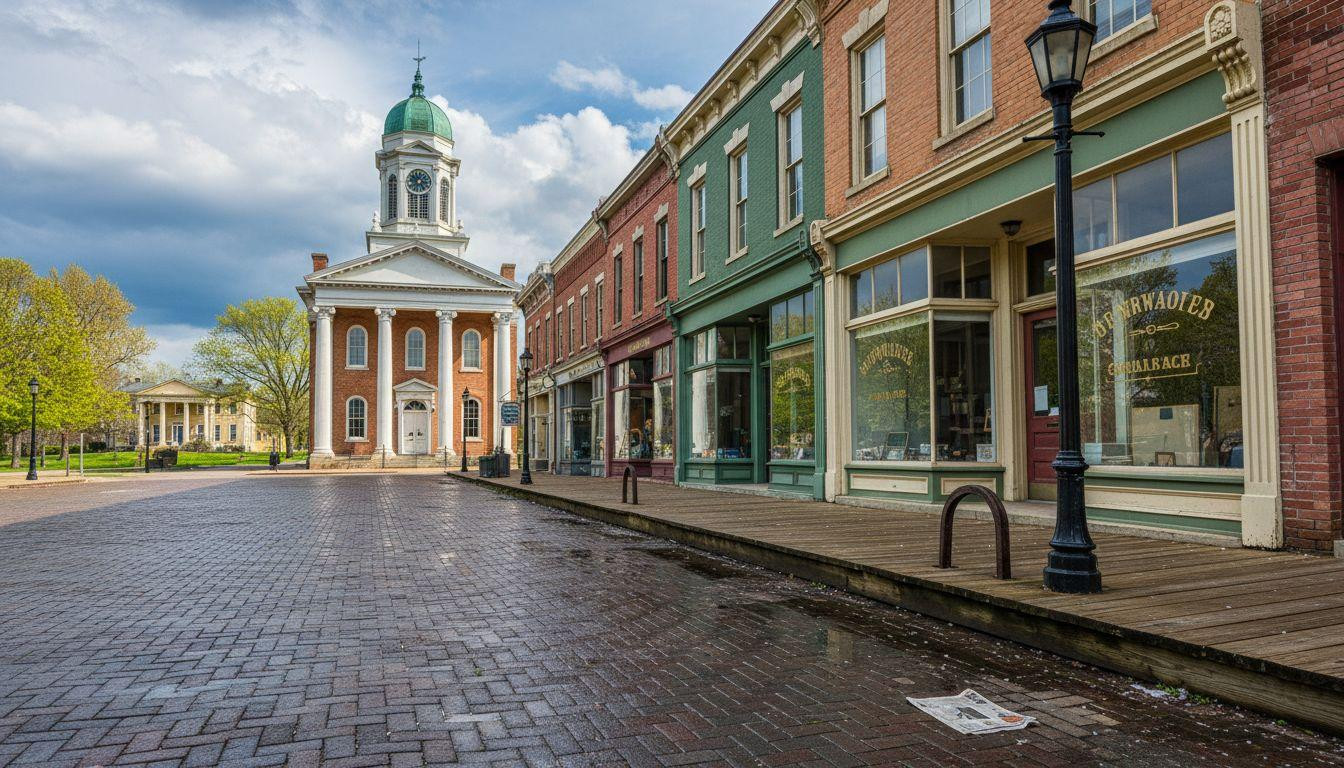
Most American town squares lost their 19th-century character by 1970. Urban renewal bulldozed storefronts for parking lots. Tourist towns rebuilt facades in fiberglass. But nine squares kept their original buildings working as they did in 1880. Not museums. Active Main Streets where the hardware store still sells nails from wooden bins and the courthouse clock still chimes on the hour.
These squares survived because no one improved them. Economic decline protected architecture. Strong preservation codes froze change. The result: brick storefronts with transom windows intact, cast-iron lampposts from 1885, wooden boardwalks that creak under your feet.
Madison, Indiana: where 133 blocks never changed
The Ohio River protected Madison from interstate highways. The town’s entire Main Street district earned National Register status in 1973. Walk these blocks and you count 133 buildings from before 1860. The Lanier Mansion dates to 1844. The Shrewsbury House opened in 1849. Both operate as historic sites with original interiors.
But the real discovery happens on West Main Street. The hardware store occupies an 1850s building with original tin ceilings. The pharmacy keeps wooden display cases from 1887. A general store sells dry goods from shelves installed in 1892. These aren’t reconstructions. The buildings never stopped working.
What makes Madison authentic
The town’s preservation ordinance passed in 1960, before most communities understood what they were losing. Design review boards approve every exterior change. Paint colors must match historical records. New construction must use period materials. The result: zero modern intrusions in the historic core.
Morning light hits the brick facades the same way it did in 1880. The courthouse square stays quiet until 9am when shop owners unlock doors with skeleton keys. You hear wooden floorboards creak. You smell old wood and coal dust from the hardware store’s basement.
How to experience it properly
Park free on side streets. Visit weekday mornings when locals shop and tourists stay away. The courthouse opens for public tours Tuesday through Saturday. Attend a county commission meeting in the 1855 chambers where original benches still seat spectators.
Skip the riverfront restaurants. Walk two blocks north to the cafe behind the post office. Locals eat breakfast there at 7am. The building dates to 1867 and the menu hasn’t changed much since.
Galena, Illinois: where 85% of buildings predate 1900
Lead mining money built Galena in the 1840s. When the mines closed in 1900, the town emptied. Population dropped from 14,000 to 3,500. No one had money to tear down old buildings or build new ones. The Depression and World War II extended the freeze. By 1960, Galena looked exactly as it had in 1880.
Today 85% of buildings in the historic district date from before 1900. Main Street runs downhill to the Galena River. Every storefront keeps its original cast-iron facade. The DeSoto House Hotel opened in 1855 and never closed. Ulysses S. Grant lived here before the Civil War. His home at 500 Bouthillier Street maintains its 1860 appearance.
The architecture that survived
Galena’s buildings use local limestone and brick. Most feature Italianate details: arched windows, decorative cornices, tall narrow proportions. The Market House dates to 1846. The Old Stockade Refuge stands from 1777. Both operate as museums but maintain original structures.
Walk Main Street at dawn before tour buses arrive. You see hitching posts still embedded in sidewalks. Transom windows above storefronts still open for ventilation. Gas lamp fixtures converted to electric in 1920 still light the street.
What still operates authentically
The Galena Post Office occupies an 1857 building. The county courthouse dates to 1839 and holds trials every week. Three churches from the 1840s conduct regular services. A pharmacy on Main Street fills prescriptions from behind an 1880s counter with original glass jars on display shelves.
For a deeper look, 15 towns where building codes froze Main Street in 1925 shows how preservation ordinances protected similar communities across the Midwest.
Georgetown, Colorado: where silver money built and altitude preserved
Georgetown sits at 8,530 feet in the Rocky Mountains. Silver strikes in 1859 created instant wealth. Mine owners built elaborate Victorian homes and commercial blocks between 1870 and 1893. When silver crashed in 1893, the town froze. No money for modernization. No reason to tear anything down.
The entire downtown earned National Historic Landmark status in 1966. More than 200 buildings survive from the 1870s and 1880s. The Hotel de Paris opened in 1875 and closed in 1954 with original furniture intact. The Hamill House from 1879 keeps its Gothic Revival details unchanged.
Victorian architecture at altitude
Georgetown’s buildings adapt Victorian styles to mountain conditions. Steep roofs shed snow. Narrow windows conserve heat. Local stone foundations resist freeze-thaw cycles. Most structures use wood siding painted in period colors: deep reds, forest greens, cream trim.
The town’s commercial district runs along 6th Street. Every storefront maintains its 1880s appearance. The Alpine Hose No. 2 firehouse dates to 1874 and displays original hand-pumped fire equipment. The courthouse square features a gazebo from 1868 where summer concerts still happen.
Living in a time capsule
Georgetown’s population stays around 1,100. Most residents work in nearby ski towns or commute to Denver 50 miles east. The town empties by 8pm. No chain stores. No modern construction in the historic core. Winter brings 180 inches of snow and closes the town for days at a time.
Similar preservation through isolation happens in this Colorado mining town that empties by 8pm where economic decline protected architectural integrity.
Your questions about historic town squares with unchanged 19th-century buildings answered
When should I visit to avoid crowds?
Visit weekday mornings from September through May. Summer weekends bring tour buses to Madison and Galena. Georgetown sees ski traffic from November through March but weekdays stay quiet. Arrive before 9am when shops open and locals conduct business. Most squares empty by 5pm when courthouses close.
How do these squares differ from reconstructed historic districts?
Reconstructed districts like Colonial Williamsburg or Old Sacramento rebuild period architecture as museums. These nine squares never stopped functioning. Courthouses hold trials. Post offices process mail. Hardware stores sell tools. The buildings maintain original use and original structure. No velvet ropes. No admission fees to walk the streets.
What threatens these preserved squares today?
Tourism pressure increases annually. Property values rise as visitors discover these towns. Local businesses face competition from gift shops and restaurants targeting tourists. Preservation boards must balance economic development with architectural integrity. Some towns limit new business licenses. Others restrict building modifications more strictly than before.
The courthouse clock in Madison chimes 5pm. Shop owners lock doors with keys that worked in 1880. Wooden signs creak in the wind. Tomorrow morning the hardware store opens again, selling nails from the same bins it used 140 years ago.