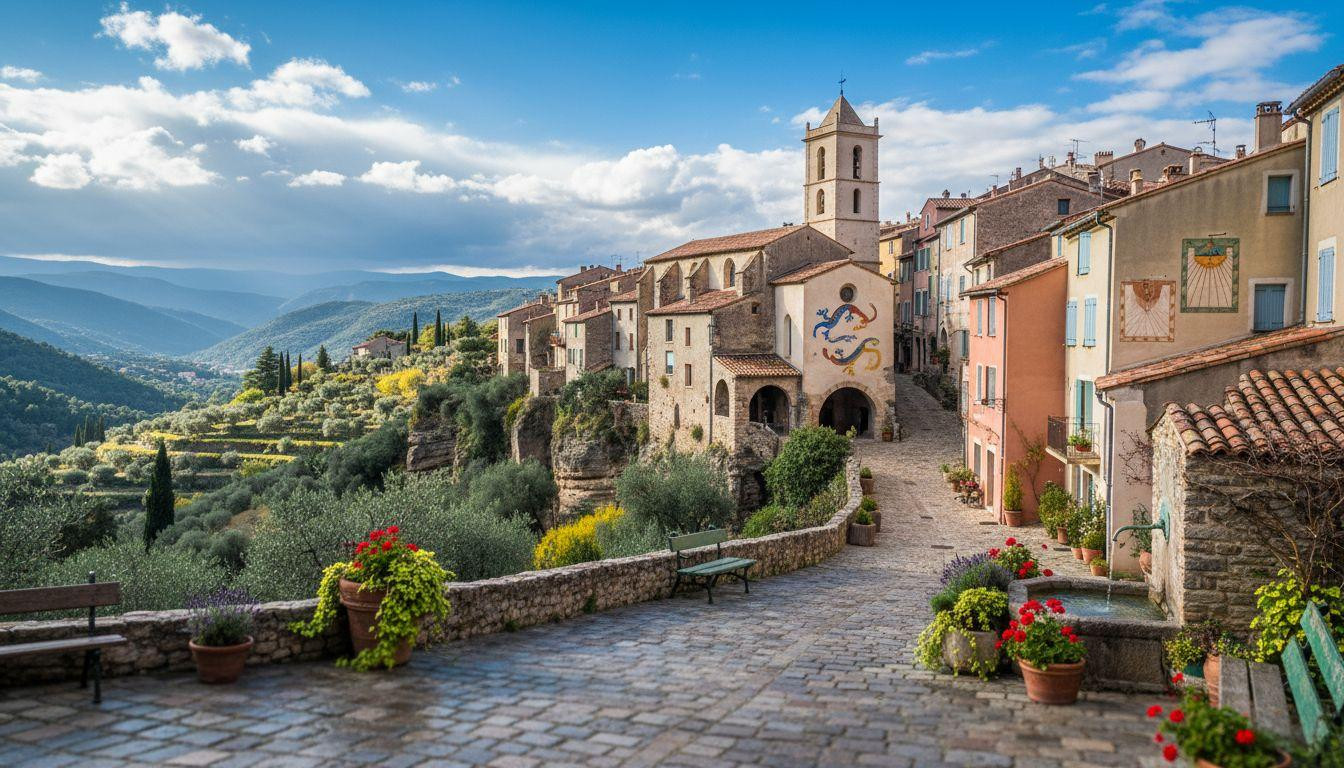
A sundial painted by Jean Cocteau catches the afternoon light on Coaraze’s hilltop square. The artistic timepiece guards more than minutes on its colorful face. It marks the unhurried rhythm of life in Provence’s overlooked mountain villages, where medieval streets wind between pastel houses and time moves to the sun’s ancient cadence.
This collection of 9 villages sits within 19 miles of Nice’s crowded coastline. Each perches on ridges and valleys of the Alpes-Maritimes hinterland. While tour buses clog the Riviera below, these settlements preserve authentic medieval life at altitudes between 1,300 and 2,600 feet above sea level.
Coaraze leads with Cocteau’s artistic sundials at 2,130 feet
Coaraze earned its nickname “Village of the Sun” through exceptional light quality at 2,130 feet elevation. The hilltop settlement of 780 residents displays 12 artistic sundials created by renowned artists including Jean Cocteau, Gilbert Valentin, and Georges Douking. These colorful timepieces adorn the town hall, school, and church square rather than serving practical timekeeping functions.
The 14th-century Saint-Jean Baptiste Church dominates the central square with baroque interior decoration. Vaulted stone passages called “pontis” connect narrow cobblestone streets lined with pastel-painted facades in shades of blue, yellow, and pink. Terraced olive groves and mimosa trees cascade down hillsides toward the Paillon Valley below.
Medieval streets reveal Renaissance frescoes
Walking Coaraze’s steep medieval streets takes visitors through vaulted stone archways dating to the village’s 12th-century founding. The Blue Chapel features 18th-century painted interiors while Renaissance frescoes survive on several building facades. Nice’s hidden Cours Saleya market lies just 19 miles away but feels worlds apart from this mountain refuge.
Pilo World Championships celebrate local tradition
Every July, Coaraze hosts the Pilo World Championships, celebrating a unique local sporting tradition passed down through generations. The village operates “to the rhythm of the sun” according to regional tourism boards. Artist studios throughout the settlement maintain a living creative community rather than serving as tourist museums.
Eight neighboring villages complete the sundial circuit
Sainte-Agnès claims the title of Europe’s highest coastal village at 2,625 feet elevation. The medieval fortress offers Mediterranean views stretching to Italy on clear days. Maginot Line fortifications from World War II provide underground exploration opportunities alongside the 10th-century Saracen castle ruins.
Peillon spirals in concentric stone circles above a 650-foot gorge drop. The 15th-century Chapel of the White Penitents preserves original frescoes depicting religious scenes. Èze combines a medieval village core with exotic gardens planted inside castle ruins, attracting 2 million annual visitors compared to Coaraze’s estimated 50,000.
Mountain villages offer varied medieval characters
Gourdon perches on cliff edges 2,500 feet above the Loup Valley. The Château de Gourdon medieval museum charges $9 entry while village access remains free. This Catalan village shares similar medieval preservation 375 miles southwest.
Roquebrune-Cap-Martin combines a 10th-century donjon (France’s oldest castle keep) with seaside resort character. The dual personality reflects its position between medieval mountain heritage and modern coastal development. Train access from Monaco makes it the most accessible of the 9 villages.
Artist communities maintain living traditions
Tourettes-sur-Loup earned designation as the “violet capital” through cultivation dating to the 1880s. The March Violet Festival celebrates the purple blooms with local products and crafts. Houses built into medieval ramparts form the village’s defensive walls, creating unique architectural integration.
Lucéram’s Sainte-Marguerite church displays 14 baroque altarpieces illuminated by candlelight during winter months. Biot maintains Renaissance glassblowing traditions at the Verrerie workshops offering free viewing of artisan techniques. 15 villages where castle towers rise throughout Europe share similar medieval preservation efforts.
Planning your mountain village exploration
A rental car proves essential for navigating winding mountain roads connecting the 9 villages. Driving times range from 20-45 minutes between settlements depending on terrain difficulty. Winter road conditions can challenge inexperienced mountain drivers, while summer heat makes midday visits uncomfortable.
Three-day itineraries allow visiting 3-4 villages daily with adequate time for walking medieval streets and sampling local cuisine. Accommodation options include mountain B&Bs charging $120-180 nightly compared to coastal hotels at $300-500. This bourbon town offers similar small-town authenticity in Kentucky’s mountain regions.
January temperatures average 45-55°F at village elevations with abundant sunshine earning Coaraze its solar nickname. Mimosa blooms brighten February hillsides while March brings violet flowering around Tourettes-sur-Loup. Summer months attract peak visitors but reward early morning and evening exploration with cooler temperatures.
Your Questions About Coaraze’s sundial villages answered
How much does visiting these villages cost?
Most village access remains free with paid attractions including Èze’s exotic gardens ($7), Gourdon’s castle museum ($9), and Biot’s Fernand Léger museum ($8). Restaurant meals range $25-45 for lunch at village trattorias. Parking typically costs nothing but requires walking 5-10 minutes to village centers on steep paths.
What makes the sundials historically significant?
Coaraze’s artistic sundials represent modern artistic interpretation of timekeeping rather than historical instruments. Jean Cocteau’s “The Lizards” sundial from the 1960s emphasizes visual beauty over practical function. The collection includes works by 6 different artists spanning 40 years of creative collaboration with the village community.
How do these villages compare to Tuscany’s hill towns?
Similar pastel architecture and terraced agriculture create Mediterranean atmosphere comparable to Tuscany’s Val d’Orcia region. However, the Alpes-Maritimes villages maintain active year-round communities rather than serving primarily as tourist destinations. Prices average 30-40% lower than equivalent Tuscan villages while offering similar medieval preservation and artistic heritage.
Late afternoon light strikes the sundials of Coaraze as shadows lengthen across cobblestone squares. The artistic timepieces continue their ancient work, measuring moments in a landscape where medieval stones hold centuries of Provençal sunshine.