“`html
The Wheeler Peak Scenic Drive gate closes in November. Snow piles up at 10,000 feet. Most visitors turn back. But strap on snowshoes and the bristlecone pine groves open up in deep winter silence. These trees have stood here for 4,000 years. You can walk among them when the crowds stay home.
Great Basin National Park sits in eastern Nevada, five hours from Las Vegas. Baker, the gateway town of 50 people, feels like the end of the road. It is. Beyond here, the Snake Range rises to 13,063 feet at Wheeler Peak. In winter, the park gets fewer than 1,000 visitors per month. The bristlecone groves see almost no one.
The 2.8-mile snowshoe to ancient trees
The Bristlecone Trail starts at Wheeler Peak Campground, elevation 9,890 feet. In summer, you drive there. In winter, the gate closes at the campground entrance. That adds 2-3 miles of snowshoeing before you even reach the trailhead. Total distance becomes 7-8 miles round trip. Elevation gain hits 1,100 feet.
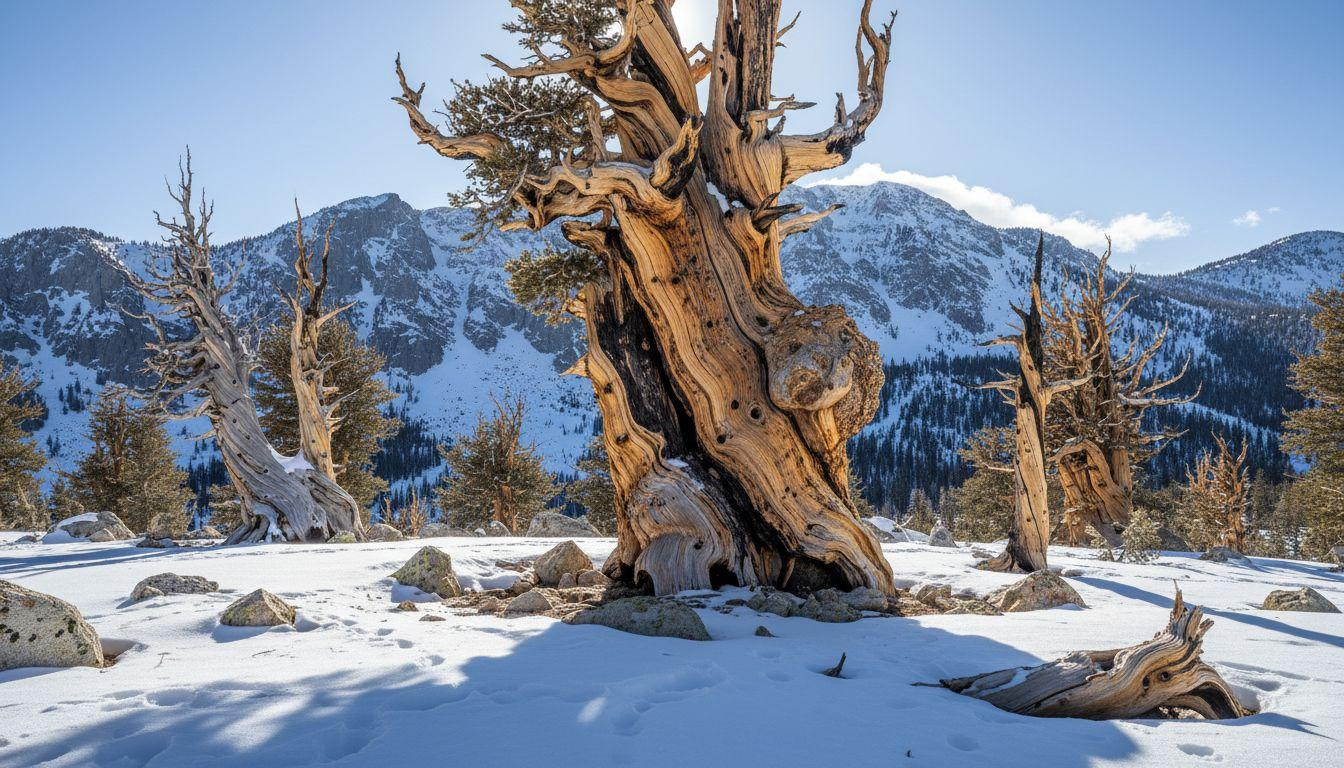
The trail climbs through limber pines first. Then the bristlecones appear. Twisted trunks, golden-brown and orange-red, emerge from snowdrifts. Some trees are 3,000 years old. The oldest documented specimen here reached 4,900 years before it was cut down in 1964 for research. The survivors remain.
Morning light at 7:15 AM in February hits the trunks from the southeast. Shadows stretch long across the snow. The wood grain shows every year of wind and ice. These trees grow at treeline where conditions stay harsh. That stress sculpts them into forms that look deliberate.
What makes bristlecones survive millennia
Bristlecone pine wood is dense. So dense it resists rot for 10,000 years after the tree dies. Dead trunks stand upright for centuries. Scientists use them to reconstruct climate patterns from the Ice Age. The living trees add one ring per year, sometimes less than a millimeter wide in drought years.
They grow between 5,600 and 11,200 feet elevation. Too low and competitors shade them out. Too high and nothing survives. This narrow band keeps them isolated. Alpine lakes in the Cascades show similar elevation constraints.
The glacier that shouldn’t exist here
Wheeler Peak Glacier sits at 12,000 feet on the northeast face. It is Nevada’s only glacier. Also the southernmost in North America. The Bristlecone and Glacier Trail combines both destinations in 4.6 miles round trip from the trailhead. In winter, that becomes 9-10 miles from the gate.
The glacier formed during the last Ice Age. It should have melted by now. Somehow it persists. Blue ice walls show through the snow in winter. Crevasses open in spring. Avalanche danger runs high here. Carry a beacon and shovel if you approach the glacier zone.
Nine winter destinations beyond the bristlecones
The bristlecone grove anchors a network of winter snowshoe routes. Most visitors never see the others. Colorado’s Flattop couloirs draw crowds. These Nevada peaks stay empty.
Stella and Teresa lakes freeze solid
Two alpine tarns sit at 10,400 and 10,600 feet. The Alpine Lakes Loop covers 4.1 miles in summer. Winter adds distance from the gate closure. Ice thickness reaches several feet by February. The frozen surfaces mirror bristlecone silhouettes at dawn. Mule deer migrate through in late winter. Their tracks cross the ice.
Backcountry camping is allowed here without permits. Register at the Lehman Caves Visitor Center in Baker. Wheeler Peak Campground stays open for day use in winter. No water. No services. Temperatures drop to -10°F at night.
Mount Washington holds the largest grove
Mount Washington Grove spreads across ridgelines 20 miles from Baker. Access requires high-clearance 4WD on unmaintained roads. Winter closes these roads completely. The grove contains more ancient trees than Wheeler Peak. Exact counts are not published. Night photography here captures the Milky Way between twisted trunks.
The park earned International Dark Sky designation in 2016. Bortle scale 1-2 means zero light pollution. Stars reflect off snow. The Quadrantid meteor shower peaks January 3-4. Alpha Centaurids arrive February 8.
Baker Creek Road leads to abandoned mines
Baker Creek Trail starts five miles from town. In winter, ski or snowshoe 6-7 miles to reach Pole Canyon mines. Silver operations ran here in the 1800s. Adits and tailings hide under snow. The route follows Baker Creek through aspen groves. Moderate difficulty. Free access.
Lehman Caves stay 50 degrees year-round
When the alpine zone hits -10°F, Lehman Caves maintain 50°F. Tours run daily at 8 AM through 4:30 PM. Reserve at Recreation.gov. Standard tours last 90 minutes. Stalactites and flowstone formations fill the limestone passages. The visitor center loans snowshoes for free.
Snake Creek Canyon forms slot ice
Snake Creek cuts through the southern Snake Range. Side drainages freeze into ice walls in January and February. Access is 15-20 miles from Baker via 4WD roads. Avalanche danger runs high. Expert winter skills required. No permits needed but register your trip at the visitor center.
Lexington Arch rises 75 feet at 8,000 feet
This natural limestone arch sits at the southern park boundary. Less snow accumulates here than at Wheeler Peak. The arch spans 75 feet. Winter access requires snowshoeing 4-5 miles from the road closure gate. Southern exposure means more sun. Deer and hares stay active here through winter.
Planning a Great Basin winter trip
December through March brings deep snow. April and May transition to spring melt. The Wheeler Peak Scenic Drive opens in June or July. Check current conditions at 775-234-7331. Tahoe charges $45 for permits. Great Basin charges nothing.
Baker has one motel. Rooms run $100-150 per night in winter. The Bristlecone General Store sells basic supplies. Gas up in Ely, 90 miles north. Las Vegas sits 300 miles south, a five-hour drive. Rental 4WD vehicles cost $100-200 per day. Gas for the round trip runs $50-70 at 2026 prices.
Snowshoe rentals are free at the visitor center. Ely outfitters charge $20 per day. Altitude sickness hits hard at 10,000 feet. Drink water. Eat snacks. Acclimatize slowly. Temperatures range from -10°F to 30°F during the day. Nights drop below zero. Wind gusts reach 50 mph.
Your questions about Great Basin bristlecone winter answered
When does the Wheeler Peak road close?
The gate closes after the first significant snow, usually in November. It reopens in June or July depending on snowpack. Winter access requires snowshoeing from the Wheeler Peak Campground gate. That adds 2-3 miles each way to any trailhead distance. Check nps.gov/grba for current status.
How does this compare to California bristlecone groves?
The Ancient Bristlecone Pine Forest near Bishop, California holds the 4,850-year-old Methuselah tree. That grove gets moderate summer crowds. Great Basin sees very low visitation year-round. Winter here means true solitude. Arizona mining towns offer similar emptiness at high altitude.
What makes winter the best time to visit?
Summer brings 100,000 annual visitors to the park. Most stay near Lehman Caves. Winter drops that to fewer than 1,000 per month. The bristlecone groves see almost no one. Deep snow creates natural access barriers. Only snowshoers make the effort. The result is profound silence at 10,000 feet among trees that predate the pyramids.
The Perseverance tree clings to an eroding cliff near the main grove. Its roots grip crumbling limestone. It still lives. Morning light in February turns the weathered trunk gold against white snow. No one else is there to see it.
“`