“`html
The ferry from Lorient takes 45 minutes. Most passengers head straight to Belle-Île-en-Mer, where summer crowds push hotel rates past $200. I stayed on Île de Groix instead. Population 2,200. Red sand beaches. Empty morning streets where fishermen still work before dawn.
This island sits 8 miles off the Brittany coast. The garnet deposits create beaches that glow rust-red against turquoise Atlantic water. No one calls it a hidden gem here. Locals just call it home.
Port-Tudy: where tuna boats built an empire
The ferry docks at Port-Tudy, the main harbor. Colorful fishing boats line granite quays that once held the island’s famous dundee sails. In the 1800s, Groix was France’s tuna capital. The boats are gone but the weathervane on Église du Bourg still points east, shaped like a tuna instead of a rooster.
The Musée de Groix sits near the port. Inside, old fishing tools and photographs show when 300 boats worked these waters. Entry runs about $6. The morning fish market happens steps away, though timing varies. I watched fishermen unload at 6am, their catches sorted by 7.
Walk 1.2 miles inland and you reach Le Bourg, the central village. Stone houses, slate roofs, three bakeries. The Thursday market brings island farmers with fresh produce. One artisan sells local conserves, another makes kouign-amann that sells out by 10am.
Plage des Grands Sables: Atlantic’s garnet beach
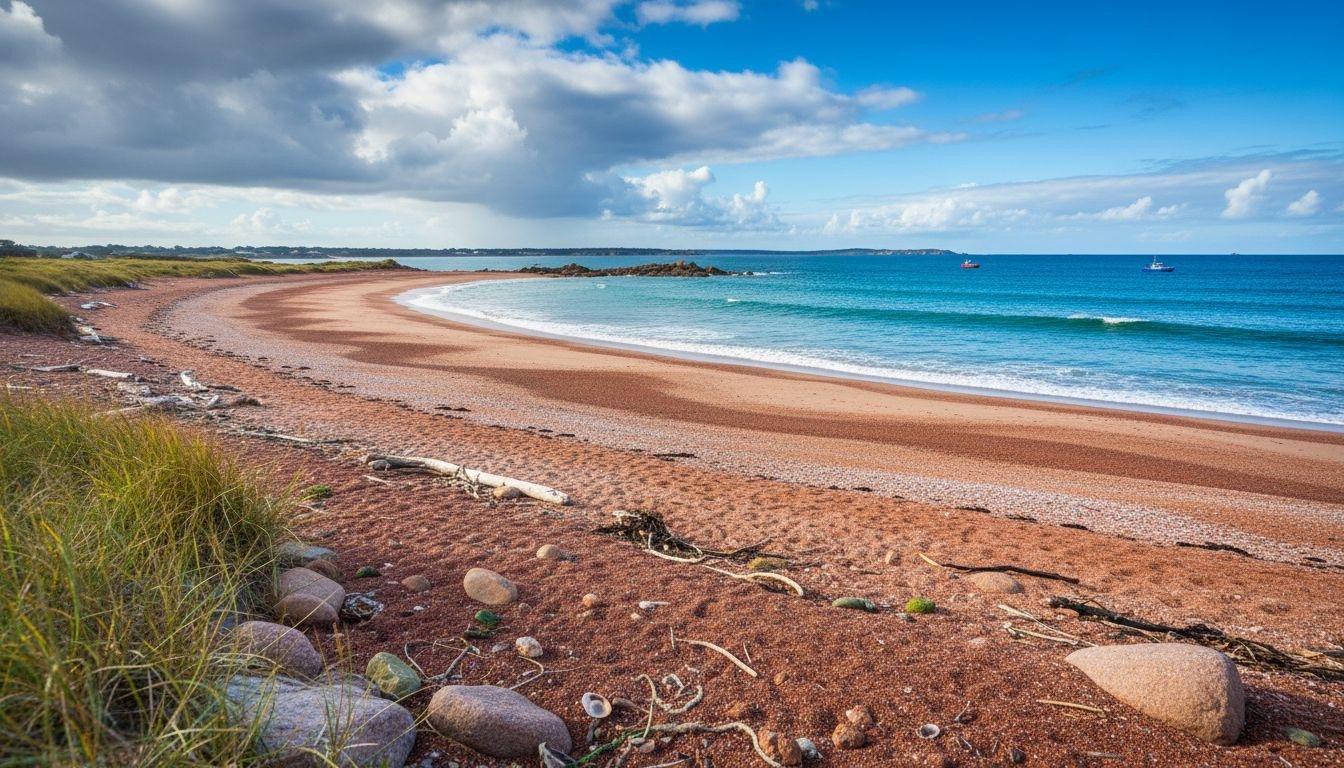
The island’s signature beach lies 3 miles from Port-Tudy. Plage des Grands Sables curves outward, a geological rarity called a convex beach. The sand contains garnets, semi-precious stones that wash up from eroded granite offshore.
The red sand phenomenon
Visit two hours before low tide. The garnets concentrate in bands, visible as rust-red streaks against lighter sand. You can collect small amounts legally. The color shifts with light, from deep burgundy at dawn to bright copper by noon.
The beach stretches roughly 1,600 feet. Water temperature in April hovers around 55°F. Swimming is cold but possible. Strong currents make it better for beachcombing than long swims.
Why the beach curves outward
Most beaches curve inward, protected by headlands. This one bulges into the Atlantic. Wave refraction and sediment deposition created the shape over centuries. Only a handful of convex beaches exist in Europe. This is the only one in France with garnet deposits.
Eight spots tourists miss on Groix
Bike rental at Port-Tudy costs $25 per day. The island measures 5 miles long by 2 miles wide. You can circle it in four hours, stopping at places most visitors never see.
Pen Men lighthouse and western cliffs
The lighthouse marks the island’s western tip, 4 miles from Port-Tudy. Built in 1839, it still operates. The coastal path here runs along cliffs that drop 65 to 165 feet to the Atlantic. April brings migrating seabirds. Bring a windbreaker. The western exposure catches full ocean wind year-round.
Inland moorland trails
Yellow gorse blooms cover the interior moorlands from April through May. The scent resembles coconut, intense on warm afternoons. Marked trails wind past megalithic sites, ancient standing stones whose origins remain unclear. The paths are free, maintained by Natura 2000 protection status.
Scattered chapel circuit
Small stone chapels dot the island, most dating to the 1600s and 1700s. Chapelle Saint-Tudy sits near the port. Others hide along inland roads, each with a sacred fountain nearby. Free maps are available at the tourism office on Quai Firmin Tristan. The full circuit by bike takes three hours.
Eastern calm-water beaches
The eastern shore offers sheltered coves with gentler waves than the Atlantic-facing west. Kayak rentals launch from Port-Tudy’s base nautique. Rates and booking details vary, but the calm eastern waters make paddling accessible even for beginners.
Your questions about Île de Groix answered
How does Groix compare to Belle-Île-en-Mer?
Belle-Île draws roughly 500,000 visitors annually. Groix sees closer to 100,000. Hotel rates on Belle-Île in summer average $220 per night. On Groix, guesthouses run $100 to $165 in April. The ferry from Lorient to Groix takes the same 45 minutes as Quiberon to Belle-Île, but Groix keeps its fishing village authenticity. Belle-Île has boutique hotels. Groix has working harbors.
When should I visit?
Late April through June offers the best balance. Gorse blooms peak in May. Water temperature reaches 68°F by July but crowds increase. September brings calm weather with 30 percent fewer visitors than August. The ferry runs year-round but reduces frequency in winter. April 2026 temperatures range from 46°F to 61°F.
Can I visit as a day trip?
Yes, but overnight stays allow more exploration. The first ferry departs Lorient around 7:30am. The last return leaves Port-Tudy near 6pm, giving you 10 hours on the island. That covers Port-Tudy, Le Bourg, and one beach. For western cliffs, inland trails, and chapel circuits, plan two nights. The tourism office above the ferry terminal has current schedules.
Morning fog lifts around 8am in April. The harbor empties as fishing boats return. Tourists arrive on the 10am ferry. By then, locals have already finished their coffee at the port café, where conversations happen in Breton and French. The garnet sand stays quiet until noon.
“`