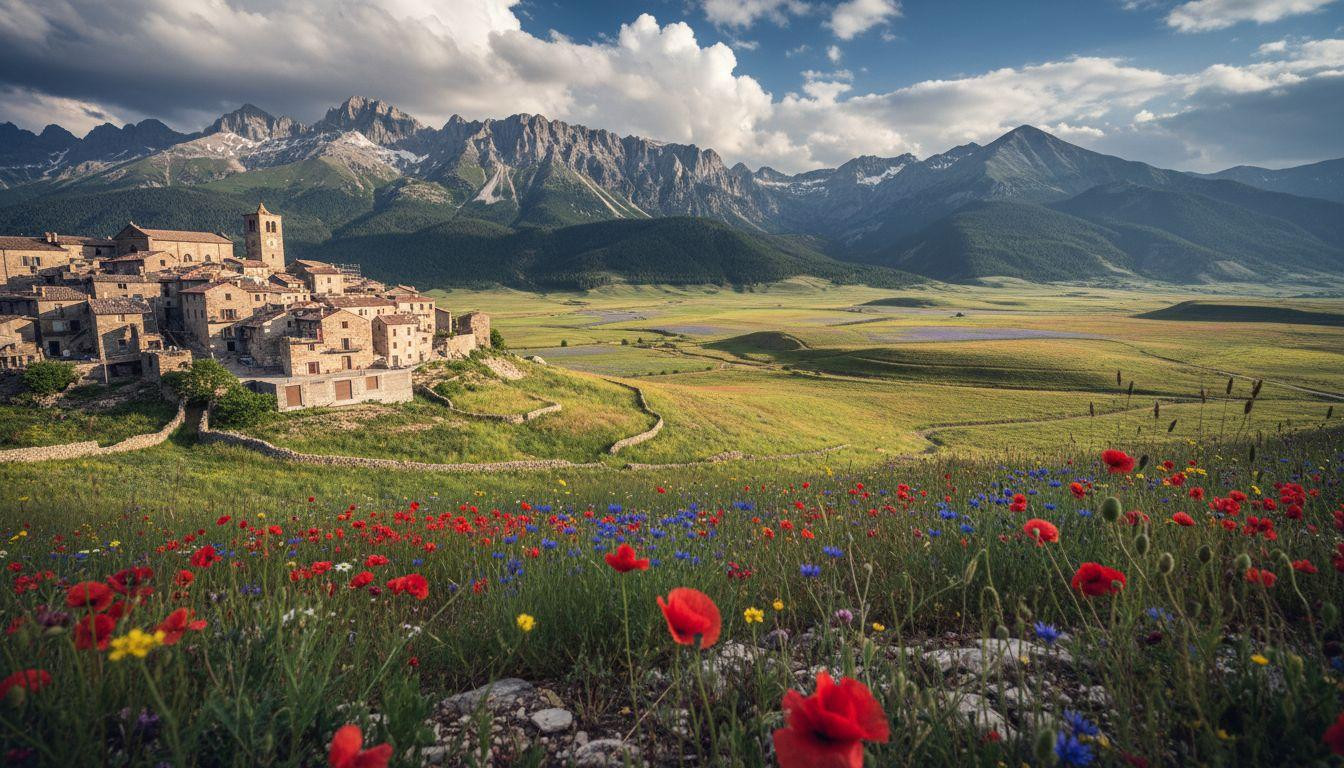
The Pian Grande plateau turns into a patchwork quilt each May. Red poppies, blue cornflowers, yellow lentils blanket 7 square miles of karst plain at 4,160 feet. Above it, six medieval villages sit at elevations where shepherds outnumber tourists and stone houses cling to Sibillini ridges. This is Umbria’s high country, 90 minutes from Rome but a world away from coastal crowds.
Castelluccio di Norcia perches highest at 4,764 feet. Population dropped from 100 to 20 after 2016 earthquakes leveled most buildings. Reconstruction stands 80% complete in April 2026. The village opens again, slowly, with Santa Maria Assunta church partially restored and fortress ruins accessible.
Castelluccio di Norcia: The flower throne at 4,764 feet
The highest village overlooks the entire Pian Grande. Dawn arrives around 6:15am in April. Golden light touches stone walls rebuilt on seismic platforms. Thirteen centuries of defensive architecture reduced to rubble, now rising again.
Wildflower bloom peaks late May through early July. April shows green lentil fields, no crowds. Baseline 100-200 daily visitors versus 5,000 in July. Parking holds 300 cars at the main viewpoint. Overflow spills onto dirt tracks.
What makes it different
Lenticchie di Castelluccio IGP lentils grow at 4,600 feet. Tiny striped legumes, planted March, harvested September. Fields show green stages in April. The altitude and harsh winds keep them small. Locals say no other lentil tastes the same.
Paragliding launches from 4,920 feet. Tandem flights cost $110-165 through Sibillini operators. You float over the plateau, stone village shrinking below, Apennine peaks circling the horizon. Wind currents stay steady April through September.
Practical details
Stay in Norcia, 17 miles away. Agriturismi run $77-99 per night in April versus $132-176 in July. The village itself has limited lodging due to reconstruction. Arrive before 8am June-July to beat crowds. April stays quiet all day.
Best panorama sits at coordinates 42.823°N, 13.192°E. Free parking. The viewpoint faces west over Pian Grande. Sunset turns the plain amber, then violet, then dark.
Norcia: Medieval butcher shops at 1,970 feet
Gateway town at lower elevation. Forty norcinerie sold prosciutto and salami before the quake. Twenty reopened by 2026. Family butcher shops line cobblestone streets, curing meats the same way since the 1300s.
Piazza San Benedetto hosts Saturday markets, 8am to 1pm. Thirty vendors sell pecorino wheels, wild boar sausage, black truffle paste. Weekdays stay calmer. The basilica reopened mid-2024 after $11 million EU rebuild. Frescoes survived the collapse.
The drive to Castelluccio
SS209 climbs 2,790 feet in 13 miles. Fully paved, fifteen hairpin turns, gradients 5-8%. Scenic overlooks at 42.783°N, 13.150°E offer safe pull-offs. The road typically closes November through early April for snow. Late April sees reopening.
Cell service holds full bars with TIM and Vodafone. Nearest gas station sits in Norcia center. Winter snowmelt can leave mud on edges through early May. Drive takes 30 minutes without stops, 45 with photo breaks.
Where to eat
Full meals run $28 average. Primi $11, secondi $17. Family trattorias charge less than tourist spots in Spoleto, which hit $44. Lentil soup costs $6-11 per bowl. Pecorino platters $11-17.
ZTL parking free outside medieval walls on Via Solferino. Train from Rome to Spoleto costs $22-33, then one hour drive to Norcia. Car rentals at Rome Fiumicino run $55 per day.
Preci: Stone abbey where monks taught surgery
Sant’Eutizio Abbey sits in the Nera River valley. Twelfth-century monks pioneered surgical techniques here. They trained 100 students in anatomy-based procedures. Marco dei Rossi, who died in 1486, wrote the first hernia surgery text. Innovations included catgut sutures from sheep intestines.
Morning fog fills the valley until 10am. Valle Castoriana waterfall drops 131 feet. April flow runs strong from snowmelt. July trickles. Piedivalle ghost village sits accessible but unfenced. Enter at your own risk after quake damage checks.
Local products
Cooperativa Allevatori Preci offers pecorino tours for $11. Aging rooms hold wheels from 3 to 12 months. The nutty scent fills the space. Varieties include caciotta and semi-hard mountain cheese. Drive from Norcia takes 20 minutes, 9 miles.
Abbey entry costs $6. Open Tuesday through Sunday. Population around 750 spreads across hamlets. Medieval stone architecture rivals coastal villages at 30% lower cost.
Visso, Montefortino, and Arquata: The eastern arc
Visso sits where Nera and Ussita rivers meet at 1,970 feet. Lago di Fiastra lies 12 miles north. The reservoir runs 164 feet deep, covers 1.2 square miles. Kayak rentals $17 per hour, June through September. Gola del Fiastrone trail gains 984 feet over 2.5 miles. Moderate difficulty, good condition in April after snowmelt.
Montefortino backs against Monte Sibilla at 7,054 feet. Gole dell’Infernaccio gorge stretches 1.2 miles with five turquoise pools. Water temperature hits 50-59°F in July. The gorge closes November through May for snow. Leather workshops still make gloves, $44-88 per pair. Tours cost $17 by appointment.
Border fortress
Arquata del Tronto marks the Umbria-Marche line at 2,549 feet. Eighty percent destroyed in 2016. Town center stays restricted for safety. Rocca fortress dates to 1450. Star-shaped bastions, three towers for 360-degree watch. Ruins remain stable with partial access.
Temporary piazza rebuilt in July 2020 hosts summer events. Population dropped from 1,200 to 500. Ascensione hermitage sits 1.2 miles away, 20-minute walk. Reconstruction efforts continue across the village perimeter.
Your questions about Umbria’s mountain villages answered
When should I visit to avoid crowds?
April through early May offers 80% fewer visitors than peak season. Lodging costs $55-77 per night versus $121-198 in July. Trails stay mud-free after late April snowmelt. Early greens appear, no summer haze. Parking available anytime versus 7am arrivals during fioritura weekends.
How does this compare to Tuscany hill towns?
Meals run $22-28 versus $39 in Spoleto. Assisi draws 10,000 daily visitors. Castelluccio sees under 200 in April. Roads have fewer curves than Montalcino routes. Mountain settings offer different atmosphere than vineyard landscapes. Sixty percent lodging savings overall.
What about earthquake damage?
Reconstruction reaches 80% completion by April 2026. Main routes stay open year-round except winter snow closures. Temporary facilities include bathrooms and food vendors at Pian Grande. Santa Maria Assunta church partially reopened. Some village centers remain restricted but viewable from perimeter paths. Locals welcome respectful visitors during rebuilding.
The wildflower carpets fade by August. These six stone villages stay rooted in pastoral time. Lentil harvests, pecorino wheels, morning mist over Pian Grande. April 2026 brings reconstruction progress to Castelluccio. The essence remains at 4,764 feet where altitude and medieval stone create calm that crowds have not discovered yet.