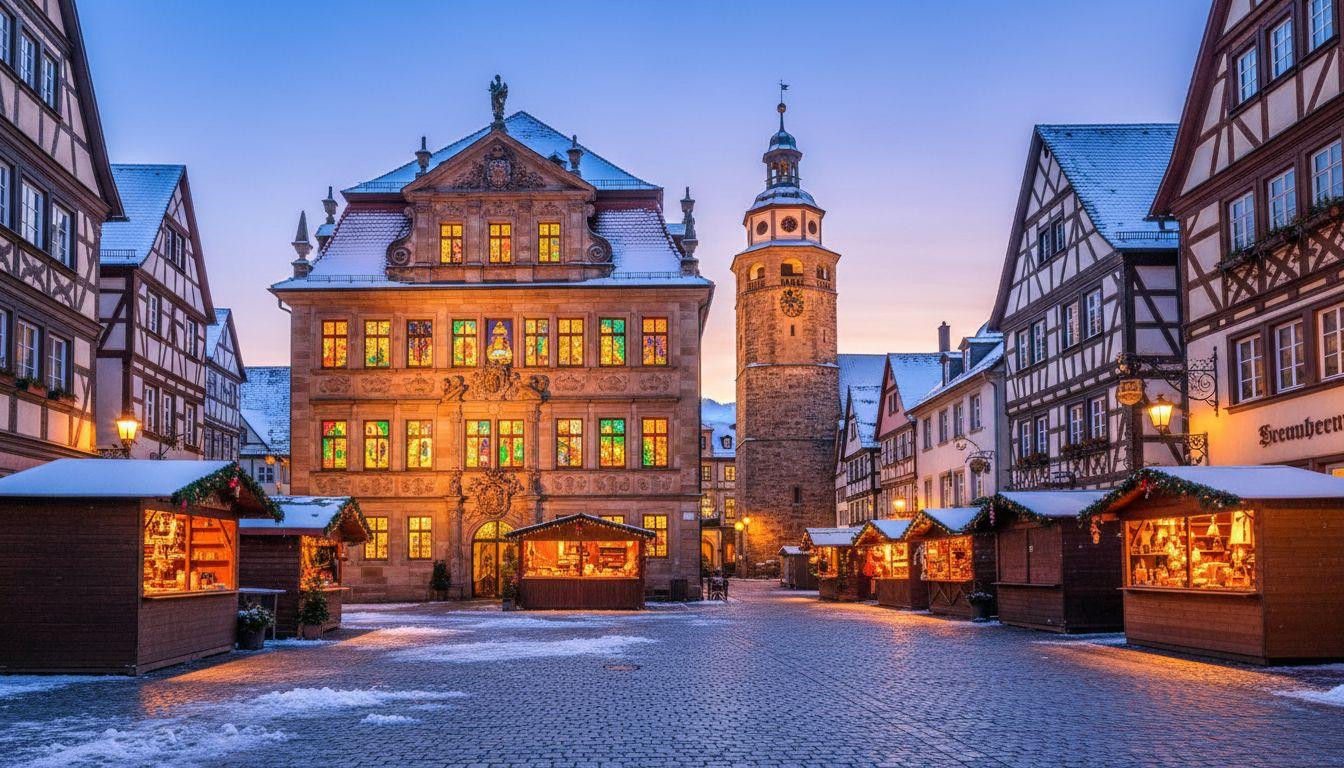
Each December evening at 6:00 PM sharp, something magical happens in Gengenbach. The entire Marktplatz falls silent as hundreds gather before the baroque town hall. Then, with a soft chime, another window illuminates on what’s considered the world’s largest Advent calendar. This Black Forest town of 11,000 transforms its most historic building into a living artwork, continuing a tradition that began in 1996 and now draws visitors from across the globe.
The world’s largest Advent calendar reveals nightly masterpieces
Gengenbach’s 18th-century Rathaus becomes a canvas each December. Artist Olaf Hajek creates 24 original illustrations for the 2025 “Paradise” theme. Each window measures approximately 8 feet tall, illuminated from within to create stunning visual impact against snow-dusted cobblestones.
The tradition earned Guinness World Records recognition in its early years. Unlike paper calendars, this uses actual building windows in perfect symmetrical arrangement. The baroque architecture seems designed for this purpose, though it predates the calendar by 250 years.
Timing your visit for the unveiling ceremony
Arrive by 5:30 PM to secure a good viewing spot. Weekends draw crowds of 2,000-3,000 people in the square. The ceremony includes brass band performances and carol singing before each window reveal. Local musicians from Gengenbach Musikverein perform traditional German Christmas music and contemporary arrangements.
Extended viewing through Epiphany
While new windows open nightly through December 23rd, the complete calendar remains illuminated until January 6th, 2026. This Epiphany tradition allows visitors to see all 24 artworks simultaneously. Evening lighting continues from 5:00 PM to 10:00 PM throughout this extended period.
Christmas market celebrates 1,300 years of Benedictine heritage
The Advent Market runs November 28th through December 23rd, featuring 45 local artisan stalls. Gengenbach maintains a strict “zero chain stores” policy, ensuring every vendor represents regional craftsmanship. Market hours are 2:00 PM to 8:00 PM weekdays, 12:00 PM to 8:00 PM weekends.
Black Forest specialties dominate the food offerings. Schwarzwälder Schinken (Black Forest ham) costs $8-12 per serving. Traditional lebkuchen (gingerbread) ranges from $3-8 per piece. Glühwein (mulled wine) sells for $4-6 per cup in souvenir mugs.
Local artisan specialties and pricing
Handcrafted Christmas ornaments start at $5 for simple designs, reaching $50 for intricate wood carvings. Traditional cuckoo clocks range from $75-300 for authentic Black Forest pieces. Pottery featuring local motifs costs $15-45 per item, while textile goods like scarves and mittens range from $20-60.
Benedictine monastery anniversary celebrations
2025 marks 1,300 years since Saint Pirmin founded Gengenbach Abbey in 725 AD. Special exhibitions at Museum House Löwenberg showcase monastic artifacts and illuminated manuscripts. The abbey church features the second-largest Romantic organ in Baden region, with free concerts every Saturday at 4:00 PM during Advent season.
Medieval quarter offers intimate discoveries beyond the crowds
Engelgasse and surrounding streets preserve 15th-17th century half-timbered architecture. These narrow lanes remain mostly tourist-free during morning hours before 10:00 AM. Golden sandstone buildings display intricate wood carvings and flower box windows, creating Instagram-worthy scenes without crowds.
The Niggelturm watchtower, dating to 1348, provides panoramic views across Kinzig Valley. Free access via spiral staircase leads to observation deck 60 feet above street level. Similar to French wine villages, Gengenbach’s circular medieval layout creates natural walking routes.
Morning photography opportunities
Early light (7:00-9:00 AM) illuminates timber facades without harsh shadows. Snow-dusted rooftops and cobblestones create pristine conditions for photography. December temperatures average 30-39°F, requiring warm clothing but offering crisp visibility for outdoor activities.
Traditional bakery demonstrations
Local bakeries offer lebkuchen-making workshops during Advent weekends. Sessions cost $25 per person and include ingredients, instruction, and take-home packaging. Historic recipes unchanged since the 1800s use regional honey, almonds, and traditional spice blends. Demonstrations run 10:00 AM to 2:00 PM on Saturdays.
Peaceful alternatives when crowds peak
The Kinzig River walk offers 3-mile loop trails starting 5 minutes from Marktplatz. Winter wildlife includes kingfishers and herons along frost-covered banks. Subtle lighting along pathways complements the town’s Christmas displays without overwhelming natural beauty.
Day trips to neighboring markets provide interesting contrasts. Offenburg, 12 miles away, hosts larger Christmas markets (November 20th-December 23rd) with 80+ vendors. Baden-Baden, 31 miles distant, features Christkindels Market in elegant spa town setting (November 27th-January 6th).
Your questions about Gengenbach’s Advent calendar answered
How do I get there from Stuttgart?
Regional trains connect Stuttgart to Offenburg (1 hour), then transfer to Gengenbach (20 minutes). Total journey time averages 1.5-2 hours, costing $33-55 one-way. Direct driving takes 90 minutes via A5 Autobahn. Parking fills early on weekends, requiring arrival before 2:00 PM for guaranteed spaces.
What makes this different from other German Christmas markets?
Gengenbach’s building-sized Advent calendar creates unique nightly drama impossible elsewhere. While Rothenburg ob der Tauber attracts 400,000+ December visitors, Gengenbach maintains intimacy with 100,000-150,000 total seasonal guests. The local-only vendor policy ensures authentic craftsmanship over mass-produced souvenirs found at larger markets.
Are accommodations expensive during December?
Mid-range hotels cost $110-175 per night during Advent season, compared to $65-110 in summer. Budget guesthouses start at $70-90 nightly, while luxury options reach $220+ per night. Booking 3-4 months ahead ensures availability, as occupancy exceeds 90% during peak weekends.
The final window opens December 23rd as church bells chime across snow-covered rooftops. Families gather one last time in the square, creating shared memories that transcend language and borders. In this moment, Gengenbach reveals its greatest magic: not just the illuminated artwork, but the quiet joy of community celebration in a world that often moves too fast.