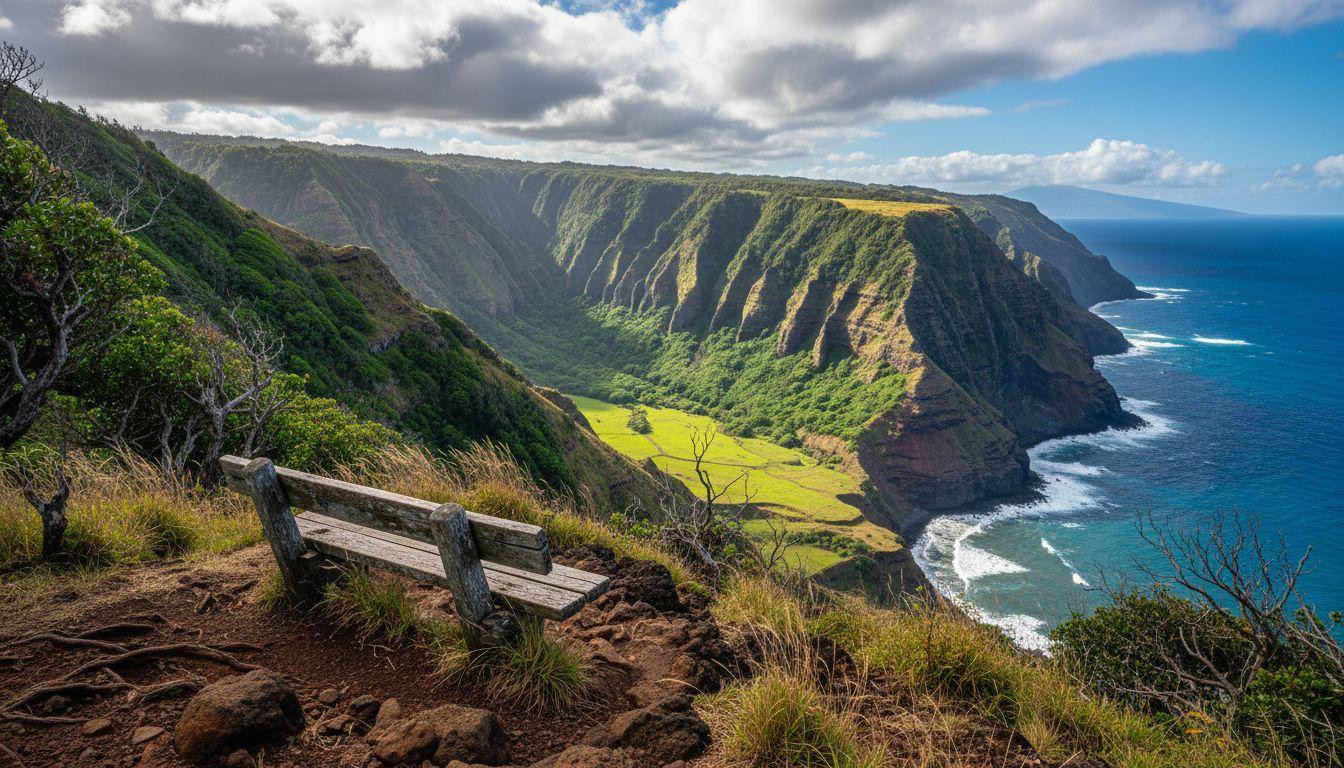
Pololu Valley’s black sand beach draws 100,000 visitors a year. Most stop at the lookout, snap photos, maybe descend the 0.75-mile trail to the shore. Then they leave. But 2.2 miles beyond that beach, past the ironwood groves and fixed-rope washouts, a wooden bench overlooks Honokane Nui Valley where green walls plunge 600 feet to meet black cliffs and cobalt ocean. No permits. No crowds. Just the kind of earned solitude that makes you understand why some places stay quiet.
The drive to Pololu trailhead takes 1.5 hours from Kona Airport, winding through Kapaʻau’s historic downtown (population 1,700) where the original King Kamehameha statue stands. Highway 270 ends at a small parking lot that fills by 9am on weekends. Arrive before 8am and you’ll find space, plus cooler temperatures for the hike ahead.
The Pololu Valley approach most tourists take
The initial descent to Pololu Beach drops 350 feet over 0.75 miles. Switchbacks cut through ironwood trees, their needles carpeting the trail. At the bottom, black basalt sand stretches 400 feet between cliffs, tide pools forming in summer when waves calm. Winter brings 12-foot swells and riptides strong enough to warrant warning signs.
This is where 95% of visitors turn around. They’ve seen the valley, touched the sand, checked the box. The Awini Trail extension starts at the beach’s far end, marked by a weathered sign most people walk past.
The 2.2-mile decision that changes everything
Awini Trail gains 300 feet through terrain the state doesn’t maintain. Roots cross the path. Sections wash out after rain, requiring fixed ropes bolted into rock. Bamboo groves close overhead, filtering light to green. The trail narrows to 18 inches in places, mud slicking the exposed roots.
Strong hikers need 45-60 minutes one way. Avoid this route after storms. The mud doesn’t just slow you down, it erases footholds. Trekking poles help on the descents back. Water is mandatory as there’s no shade once you reach the lookout.
What the extension delivers
The trail emerges from forest onto a ridgeline. Suddenly the full amphitheater of Honokane Nui Valley opens below. Green pastures cascade down volcanic slopes, ending at cliffs that drop straight into surf. The wooden bench sits 20 feet from the trail, positioned to frame the entire scene.
On clear mornings, Maui’s Haleakalā Crater appears 30 miles across the channel. Humpback whales breach in winter months, their spouts visible from December through March. The bench holds six people comfortably. Most days you’ll have it to yourself.
Why this rivals Kauai’s famous coast
Nā Pali Coast tours cost $200-500 for boat or helicopter access. The 11-mile Kalalau Trail requires permits that sell out months ahead. Honokane Nui delivers similar drama (sheer cliffs, lush valleys, untouched coastline) for free, with no advance planning beyond checking weather.
The scale differs slightly. Nā Pali’s cliffs reach 4,000 feet. Kohala’s top out around 1,000 feet. But from the bench, watching light shift across valley walls as clouds pass, the comparison holds. This is Big Island’s answer to Kauai’s most iconic landscape, minus the crowds and commercialization.
Building a North Kohala day from Kona base
Leave Kona by 6:30am to reach Pololu before parking fills. The 70-mile drive follows Highway 19 north, then cuts west on Highway 270 through Hawi (8 miles from trailhead). Stop at Kapaʻau for coffee and pastries. Fresh Off the Grid serves poke bowls and local plates for $15-25. Gas stations end here, so fill up.
Budget 4-5 hours total: 2 hours hiking, 1 hour at the lookout, 1 hour beach time if conditions allow swimming (summer only). Return through Hawi for lunch. The town’s 19th-century storefronts house cafés and galleries worth 30 minutes of browsing.
Comparing valley overlooks
Waipiʻo Valley sits 9 miles east, accessible via paved road to an overlook or steep 4WD descent requiring tours ($100-200 per person). The valley is deeper and more developed, with taro farms and a few residents. Honokane Nui remains completely wild, no structures visible from the bench.
Both deliver impressive Big Island scenery without resort infrastructure. Waipiʻo draws more tourists due to easier access. Honokane Nui rewards those willing to hike past the crowds.
What the cultural context adds
Honokane Nui Valley holds significance in Native Hawaiian history as part of the Kohala district’s valley chain. The extinct Kohala Volcano last erupted 120,000 years ago, erosion carving these amphitheaters over millennia. Respect for ʻāina (land) means packing out all trash and staying on established trails.
The adjacent Honokane Iki Valley remains private property. Residents discourage entry. Stick to the Awini Trail and lookout bench. Leave No Trace principles aren’t suggestions here, they’re requirements for keeping this access open.
Timing your visit for best conditions
Summer and fall (June through November) bring drier trails and clearer views. Winter adds whale watching but increases rain and mud. February 2026 sits in the transition period, with temperatures around 75°F and lighter crowds than peak season.
Morning light (8-10am) illuminates the valley best for photography. Afternoons bring haze from trade winds. Weekdays see fewer hikers than weekends. The bench faces northeast, so sunrise isn’t visible but early light still creates dramatic shadows across cliff faces.
Check recent trail reports before going. Heavy rain can make Awini Trail dangerous for 2-3 days after storms. The state doesn’t close it officially, so the decision falls to individual hikers. If you see standing water or fresh washouts, turn back.
Your questions about Honokane Nui Valley Lookout answered
How difficult is the Awini Trail extension really?
Moderate to challenging for the 2.2-mile round trip beyond Pololu Beach. The 300-foot elevation gain includes steep sections with fixed ropes. Slippery roots and narrow passages require attention. Strong hikers comfortable with uneven terrain handle it fine. Casual walkers should stick to Pololu Beach. Dogs aren’t recommended due to rope sections and exposure.
What makes this different from other Big Island hikes?
The combination of accessibility and emptiness. You can drive to the trailhead, hike 2.2 miles, and find world-class scenery with almost no one around. Most dramatic Hawaii landscapes require boats, helicopters, or permits. This one just asks for decent fitness and willingness to push past where crowds stop.
How does this compare cost-wise to Kauai’s Nā Pali?
Nā Pali Coast tours run $200-500 per person for boat or helicopter access. Kalalau Trail hiking requires advance permits and multi-day commitment. Honokane Nui costs nothing beyond car rental (4×4 not required, $50-100 daily) and gas ($80 round trip from Kona). Total day trip budget: $105 versus $300-500 for comparable Kauai scenery. Plus you skip the resort crowds entirely.
The bench at Honokane Nui faces a valley carved over 120,000 years, green walls meeting black cliffs meeting blue ocean. Morning mist lifts around 8:30am in February, clearing the view for maybe 20 minutes before trade winds bring afternoon haze. Most visitors never see this. They stop at Pololu, satisfied with the famous view. The bench stays empty, waiting for those who walk 2.2 miles further.